
South Korea: K-ETA exemption extended until 2028
The South Korean Ministry of Justice has extended the temporary exemption of the Korea Electronic Travel Authorization (K-ETA) for one year.
Nationals from the countries already exempted will therefore be able to enter South Korea without a K-ETA from January 1 to December 31, 2027. The notice was published on November 23, 2026, on the official K-ETA portal.
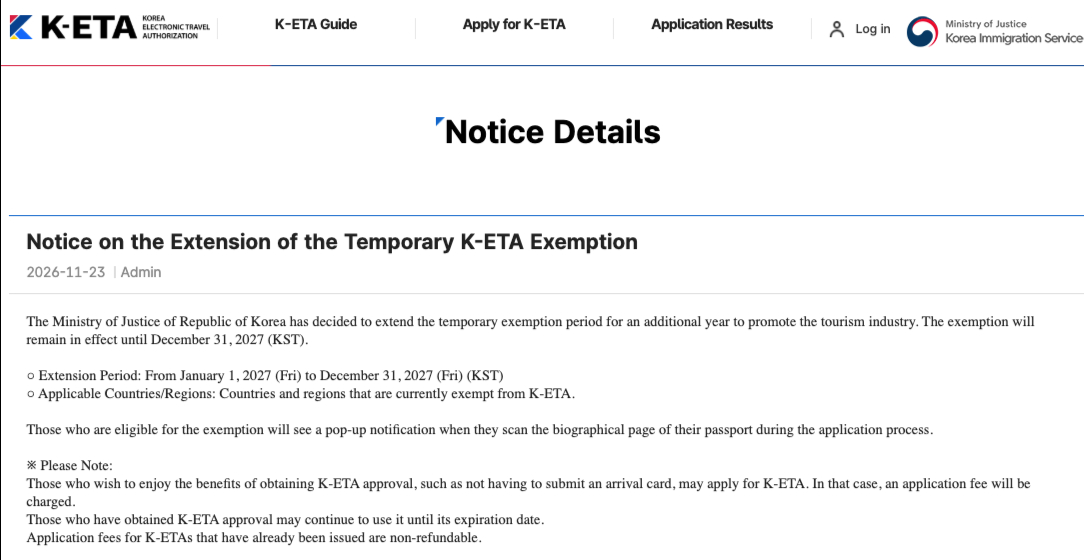
What the official notice says
In the notice titled “Notice extending the temporary exemption of the K-ETA,” the Ministry of Justice states that the measure, introduced in support of South Korea’s tourism sector, is extended for one year and applies until December 31, 2027. The period of extension runs from January 1, 2027, to December 31, 2027 (Korean Standard Time).
The scope of the exemption remains unchanged: it applies to the same countries as before. The notice does not publish a new list.
Nothing changes before January 1, 2027. The existing regime, which was due to end on December 31, 2026, continues uninterrupted: an exempt traveler does not need to apply for a K-ETA whether they are arriving in December 2026 or January 2027. We detailed the previous decision in our article on extending the exemption until December 2026, which ended at that point.
Which countries are affected
The November 23 notice refers to “currently” exempted countries. The most recent detailed list is found in the notice released by the South Korean Embassy in Switzerland, valid until December 31, 2026:
Asia: Japan, Taiwan, Hong Kong, Singapore, Macao;
Americas: Canada, United States, Guam;
Europe: United Kingdom, Germany, France, Italy, Netherlands, Spain, Poland, Sweden, Finland, Norway, Belgium, Denmark, Austria, Switzerland, Liechtenstein;
Oceania: Australia, New Zealand.
This list is from 2026. Since the extension notice does not reproduce it, the reference remains the view published on the portal described below. For other nationalities, the embassy refers travelers to the K-ETA website and to its local representation.
How to know if you’re exempt
There is a direct test available on the portal. When applying for a K-ETA, the traveler scans the identity page of their passport: if their nationality is exempt, a window “K-ETA Exemption Target” will appear. This is the verification method the Ministry of Justice itself indicates, more reliable than a copied list.
The K-ETA remains possible on request
A traveler who is exempt can still submit a voluntary K-ETA application if desired. The notice cites a benefit of such applications: holders of a K-ETA do not need to fill out an arrival card upon entry into South Korea. These voluntary applications are subject to fees and are non-refundable.
K-ETA authorizations already issued remain valid until their expiration date and their fees are non-refundable.

A specialist in regulatory monitoring and a content destination expert, she analyzes daily changes in entry formalities to turn complex administrative processes into practical guides. Her role blends ground-level expertise with technical precision to ensure the reliability of the information provided to travelers.

Get our visa news first in your Google results: add Visamundi to your preferred sources.
