

USA: over 175,000 visas revoked even after issue
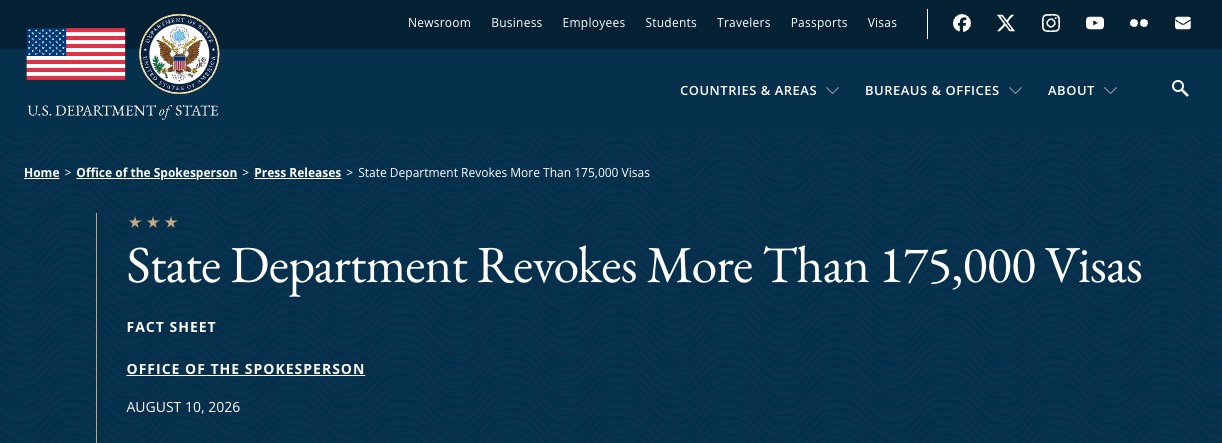
The U.S. State Department revealed on August 10, 2026 it had revoked more than 175,000 visas held by foreign nationals — up from 100,000 in January — including titles already in use.
The cancellations apply to visas that were both issued and, in some cases, actively in use, reflecting an ongoing scrutiny process that continues after consular approval.
A granted visa is not a visa secured
This is the point the State Department statement makes most emphatically, and it materially changes the equation for anyone holding a U.S. visa. The department describes ongoing “continuous monitoring” designed to ensure visa holders meet their conditions and do not pose threats to public safety in the United States.
In practice, your case file remains open not from the day the foil is placed in your passport but stays active for the full validity of the visa, which can be up to ten years for certain categories.
The department sums up its doctrine in one sentence: “A U.S. visa is a privilege, not a right.” The formulation is more than rhetorical; it signals a regime in which U.S. authorities may reverse a previous decision without the holder filing a fresh application.
What triggers a revocation
The statement breaks triggers into ranked categories, and the breakdown upends several common assumptions about visa cancellation.
The single largest driver is contact with law enforcement for criminal activity. Four leading offence types top the list: assault, driving under the influence, theft and drug-related offences.
A significant share, in the department’s own wording, arises from other offences: reckless driving, sexual assault, child abuse, fraud and embezzlement.
Driving while impaired is notable: it ranks second among causes, ahead of theft and drug offences. In several U.S. states, a stop for this offence may be prosecuted as a routine traffic misdemeanor locally, yet it is sufficient ground to trigger federal revocation of the immigration status.
An arrest is enough; a conviction is not required
The statement deliberately uses terms like “arrested” or “charged,” avoiding language tied to judicial outcomes. A presumption of culpability emerges: revocation is an administrative decision taken by the State Department based on a law-enforcement alert, and the department’s examples are presented at the arrest or indictment stage.
No mechanism for automatic reinstatement is mentioned if the U.S. court case later resolves favorably for the individual; the communiqué offers no route back once the visa is voided.
Cancellations extend far beyond tourist visas
The January 2026 statement provided a useful breakdown that August’s release no longer repeats: of the 100,000 revocations at that time, roughly 8,000 were student visas and 2,500 specialized visas.
Though student visas represent a small fraction of the total, their revocation has immediate academic consequences. In India, the U.S. embassy issued a specific warning reminding students that breaches of U.S. law can trigger visa cancellation and removal.
August’s release cites one broad episode illustrating how sweeping the policy has become: an American embassy in North Africa rescinded more than a hundred visas issued to parents who traveled to the United States to give birth, seeking citizenship for their child by this route. These revocations involve no criminal violation; they target use of a visa for a purpose other than that declared.
Ramifications of revocation
A cancellation is not merely an interruption of a current trip; it leaves a lasting record that affects future travel, even for visa-exempt travelers.
Visitors who would normally qualify for the Visa Waiver Program discover the impact when the ESTA screening explicitly queries revocation history; the system continuously cross-checks applicants against multiple databases, including the revoked-visa list. A previously canceled visa—whether declared or silently flagged—can disqualify the traveler from waiver eligibility and push the case back to a consular visa application.
The U.S. administration has also expanded the data it reviews when adjudicating new applications—a development we detailed last spring: what applied to fresh cases now extends to post-issuance monitoring.
The release ties revocations expressly to removals, without spelling out how the two processes overlap. On that front, the consequences of overstaying a U.S. visa share a similar logic: what happens during a stay informs what will be possible at the next point of entry.
The two consecutive announcements trace a clear trajectory. The State Department reported over 100,000 revocations on 12 January 2026 and more than 175,000 on 10 August—a rise of roughly 75,000 cancellations in seven months. |

As CEO of Visamundi, I am dedicated to simplifying international travel by assisting our clients in obtaining visas worldwide. By staying at the forefront of ever-changing regulations, I ensure our agency remains a trusted pillar in the visa services industry.

Get our visa news first in your Google results: add Visamundi to your preferred sources.
