

ETIAS: EU withdraws launch date
The official European Travel Information and Authorization System website no longer displays a start date, leaving travelers and operators without a confirmed timeline.
The previously published target launch window in late 2026 has disappeared from the European Travel Information and Authorization System homepage. No new date has been announced, and no applications are currently being accepted.
What the official portal shows today
The system’s homepage now features just two sentences about timing: the mechanism ‘is not currently in operation and no travel authorization applications are being collected at this stage,’ and the EU ‘will announce the exact start date several months in advance.’
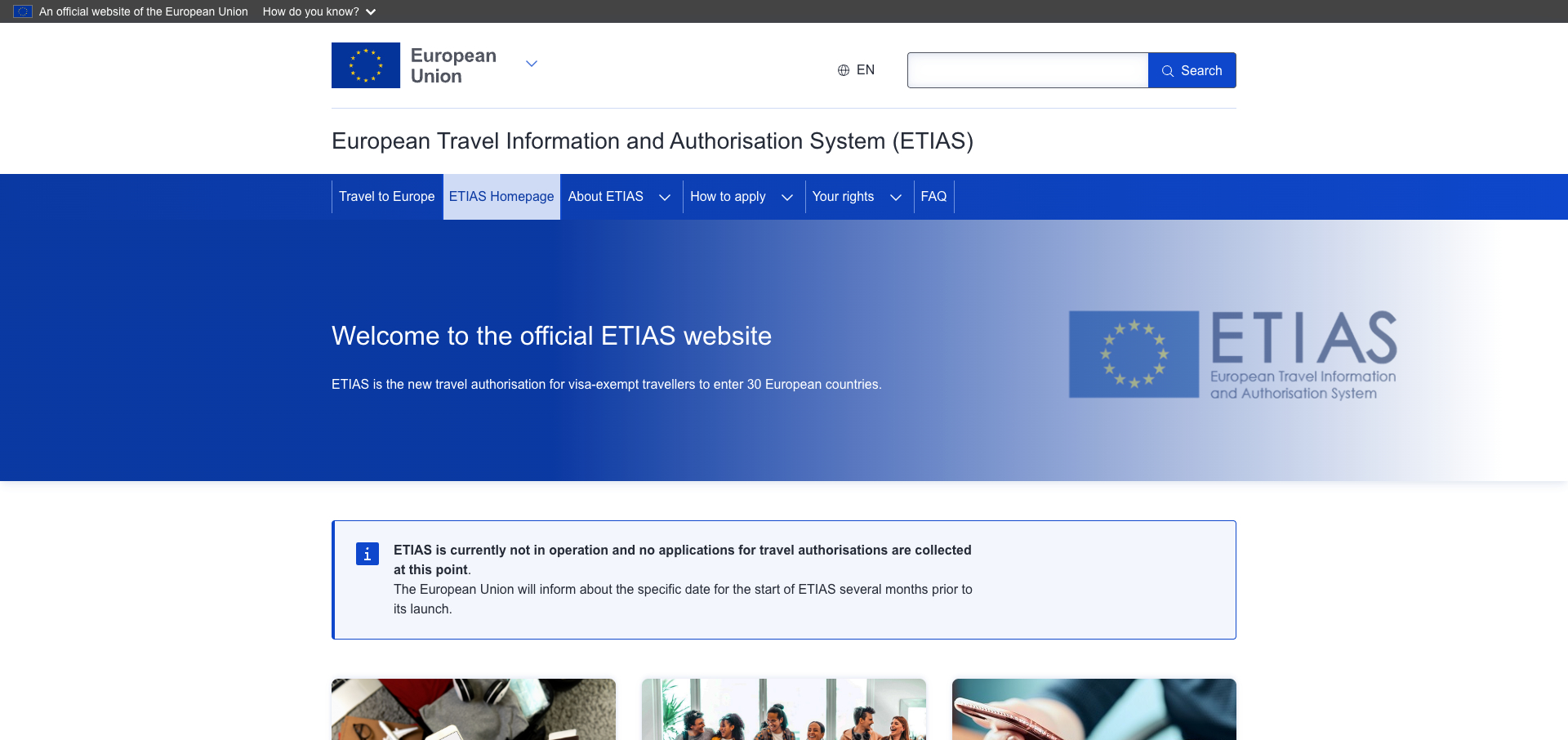
The dedicated page on the European Commission website repeats the same message, without providing a date.
This silence departs from earlier institutional announcements.
A revised timetable endorsed by EU member states’ interior ministers on 5 March 2025 had set the system to go live in the last quarter of 2026, following the deployment of the Entry/Exit System (EES). An official communication to UK nationals on 15 April 2026 still cited a start date of ‘from the last quarter of this year.’
The change in stance is evident in the most recent public update, published on 5 July 2026, aimed at travel agents. The notice explains system operation, fees, validity period and filing process, but no longer includes a deadline. It uses future tense and the phrase ‘once the system is launched.’
What this means for travelers and operators right now
Nothing. No applications can be submitted, no forms are open, and no trips to the 30 European countries covered by ETIAS currently require this authorization. As long as the system is not operational, any site offering to submit an application cannot send it, because the system is not collecting data.
When the launch date is announced, applications will only be accepted via the official site europa.eu/etias, the official mobile app or a visa agency. Institutions have pledged several months’ advance notice, providing time to prepare once the date is known.
Who will need to apply on launch day
The system will cover short-term visa-exempt visitors from 59 countries and territories, including: Brazil, Canada, United Arab Emirates, United States, Georgia, Hong Kong, Israel, Japan, Malaysia, Mauritius, Mexico, Moldova, United Kingdom, South Korea, Singapore, Taiwan, Ukraine, and also Albania, Serbia and Montenegro.
It will apply for entry into 30 European countries: the Schengen Area states, plus Bulgaria, Croatia, Cyprus, Romania, Iceland, Liechtenstein, Norway and Switzerland. Ireland remains outside the ETIAS scheme.
Several groups are exempt: nationals of these 30 countries and Ireland—even if they hold another passport—must travel on their EU or Irish passport. UK nationals covered by the Withdrawal Agreement who hold uniform-format residence permits are also exempt, with two key exceptions: those residing in Ireland and permit holders issued by Cyprus when traveling to another ETIAS country.
Travelers who already require a visa for Europe are unaffected and continue to apply through the existing visa process.
Fees and conditions already set
The system parameters are fixed; only the start date is missing. The application fee is €20, up from an earlier €7, a hike decided in July 2025 to cover operating costs.
Exempt from the fee are applicants under 18, those over 70, and family members of EU citizens who meet the status requirements. Exemption applies to fees only; the application itself remains mandatory.
Special rules apply to certain travel documents: Hong Kong and Macau passports must be Special Administrative Region passports, and Taiwanese passports require an ID card number.
Carriers will enforce compliance: airlines, cruise operators and other transport companies are required to verify that passengers hold valid authorization before boarding.
The border-check system is already live
This delay affects the pre-travel authorization, not the border entry process. The Entry/Exit System (EES), launched progressively on 12 October 2025 and fully operational since 10 April 2026, replaces passport stamping and enables automatic detection of over-stays.
The two systems serve different purposes: EES checks biometrics at the border on arrival; ETIAS is an online pre-departure requirement, and its absence can be grounds for boarding denial.
A transition and grace period of at least 12 months will follow ETIAS activation, as agreed by EU ministers. This means the requirement will not apply overnight, and the advance notice period will be followed by an additional adjustment phase. |

As CEO of Visamundi, I am dedicated to simplifying international travel by assisting our clients in obtaining visas worldwide. By staying at the forefront of ever-changing regulations, I ensure our agency remains a trusted pillar in the visa services industry.

Get our visa news first in your Google results: add Visamundi to your preferred sources.
