

Guinea and European Union: multiple-entry visas suspended on both sides
On July 10, 2026, Schengen states stopped issuing multiple-entry visas to Guinean nationals, extending processing times from 15 to 45 days. Conakry announced reciprocal measures against EU citizens on July 24, though no formal regulations have yet been published.
Travelers with Guinean passports—or planning a trip to Guinea—must adjust their visa application strategies on both sides of the equation.
What Europe’s decision actually suspends
Executive decision (EU) 2026/1733 was adopted by the EU Council on 10 July 2026, published in the Official Journal on 15 July, and took effect upon notification. It does not halt visa issuance; instead, it freezes four provisions of the EU Visa Code Regulation (EC) No 810/2009.
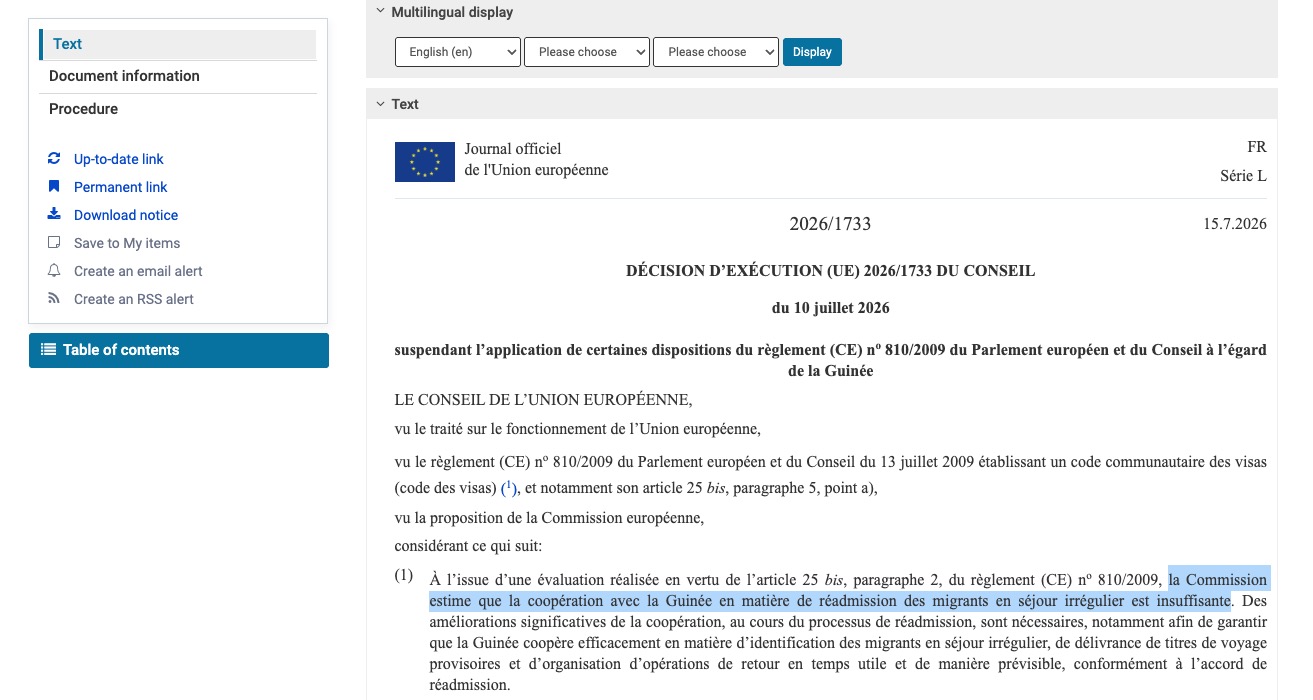
The four suspended measures are specific:
Article 24, paragraphs 2 and 2quater: issuance of multiple-entry visas. Guinean applicants now receive single-entry visas only, regardless of prior travel history.
Article 23, paragraph 1: standard 15-calendar-day processing period has been extended to 45 days. The decision removes the previous exception that limited longer waits to specific cases, making the 45-day rule universal.
Article 16, paragraph 5b: optional waiver of visa fees for holders of diplomatic or service passports. These passports now incur charges.
Article 14, paragraph 6: consular discretion to waive certain supporting documents. Full documentation is now required.
This move is justified under the EU Visa Code’s readmission cooperation clause (Article 25 bis), citing delays and obstacles in Guinea’s issuance of travel documents, issuance of laissez-passer, and facilitation of return operations.
No end date is set in stone
Labeled temporary, the decision contains no sunset clause or automatic review. Revocation depends on a new Council decision, preceded by a Commission assessment confirming improved cooperation.
In practice, no one can safely predict when multiple-entry visas may return for Guinean applicants. Autumn applications should be prepared under current rules, not expectations of imminent relaxation.
Guinea’s reciprocal response—and the formalities still pending
On 24 July 2026, after a meeting with EU ambassadors, Guinea’s Minister of Foreign Affairs, African Integration and Guineans Abroad, Dr. Morissanda Kouyaté—reappointed on 27 July—announced three reciprocal measures: temporary suspension of multiple-entry visas for EU citizens, application of processing fees to holders of European diplomatic and service passports, and extension of processing periods.
As of publication, no official Guinean text has appeared on government channels, and the national e-visa portal shows no changes. These measures remain political announcements without published, consultable regulations. We report them as announced, not established policy.
Applying for a visa to Guinea today
Applicants must use the official Air and Border Police portal, which lists tourist visas at 100 USD €87.93, transit/transshipment visas at 50 USD €43.97, and long-stay visas at 500 USD €439.67. The portal does not publish processing times; upon approval, an entry letter is emailed and the visa is affixed on arrival.
Guinea has not specified the new processing delays announced on 24 July. The only certain rule is to file well in advance rather than rely on past experience.
Applicants from Côte d’Ivoire, Morocco, Canada, Lebanon, or Vietnam are unaffected by the reciprocal measures, despite sharing the same portal.
Conversely, nationality—not residence—determines applicability: a Belgian national residing in Dakar falls under Guinea’s reciprocal measures, while a Brussels-based non-EU passport holder does not. The same logic applies in Schengen: decision 2026/1733 targets Guinean nationals regardless of where they apply.
The Article 25 bis enforcement cycle
Guinea’s case illustrates a standard mechanism: Article 25 bis explicitly links visa policy to readmission cooperation. The Commission evaluates third countries, and the Council may impose escalating restrictions.
Guinea is neither first nor alone. Executive decision (EU) 2024/1341 (29 April 2024) suspended the same four provisions for Ethiopian nationals; decision (EU) 2021/1781 (7 October 2021) did likewise for Gambians. For Guinean applicants, the takeaway is clear: the toolkit is standardized, and control remains in the hands of both administrations. Lifting the measures requires a new Council act—effectively a negotiation lever, not a penalty on travelers.
Guinea’s response follows a common regional pattern seen elsewhere: the 2024 overhaul of Namibia’s visa regime—invoking diplomatic reciprocity—was one such response documented earlier on visamundi. Underlying fiscal imbalances persist as well—fees for refused Schengen applications remain non-refundable, a point highlighted in our earlier coverage here.

As CEO of Visamundi, I am dedicated to simplifying international travel by assisting our clients in obtaining visas worldwide. By staying at the forefront of ever-changing regulations, I ensure our agency remains a trusted pillar in the visa services industry.


Get our visa news first in your Google results: add Visamundi to your preferred sources.
