

Suriname raises entry fee to €50 and makes ICF form mandatory
The Surinamese Ministry of Foreign Affairs has updated entry requirements: a €50 entry fee per visit plus a mandatory online immigration and customs form (ICF). Service fees apply and the official payment portal has moved.
The ministry also reminds travellers that an immigration and customs form must be completed online before every trip to Suriname. Three days prior, the ministry had announced a change to the address of the payment portal.
Entry fee set at €50 or $50, excluding service fees
The fee is clearly stated on the Suriname Ministry of Foreign Affairs’ “Travelling to Suriname” page: €50 or $50 per entry, excluding the service fee of VFS Global, which is set at €8 or $8. The amount must be paid each time a traveller crosses the border.
Since 1 May 2025, a multi-entry option has also been available. A 26 April 2025 notice from Paramaribo sets the price of the “Entry Fee Multiple” voucher at €75 or $75. Valid for three months from first arrival in Suriname, it allows up to five entries and exits within that period; each stay must still comply with the legally permitted length of stay.
Children aged 0–2 years are exempt from the fee as of 1 January 2025. From age 3 onward, the entry fee is due.
Travellers who previously benefited from a reduced fee now face the full rate: the ministry’s published tariffs take precedence, and none of the reductions are currently listed.
Who pays, who is exempt?
The ministry’s information sheet clearly distinguishes the various scenarios. CARICOM member-state nationals are exempt from both visa and entry-fee requirements.
Twenty-one countries remain subject to the visa obligation: Afghanistan, Angola, Bangladesh, Cuba, Dominican Republic, Egypt, Eritrea, Ghana, India, Cameroon, Kenya, Nepal, Nigeria, Pakistan, Somalia, Sri Lanka, Syria, Tunisia, Venezuela, Zambia and South Africa.
Outside these cases—with the exception of CARICOM, holders of a PSA document, Vatican nationals and those holding diplomatic or service passports registered with the ministry—visa-exempt travellers coming to Suriname for tourism or a family visit must still pay the entry fee.
The ministry highlights a common point of confusion: travellers whose visa requirements are waived under a bilateral agreement must nonetheless pay the entry fee. Waiving of the visa does not waive the payment obligation—an important distinction already noted when the system was introduced.
The consular section also lists further exemptions: holders of a valid visa, Surinamese-resident permit holders, holders of a laissez-passer issued by an international organisation, and passengers in transit at Zanderij and Zorg en Hoop airports.
The voucher must be presented twice
Entry-fee payment is made online; the PDF voucher is delivered by e-mail. A crucial point—one that costs travellers when overlooked—is that the voucher must be shown at check-in or boarding and again on arrival, to immigration authorities at any entry point. Without it, entry to the country will be refused.
In some border areas, cash payment remains possible. The ministry names the Suriname Consulate General in Cayenne and the Cayenne outpost in Saint-Laurent for arrivals from French Guiana, and the Canawaima Management Company in South Drain, Nickerie for those coming from Guyana.
The payment portal address changed on 10 August 2026
The most likely source of confusion in the weeks ahead is the portal change itself. In a 10 August 2026 notice signed in Paramaribo by Ambassador Luziano Truideman, director of general and consular affairs, the ministry announced that the VFS Global site used to lodge visa applications and pay the entry fee had moved.
The technical reason for the move was a migration of existing data to a new VFS Global platform. With immediate effect, the only official and valid address for submitting a visa application and paying the entry fee is https://suriname.vfsevisa.com. Travellers are warned that the previously used page on the same domain is no longer active and must not be used.
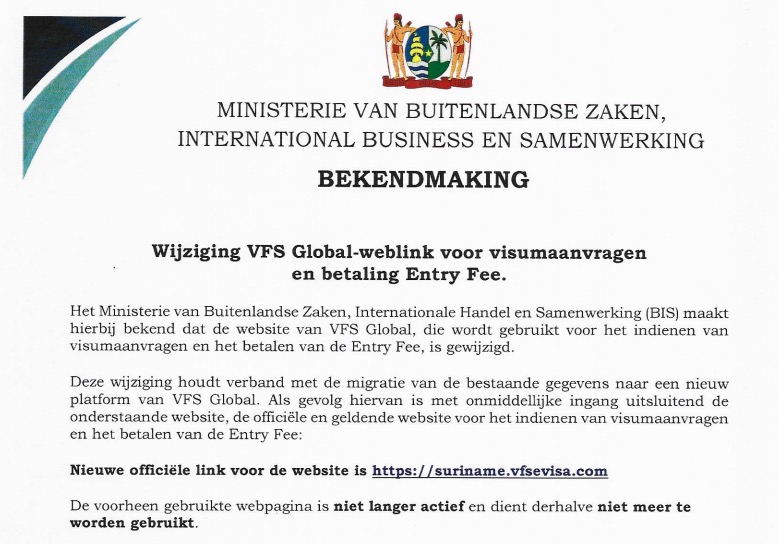
The announcement urges travellers, travel agencies, airlines and tourism organisations to use only the new site and update their own information pages accordingly. Links to old addresses may still be circulating elsewhere on the web.
The ICF form is free but mandatory up to seven days before arrival
The ministry’s information sheet closes with a separate obligation—one that is easily overlooked because it is free: the Immigration and Customs Form (ICF), available on the official portal icf.sr, must be completed electronically up to seven days before arrival.
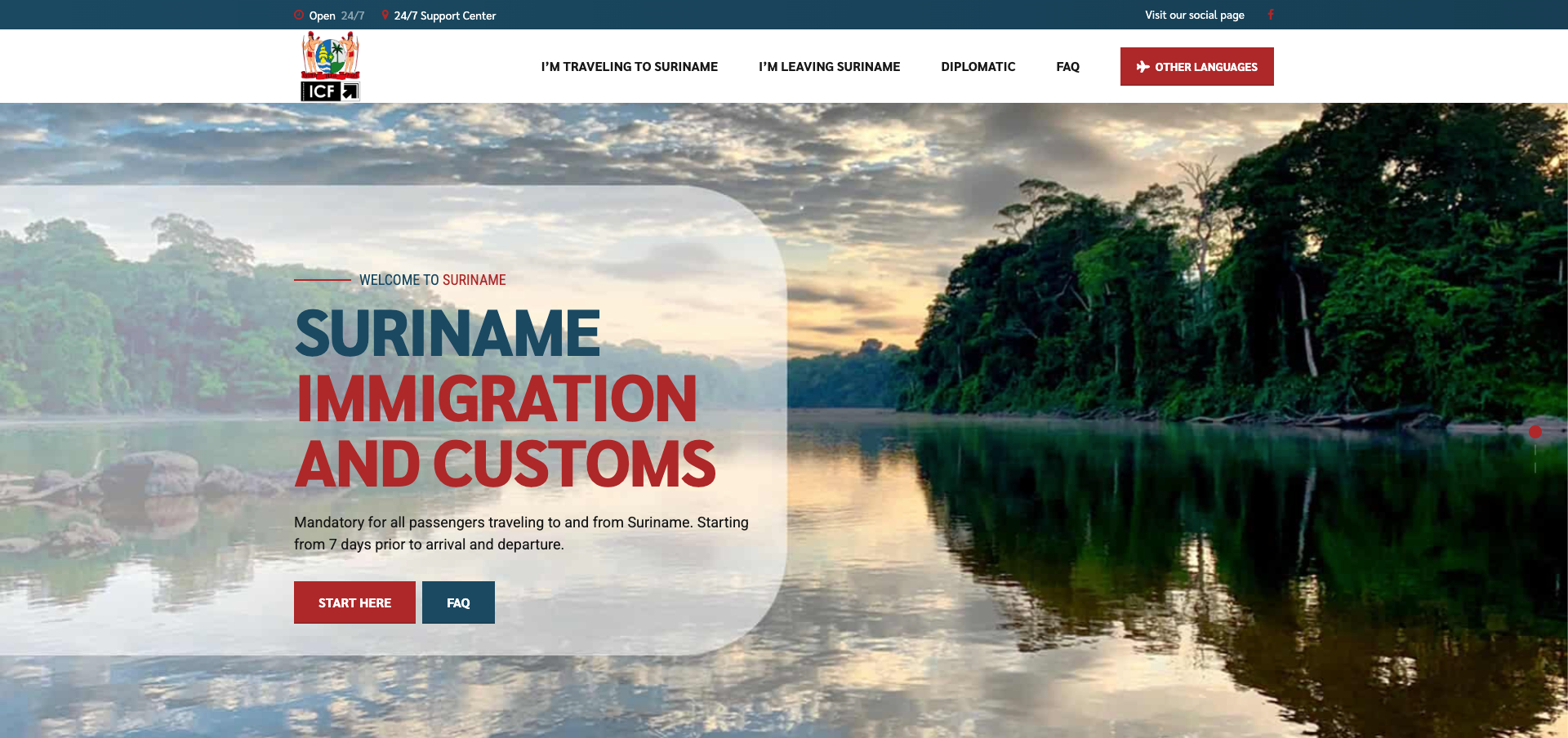
The portal states that the process is compulsory for all passengers, in both directions: on arrival in and departure from Suriname. Travellers can begin the form seven days before each journey; it is free of charge. Completion yields a QR code that should be screenshot or printed and presented on arrival and departure—this QR code serves as proof of compliance to the authorities.
A traveller who is visa-exempt must therefore handle two unrelated online steps: paying the entry fee on the VFS portal (which produces a PDF voucher) and completing the ICF form on icf.sr (which produces the QR code). Both documents must be shown at the border; neither replaces the other.
Minors travelling under age 17 who are not accompanied by both parents must present a notarised parental consent letter, together with a certified copy of the family booklet or a certified birth certificate. The requirement applies to: a child travelling alone; a child travelling with only one parent; or, where applicable, a child under legal guardianship or adoption, requiring a certified copy of the relevant court decision.
From a public-health standpoint, travellers arriving from or who have recently transited through a country where yellow fever is endemic must present a valid yellow-fever vaccination certificate on arrival. The ministry notes that the vaccination must have been administered at least ten days before entry into Suriname.

As CEO of Visamundi, I am dedicated to simplifying international travel by assisting our clients in obtaining visas worldwide. By staying at the forefront of ever-changing regulations, I ensure our agency remains a trusted pillar in the visa services industry.

Get our visa news first in your Google results: add Visamundi to your preferred sources.
