
Visamundi Unveils Visa Complexity Index to Guide Travelers
Visamundi introduces a Visa Complexity Index to help travelers navigate visa requirements. The index rates destinations from 1 to 5 based on technical difficulty, document requirements, processing times, and additional fields.
·
Travel procedures are constantly evolving, and new online visa application processes continue to emerge. To streamline border control checks, an increasing number of countries are refining their systems to make the arrival process smoother and more efficient for travelers.
Depending on the destination, entry requirements can differ—often necessitating multiple travel documents. Examples include e-visas, traditional paper visas, electronic arrival cards, or electronic travel authorizations.
Our agency, specializing in helping travelers secure various travel documents, is innovating with the launch of its Visa Complexity Index. This new tool provides business travelers and tourists with a clear, immediate assessment of the technical challenges involved in obtaining their visas and entry documents
Why a Visa Complexity Index?
For many travelers, a visa is simply a stamp in a passport. However, the behind-the-scenes administrative reality varies widely by destination. There’s a significant gap between an easy electronic authorization (like ESTA or AVE) and an intensive business visa requiring certified letters of invitation. Our agency created the Visa Complexity Index based on destinations in our catalog, enabling clients to understand why some applications take longer or cost more. It also helps travelers plan their paperwork early based on the complexity of their case.
How Is the Index Calculated?
The Visa Complexity Index was developed by our production team. Each in-house destination expert assigned a rating on a 1 to 5 scale, based on daily analysis that considers multiple factors depending on the destination’s application process.
Technical form complexity: Challenges posed by online application forms (frequent bugs, approximate translations, or country-specific document formats).
Document compliance requirements: The number and type of supporting documents needed (ticket confirmations, travel insurance, letters of assignment, business registration documents, etc.), plus verification of their formats and compliance.
Processing time risk: The likelihood of rejection or requests for additional information for a standard visa file.
Additional required fields: Extra information requested on each application form. Our team proactively follows up with clients to ensure a complete dossier submission.
With this index, clients can instantly assess the level of difficulty for obtaining an e-visa, electronic arrival card, or electronic travel authorization, such as ESTA, AVE, or AVE/ETA.
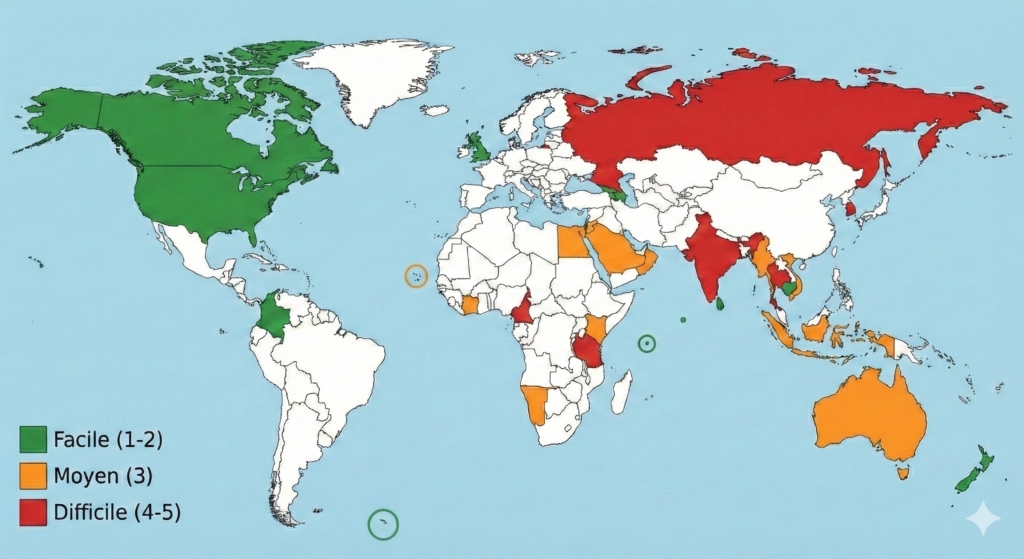
Easy (Index 1–2): Electronic travel authorizations (e.g. ESTA USA, AVE Canada, ETA UK) are typically quick and require minimal additional information.
Moderate (Index 3): E-visas that ask for specific supporting documents (e.g. e-Visa Côte d'Ivoire or Vietnam).
Complex (Index 4–5): Forms that are intricate, with a risk of extra steps during processing (e.g. e-Visa India, Thailand).
Visit our website at visamundi.co/ and check your next destination’s requirements ✈️

Get our visa news first in your Google results: add Visamundi to your preferred sources.
