
Australia<>New Zealand travel without paper passports: a campaign promise yet to materialize
New Zealand's National Party promises that if it is re-elected on November 7, 2026, to test a
This is a campaign commitment: no text has been adopted, no date has been set, and no bilateral agreement provides for it. To cross the Tasman Sea, current rules remain the only applicable ones.
What the National Party proposes
The announcement was published on October 1, 2026 by the National Party, the party of Prime Minister Christopher Luxon, and promoted by its spokesperson for tourism, Louise Upston. The idea is that of a trial of a "seamless trans-tasman travel" for citizens of Australia and New Zealand traveling between the two countries.
The party describes a fully digital process. The eligible traveler would forward passport and travel data in advance, complete New Zealand's arrival declaration online before departure, and see their identity and eligibility checked digitally. On arrival, a dedicated lane for trans-Tasman flights would open at four airports: Auckland, Wellington, Christchurch, and Queenstown, leveraging existing eGates and facial recognition technology.
According to the program, this would mean "no physical passport required at the boarding gate", while keeping the option for border agents to intercept high-risk passengers. Travelers flagged for additional checks would leave the simplified system.
The target date for this trial is the Men's T20 Cricket World Cup co-hosted by Australia and New Zealand, according to the party, from October 21 to November 19, 2028. The party pledges to launch the trial before this event, without specifying a start date or duration.
A campaign promise, not an adopted measure
Nothing in this proposal constitutes a government decision. The text comes from the National Party as a political party during its campaign for the November 7, 2026 elections, the timeline for which was set by the Electoral Commission. Its implementation depends on two conditions: the party retaining power and obtaining Australia's agreement, since the proposal itself mentions "working with Australia".
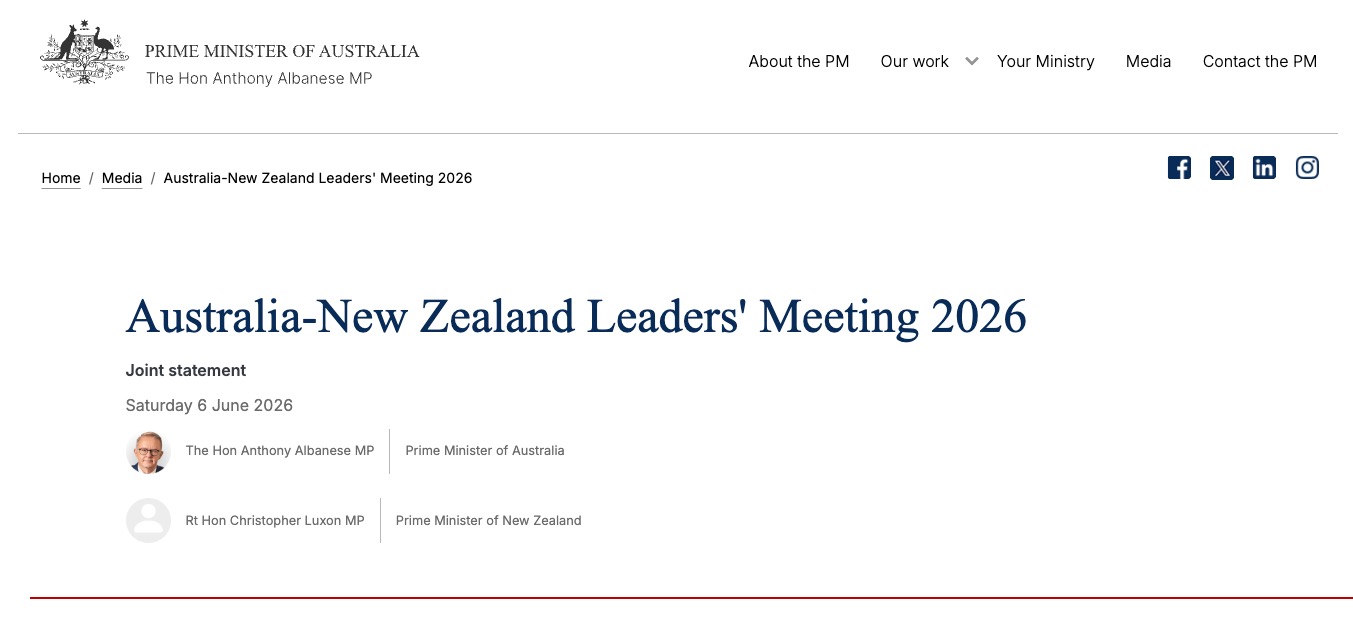
At the government level, the latest bilateral agreement between the two prime ministers, published after their June 6, 2026 meeting, reiterates that Australians and New Zealanders cross the Tasman Sea "to visit, live, work, and study" under the Trans-Tasman Travel Arrangement. It does not set any timeline or mention a plan for paperless travel.
Both countries are each other’s top outbound destinations.
As it stands, neither a dedicated lane nor an open application for such a trial currently exists.
The passport isn’t going away
The term “paperless travel” can be misleading. Under the plan outlined by the National Party, travelers would still need to hold a valid passport and submit its details in advance. What would change is the requirement to present the physical document at certain stages of the process, replaced instead by digital verification on smartphones and biometric checks.
The scope of this plan is currently limited: only holders of an Australian or New Zealand passport would be eligible. Travelers holding other nationalities—including permanent residents of one of the two countries—would not be covered by this trial. Under the plan, even if it were implemented, nothing would change for them.
The program also clarifies that biosecurity and customs inspections would remain unchanged: the same arrival declarations to be completed, luggage subject to inspection, and the option to be directed to an agent.
An initiative already explored by both governments
The idea of contactless travel isn’t new to this election cycle. During an August 16, 2024 meeting, the prime ministers of Australia and New Zealandapprovedthe work of the Trans-Tasman Seamless Travel Group, a joint effort to facilitate travel between the two countries without lowering border security standards. They then announced steps toward a “contactless travel” system, where travelers could submit digital documents.
Two concrete projects emerged from this initiative: Australia was testing a digital arrival card for the first time, and New Zealand was expanding its eGates. On the Australian side, this digital card gradually replaces the paper form, a transition we covered in July 2026. On the New Zealand side, customs introduced digital declarations in October 2025, allowing travelers from 59 countries and territories to use eGates, provided they are over 10 years old and hold an e-passport.
The National Party’s plan builds on this framework by setting a deadline for implementation. However, it does not establish any new rules at this stage.
Current border processes between the two countries
Citizens of Australia traveling with an Australian passport do not require a visa or the NZeTA electronic travel authorization to enter New Zealand. In the other direction, New Zealand citizens must travel with a valid New Zealand passport. Upon arrival in Australia, they receive a special category visa (Special Category visa), without prior action.
Permanent residents of New Zealand who are not eligible for this visa must apply for one before departing. For all other nationalities, each country maintains its own entry requirements: NZeTA or visa for New Zealand, electronic travel authority or visa for Australia, depending on the traveler’s passport. Holding residency in one country doesn’t exempt travelers from the other country’s requirements of entry, unless an exception—such as the November 2025 visa-exemption trial for Chinese citizens traveling from Australia—is in place.
Additionally, regardless of nationality or direction of travel, all passengers heading to New Zealand must complete the New Zealand Traveller Declaration. It is free of charge, available online or via a dedicated mobile app before departure, though a paper form remains an option for those unable to submit online. This is precisely the declaration the National Party eyes to serve as the base for its proposed contactless arrival process.

As CEO of Visamundi, I am dedicated to simplifying international travel by assisting our clients in obtaining visas worldwide. By staying at the forefront of ever-changing regulations, I ensure our agency remains a trusted pillar in the visa services industry.


Get our visa news first in your Google results: add Visamundi to your preferred sources.
