Choose the visa that fits your trip. Fully online process, real-time tracking.
Visamundi service: €39 incl. VAT
Consular fee: ≈ €5(7 CAD)
AuthorizationCanada is one of the destinations that has replaced the traditional visa with an electronic travel authorisation for nationals of visa-exempt countries. Known as the ETA (Electronic Travel Authorization), this fully online process is mandatory for every eligible national wishing to enter Canada by air. It is not a visa: it simply confirms that your profile has been verified and pre-approved by Canadian authorities. Straightforward in principle and quick to obtain, it must nonetheless be completed before booking your flight — not at the last minute.
01 · The essentials
The entire procedure is paperless: no visit to a consulate is required, regardless of the purpose of travel.
The form is available in several languages and no additional documents are required beyond a biometric passport.
The ETA applies only to entries by air — arrivals by sea or land are subject to different rules.
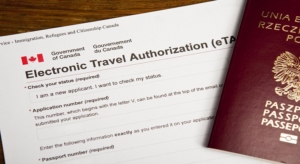
The ETA (Electronic Travel Authorization) is a mandatory electronic document for citizens of visa-exempt countries travelling to Canada by air. It is not an e-visa in the strict sense: the ETA is not a visa stamped in your passport, but a digital authorisation linked to your biometric passport in Canadian systems. At check-in, the airline verifies that your passport is associated with a valid authorisation. Without an ETA, you will not be allowed to board.
The ETA is Canada's equivalent of the American ESTA (Electronic System for Travel Authorization). Since late 2016, European nationals — including citizens of France, Belgium, and Switzerland — as well as Australians and other eligible nationalities may enter Canada without a visa for tourist or business stays. In exchange for this visa exemption, holding a valid ETA is required before any departure.
Unlike a traditional visa, the ETA is obtained entirely online. You do not need to visit the Canadian consulate in your country of residence. The application form is available online, translated into several languages, and most applicants receive approval within a few minutes to 48 hours.
02 · Eligibility
The ETA is intended for nationals of countries that are exempt from the Canadian visa requirement — that is, nationalities for which no Canadian visa is required for short tourist or business stays. Eligible nationalities include: Andorra, Australia, Austria, Bahamas, Barbados, Belgium, Brunei Darussalam, Chile, Croatia, Cyprus, Czech Republic, Denmark, Estonia, Finland, France, Greece, Hong Kong, Hungary, Iceland, Ireland, Israel, Italy, Japan, Latvia, Liechtenstein, Lithuania, Luxembourg, Malta, Mexico, Monaco, Netherlands, New Zealand, Norway, Papua New Guinea, Poland, Portugal, Romania, Samoa, San Marino, Singapore, Slovakia, Slovenia, Solomon Islands, South Korea, Spain, Sweden, Switzerland, Taiwan, United Arab Emirates, United Kingdom, Vatican City State. Lawful permanent residents of the United States are also eligible.
American citizens (US passport holders), however, are not required to obtain an ETA: they enter Canada without any prior authorisation. Certain other profiles are also exempt: crew members (cabin crew and pilots), travellers transiting to certain destinations, and holders of a valid Canadian visa.
If your nationality does not appear on the list of ETA-eligible countries, or if you wish to work or study in Canada, the ETA will not apply to you. You will need to contact the Canadian embassy or consulate in your country of residence to apply for a traditional visa.
You must travel with a valid ordinary biometric passport that covers the entire duration of your stay. Identity cards, diplomatic passports, emergency passports, and residence permits are not accepted.
The ETA covers tourism, business travel, visits to family and friends, and transit through the international zone of a Canadian airport. It does not authorise paid employment or study.
Minor children must also have their own ETA. Government fees apply and each traveller's details must be submitted individually.
The ETA applies only to entries by air. If you arrive in Canada by ship (cruise, ferry) or overland from the United States, a traditional visa may be required. Check with your cruise company or the embassy.
03 · The process
The ETA application process is entirely paperless. You do not need to visit an embassy, send your passport by post, or make an appointment. Everything is done online. The form is available in several languages, which makes entering your information considerably easier. Most applicants receive their ETA within a few minutes, sometimes a few hours.
To ensure your application is processed under the best conditions, make sure you fill in each field of the form accurately. An error in your passport number, date of birth, or the spelling of your name can delay or compromise the processing of your file by the Canadian authorities. A scan of your passport identity page is submitted through a secure portal to cross-check the information and maximise your chances of approval.
Check that your passport is biometric, ordinary, and valid for the entire duration of your stay in Canada — ideally with at least 6 months of validity beyond your planned return date. Scan or photograph the identity page clearly.
Enter all the required information: personal details (surname, given name, date of birth, nationality, marital status), information about your stay in Canada, and professional situation (occupation, employer, length of service). The form is translated into several languages to make completion easier.
The government fee set by the Canadian government amounts to 7 CAD €4.36. Service fees are added for verifying your file, entering and submitting the application to the Canadian authorities, and tracking your application.
Upload a photocopy of your passport identity page through the secure portal provided. This step cross-checks the information entered and reduces the risk of error or rejection.
Canadian immigration services process your application. In the vast majority of cases, approval is granted within a few minutes. Some applications may nevertheless take up to 72 hours, depending on the criteria applied by the Canadian authorities.
You receive your ETA by email. The authorisation is electronically linked to your biometric passport. It is advisable to keep an electronic or printed copy of your ETA to present at check-in and on arrival in Canada.
04 · Validity & stay conditions

The Canadian ETA is valid for 5 years from the date of issue, or until the expiry of the passport linked to it if that date comes first. This is one of its most advantageous features compared to other electronic travel authorisations: a single application is enough to cover many stays in Canada over several years.
Throughout the ETA's validity period, it permits multiple entries into Canada, with each stay limited to a maximum of 180 consecutive days. This 180-day limit is not intrinsic to the ETA as a document: it is linked to the visa-exemption programme associated with the traveller's nationality and will be assessed by the immigration officer on arrival.
If your passport expires before the 5-year validity of the ETA, you will need to submit a new ETA application with your new passport. The ETA is indeed linked to a specific passport: a change of passport requires a new application, even if your old ETA is still within its period of validity.
If you wish to extend your stay beyond the duration initially authorised by the immigration officer, it is possible to apply directly to the Canadian authorities, at least 30 days before your authorised stay expires. It is strongly advised not to wait until the last moment before making this request.
Please note: the ETA does not confer an automatic and absolute right to enter Canadian territory. As with any electronic travel authorisation, the final decision rests with the immigration officer who receives you at the border. That officer may ask questions about the duration of your stay, your visit plans, your financial means, or your intention to leave Canada at the end of your stay.
05 · Fees
The cost of the Canadian ETA consists of two separate elements. The first is the government fee set by the Canadian government, amounting to approximately 7 CAD €4.36. This fee is independent of your nationality and applies to all eligible applicants, including minors.
The second element corresponds to the service fees related to the handling of your file: verification of the information entered, compliance check of the identity document provided, entry and submission of the application to the Canadian authorities, file tracking and exchange management. In total, the ETA application represents a total cost of approximately 35 €, all charges included.
The ETA remains a particularly affordable document compared to a traditional visa. Its 5-year validity with multiple entries also makes it a worthwhile investment for travellers who visit Canada regularly.
06 · Before you leave
Obtaining the ETA is the first administrative step to complete, but it does not cover all the preparations to anticipate before departing for Canada. Here are the key points to check well before your flight to avoid any unpleasant surprises at the airport or Canadian border.
Canada applies clear entry rules and enforces them from the moment of check-in. The airline will verify your ETA before allowing you to board: do not overlook this step and never travel without having received email confirmation of your authorisation.
The Canadian ETA is an electronic travel authorisation — not a visa — intended for nationals of visa-exempt countries wishing to enter Canada by air. It is valid for 5 years with multiple entries and allows stays of up to 180 days per visit. Government fees amount to approximately 7 CAD €4.36, to which service fees are added. The process is entirely online, requires no additional documents beyond your passport, and processing generally takes a few minutes to 48 hours. Submit your application at least one week before departure and always check that the passport you are carrying is the one registered in your ETA before each trip to Canada.
Safety
The vigilance level recommended by five foreign ministries, on a shared scale.
Average level
No specific threat reported by the ministries.

US Department of StateAdvice dated June 5, 2026
Normal precautions · Canada - Level 1: Exercise Normal Precautions

German Federal Foreign OfficeAdvice dated September 1, 2026
Normal precautions · Canada: Travel and Security Warnings

UK Foreign Office (FCDO)Advice dated June 2, 2026
Normal precautions · Canada travel advice

France DiplomatieAdvice dated September 15, 2026
Normal precautions · Canada: Travel Advice
Levels published by the ministries cited, reproduced unchanged. Visamundi is a private agency with no ties to these administrations.
FAQ