
EU prepares Schengen visa exemption process for 5 Gulf countries
The European Union member states have placed on their agenda for October 7, 2026 the start of a visa exemption process for Bahrain, Kuwait, Oman, Qatar, and Saudi Arabia—though not yet finalized.
This is not the end of Schengen visas for these travelers yet: it's the first step in a multi-stage process. The second EU-GCC summit, scheduled for Riyad on October 24, 2026, is expected to serve as the official launch.
What the EU-27 have proposed
The provisional agenda of the Committee of Permanent Representatives (Coreper), published by the Council of the EU on October 2, 2026, includes five identical entries for the October 7 meeting—one for each country: Bahrain, Kuwait, Oman, Qatar and Saudi Arabia. For each entry, two texts are submitted to the EU member states’ ambassadors: conclusions "on the launch of the visa exemption process", for approval, and a "visa exemption action plan" for validation.
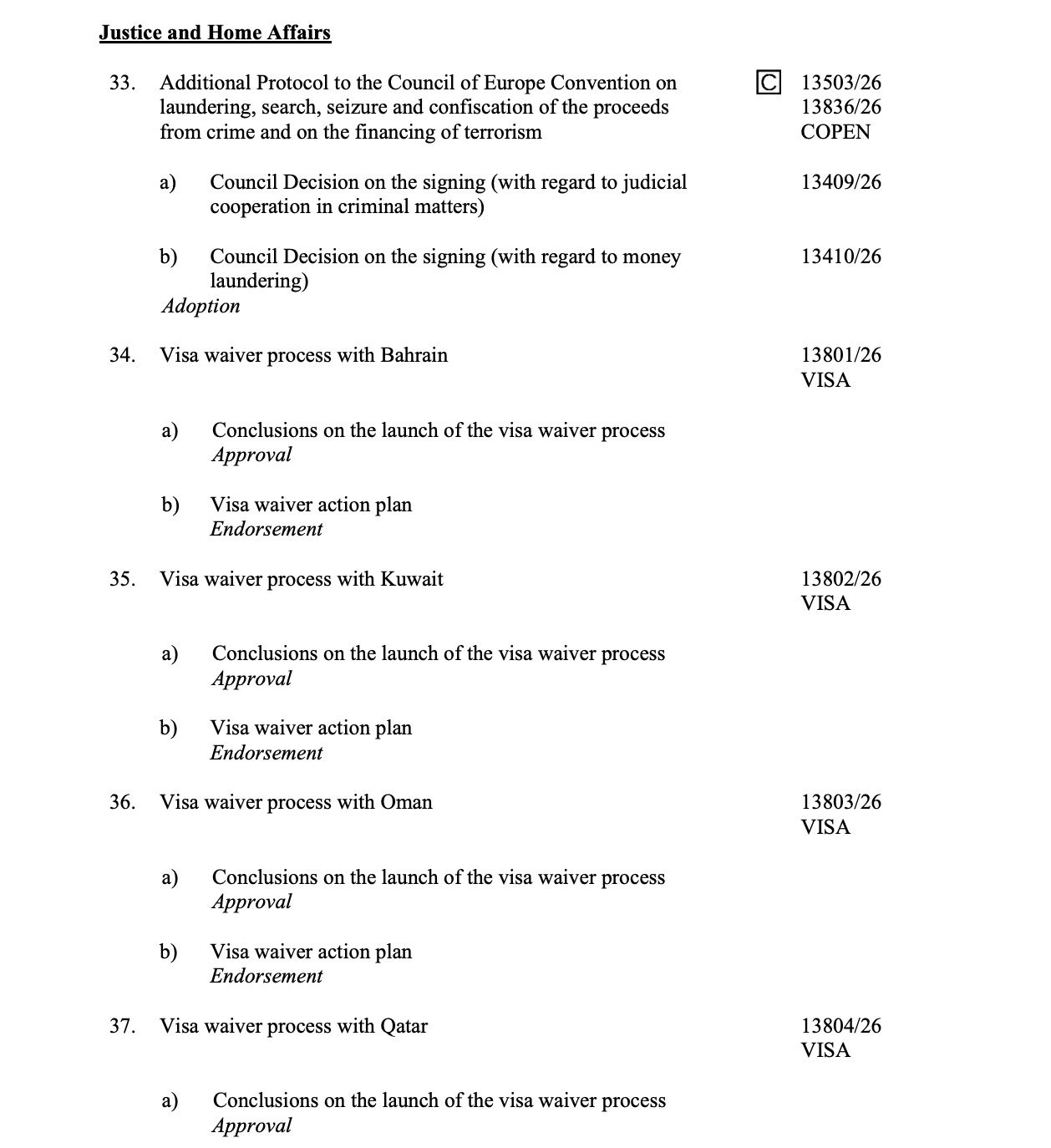
These agenda items fall under the category of "no-debate" items, reserved for texts that have already been technically agreed upon. At this stage, neither the conclusions nor the action plans are public, meaning their exact content—particularly the conditions attached to each country—remains unknown.
The same meeting also included a preliminary exchange of views on the EU-GCC summit in Riyad, scheduled for October 24, 2026.
As for the Gulf side, the Secretary-General of the Gulf Cooperation Council (GCC), Jasem Albudaiwi, stated in an interview published on October 9 by the Saudi Press Agency that the five countries were "very close" to the start of the process and that an announcement was expected at the summit. This statement has not yet been officially confirmed by a GCC communiqué.
A process that still involves multiple steps
Launching a process does not automatically grant visa-free entry. According to the EU Visa Policy Strategy adopted on January 29, 2026, the EU describes the next steps. Once a country is selected as a candidate, it enters into a structured dialogue based on agreed-upon criteria and its cooperation with the EU on security, migration, and border management. The outcome of this dialogue is then formalized through a visa exemption agreement with the EU.

The criteria considered by the European Commission include refusal rates for visa applications, unfounded asylum requests, return rates, and cooperation on readmission, along with counter-terrorism and organized crime measures. The strategy indicates that these criteria will be finalized with the member states by 2026..
To be included in the visa exemption list, the nationality must also meet the conditions outlined in the agreement. The change is implemented through an ordinary legislative procedure that requires the Parliament and the Council to approve the modification in the EU list of visa-exempt countries.
Kuwait and Qatar: a proposal pending since 2022
Previous attempts suggest this process may take time. On April 27, 2022, the European Commission proposed lifting visas for citizens of Kuwait and Qatar. As per the European Parliament Legislative Observatory, the text was moved to committee in December 2022 and resubmitted on December 12, 2022, instead of being voted on by the entire Parliament.
The file indicates that, after the 2024 elections, the European Parliament has yet to adopt a position on this proposal in its first reading. Kuwaiti and Qatari travelers remain subject to Schengen visas, aligning with the current visa requirements for Saudi and Bahraini travelers.
Current visa rules for Gulf nationals
Only citizens of the UAE are currently exempt from Schengen visas. An agreement between the EU and the UAE, concluded in 2015, allows for stays of up to 90 days within any 180-day period for all purposes except paid employment.
The remaining five countries—Bahrain, Kuwait, Oman, Qatar, and Saudi Arabia—benefit from more flexible visa rules, known as "cascade", which allow multiple-entry visas valid for up to five years. As noted by the Danish Immigration Service, Saudi and Kuwaiti applicants residing in their home countries receive a five-year visa on their first application if their passport has a validity of at least five years. If they apply from abroad, they are subject to the general Schengen rules.
The Gulf unified tourist visa, approved in June 2025 by the six GCC countries, is a separate initiative from the proposed EU visa exemptions for Gulf nationals. This visa allows foreign travelers to enter the Gulf countries, not GCC citizens to enter the EU.
The Riyad summit: the next milestone
The first EU-GCC summit was held in Brussels on October 16, 2024, where leaders agreed to meet every two years to discuss "practical and constructive measures" toward a "safe and mutually beneficial" visa-free travel regime between Schengen Area and the Gulf states. The statement was echoed by the foreign ministers in Kuwait on October 6, 2025.
As of now, not all six GCC countries are at the same stage of progress. While Kuwait and Qatar have active legislative proposals, Bahrain, Oman and Saudi Arabia do not yet have any on file. However, the unified tourist visa approved by the GCC in June 2025 could serve as an example for future EU-GCC discussions.

As CEO of Visamundi, I am dedicated to simplifying international travel by assisting our clients in obtaining visas worldwide. By staying at the forefront of ever-changing regulations, I ensure our agency remains a trusted pillar in the visa services industry.
Get our visa news first in your Google results: add Visamundi to your preferred sources.
