
Ghana mandates online health declaration for all travelers from November 12
Starting November 12, 2026, travelers arriving in Ghana will be required to complete an online health declaration form before departing. The official portal, which is free and delivers a QR code for presentation to public health agents upon arrival, has introduced this screening measure as part of broader Ebola prevention efforts.
A measure introduced as part of Ghana’s ongoing Ebola surveillance, it applies to all passengers regardless of nationality or visa status. The Ghana Health Service (GHS), the country’s public health agency, announced on November 12 in an official statement, signed by its director-general, Dr. Samuel Kaba Akoriyea. This announcement was widely covered by Ghanaian media, though as of November 13, the declaration portal had not yet been added to the GHS website. The official portal is clear: the form is presented as 'mandatory for all arriving passengers'.
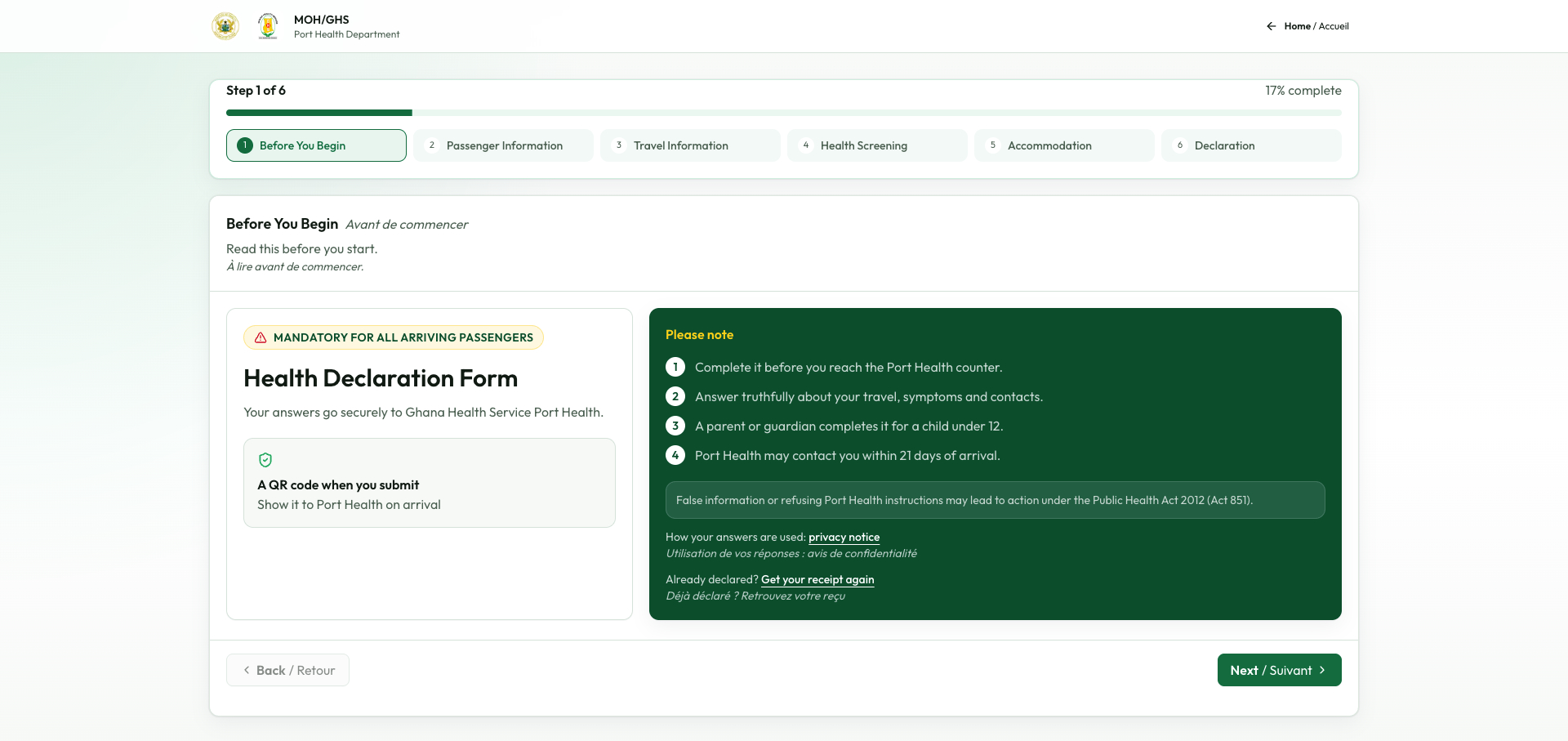
The requirement applies to all travelers, whether they are visa-exempt or not; this includes those from countries where visa-free entry was introduced in the spring. The GHS website summarizes it this way: every passenger arriving in Ghana must complete this declaration, described as an Ebola screening form.
The rollout was tested before the official announcement. On October 29, the GHS confirmed they had trained staff at Kotoka International Airport in Accra on the new electronic system. During the training, travelers arriving at the airport were already asked to scan a QR code and complete the form before proceeding with entry formalities.
How to complete the declaration
The form must be filled out on the official health declaration portal, managed by the Ghana’s Port Health Services under the Ministry of Health. It is available in English and French. The announcement instructs travelers to submit before boarding for Ghana, while the portal itself states it must be completed before arriving at Port Health Services desk.
● The form is completed in 6 steps:
a preliminary information page;
passenger identity;
travel information, including flight details and visited countries in the last 21 days;
health questionnaire related to symptoms of Ebola virus exposure;
Ghanaian address of stay;
a declaration of honor.
A QR code is displayed immediately after the form is submitted. In case it is lost, there is a 'Find my receipt' section to retrieve it. The portal can also be saved as a home screen icon on a mobile device, although internet access is required to submit the form. The GHS recommends completing the declaration online before travel, not after arrival.
For travelers under 12, a parent or guardian completes and submits the form in their place.
On arrival landing process
The QR code is presented to a Port Health Services agent upon arrival. The existing procedures show that each traveler needs to present their declaration; the GHS lists the symptoms to report: fever, severe weakness or fatigue, headache, vomiting or diarrhea, and unexplained bleeding or bruising.
The Ghana Health Service has equipped its officers with webcams to scan QR codes. The goal is to expedite arrivals avoid travelers handling their own devices.
Additionally, the declaration is not limited to the border; port health authorities may contact the traveler up to 21 days after arrival. Travelers coming from countries with active virus circulation may be subject to monitoring throughout this 21-day period.
Penalties for false declarations
The portal warns that false information, hiding symptoms, or refusal to follow Port Health Services guidelines could result in legal action under the Public Health Act of 2012 (Act 851). The November 7 announcement does not specify sanctions amounts. The GHS also notes that procedures for land or sea arrivals have not yet been documented — the portal refers to 'points of entry' without listing specific locations.
The Ghana follows several other countries in the region that introduced online health declaration requirements amidst an Ebola outbreak, such as Tanzania in October.

A specialist in regulatory monitoring and a content destination expert, she analyzes daily changes in entry formalities to turn complex administrative processes into practical guides. Her role blends ground-level expertise with technical precision to ensure the reliability of the information provided to travelers.

Get our visa news first in your Google results: add Visamundi to your preferred sources.
