
Kazakhstan: ETA to be free but mandatory starting July 1, 2027
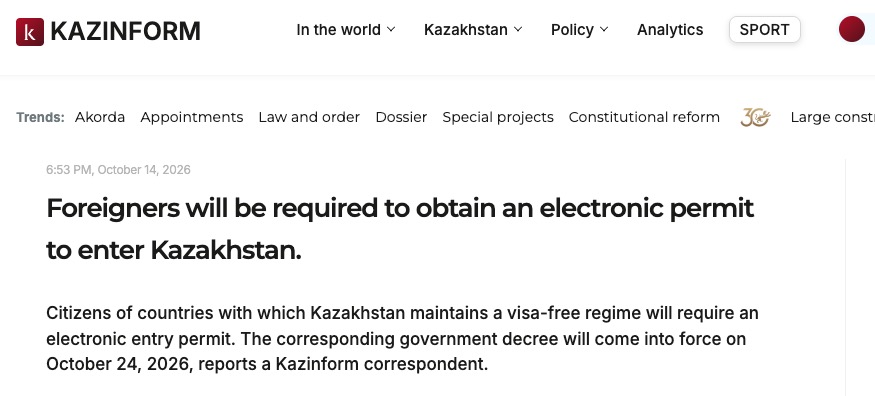
The Kazakhstan government has finalized the rules for the electronic travel authorization (ETA). The adopted text will take effect on October 24, 2026, with the authorization issued free of charge beginning November 1, 2026. While initially optional, the ETA will become mandatory at border checkpoints starting July 1, 2027.
The ETA applies to travelers who currently enter visa-free, including nationals of the Eurasian Economic Union.
Free: the final text resolves the fee issue
In August, we reported that Kazakhstan’s Ministry of Internal Affairs was consulting on a draft making the ETA a paid authorization without setting a specific amount. In September, during the pilot phase, unofficial estimates suggested fees of approximately 3,900 tenge €7.77 (and 7,600 tenge €15.14 if paid at the border) were circulating, shared by a Kazakh embassy.
However, the officially adopted version ends these speculations. According to the state agency Kazinform, which published extensive excerpts on October 14, 2026, the authorization fee “will be zero tenge.” Thus, no official fees are associated with the ETA.
Who will need to apply
The finalized rules apply to three groups of travelers for entry or transit through Kazakhstan:
Nationals of countries included in the Kazakh visa-exemption list;
Citizens of the Eurasian Economic Union (Russia, Belarus, Armenia, Kyrgyzstan);
Nationals of countries with a bilateral visa-free travel agreement with Kazakhstan.
Previously, citizens of Russia, Belarus, Armenia, and Kyrgyzstan could cross the border without any prior procedure. Starting in November 2026, those groups will also need to apply for and obtain their online authorization before travel.
If you are a citizen of the United States, the United Kingdom, Germany, France, Japan, or South Korea, for instance, you are still allowed to stay up to 30 days per trip within a 90-day limit over a 180-day period.
Four-step deployment timeline based on entry point
The rollout timeline depends on the entry checkpoint, not the traveler’s nationality. It is as follows:
Date | Entry points covered |
|---|---|
November 1, 2026 | International Airport of Aktau and four land border crossings: Urlyutobe (Pavlodar region), Aukhatty (Jambyl region), Atameken (Turkestan region), and Nurly Zhol (Jetyssou region) |
January 1, 2027 | International Airports of Astana and Almaty |
March 1, 2027 | All other land border crossings |
July 1, 2027 | Entry may be refused if no authorization is presented |
During the transition phase until July 1, 2027, travelers will not be denied entry at any border checkpoint if they do not have an ETA. For example, a traveler landing in Almaty in February 2027 without an ETA will still be admitted. However, beginning July 1, 2027, the ETA will be a requirement for entry.
How to apply
Applications are accepted exclusively online through the QazETA platform. This digital authorization system was launched in a pilot phase for foreigners in January 2026 using the website Kazinform.
In the final version, the timeline is the following: applications must be submitted no later than 72 hours before intended entry. The authorization is valid for 180 calendar days from the date of issue, subject to verification by national security services. During passport control, travelers must present the same passport or travel document used to apply for the ETA.
Additionally, travelers should note that a renewed passport after application will not match their obtained authorization.
Travelers exempt from ETA
Starting November 1, 2026, there are 29 categories exempt from the ETA requirement, but eligible travelers must present supporting documentation:
Children under the age of 16;
Persons aged 65 or older;
Holders of a valid Kazakh visa;
Temporary residence permit or permanent residence permit holders in Kazakhstan;
Passengers in transit staying in the international transit zone of an airport without crossing the border;
Airplane, ship, and train crews, as well as truck drivers and tour bus drivers with more than 12 seats engaged in international traffic.
Diplomatic or service passport holders, official delegations, refugees and asylum seekers, as well as individuals invited by certain Kazakh institutions (Presidential Administration, Government, Ministry of Foreign Affairs notably) are also exempt. For example, a family with a 15-year-old teenager and grandparents aged 67 will only need the parents to apply for the authorization.

A specialist in regulatory monitoring and a content destination expert, she analyzes daily changes in entry formalities to turn complex administrative processes into practical guides. Her role blends ground-level expertise with technical precision to ensure the reliability of the information provided to travelers.

Get our visa news first in your Google results: add Visamundi to your preferred sources.
