
Malawi now requires all travellers to complete an online health declaration
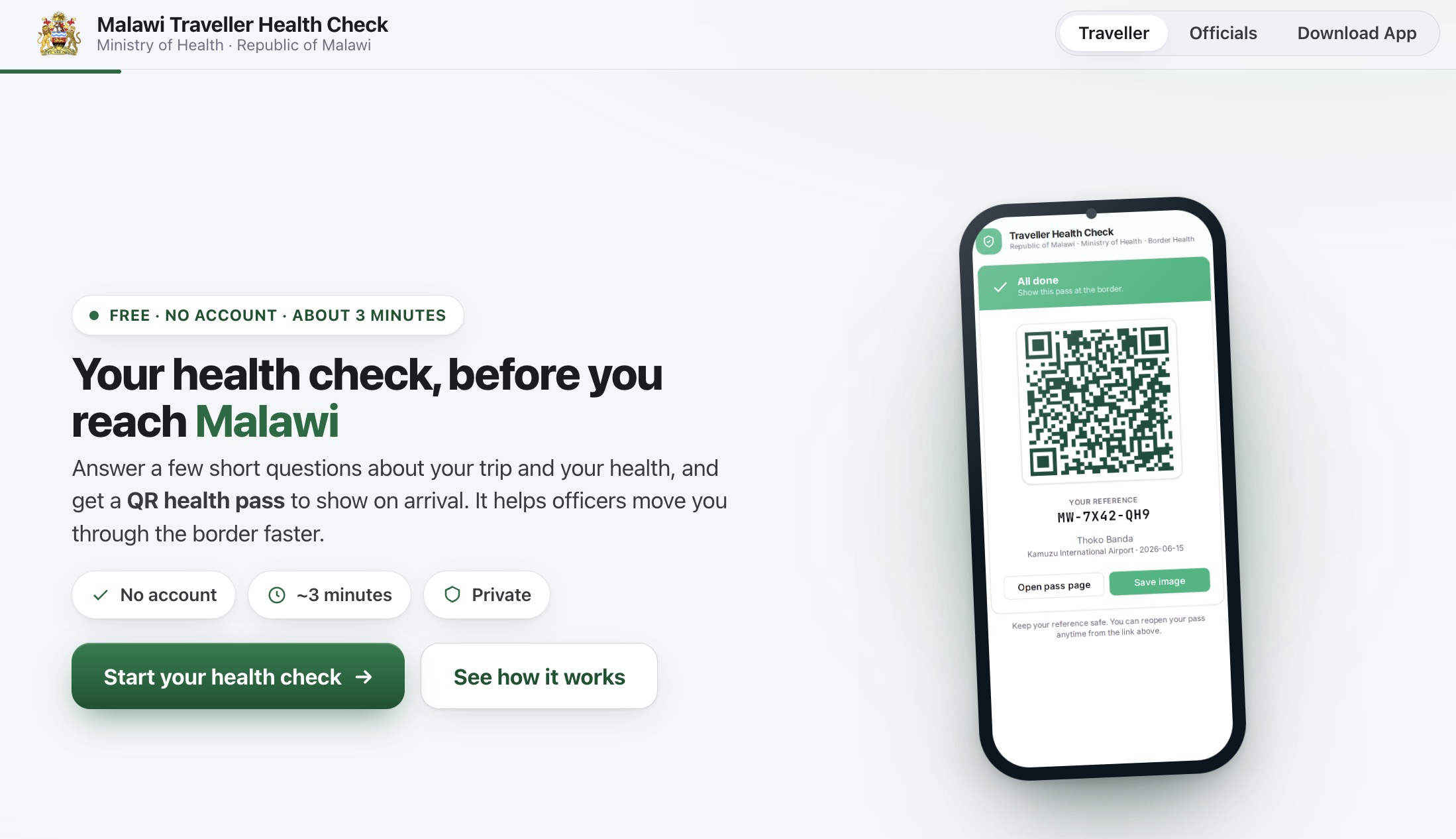
The Malawi Ministry of Health and Sanitation now mandates an online health declaration for all arriving travellers, known as the Traveller Health Check.
The form is free, generates a QR code that border agents scan, and can be completed before departure or on arrival. Canadian authorities updated travel advice on this on 6 August 2026. Access the portal at https://poe.health.gov.mw/welcome/#welcome
What this replaces
Previously, health screening upon entry to Malawi relied on paper forms filled out in queues at Lilongwe airport and land border crossings. The Traveller Health Check digitises this process: responses are entered once and attached to a QR code that border officials scan at the desk. The requirement applies to all arrivals regardless of nationality or travel purpose. UK authorities list it in their entry conditions for Malawi as a Malawi ministry requirement for arriving passengers. A traveller from Côte d’Ivoire, Belgium, South Africa or Vietnam faces the same process whether arriving for tourism, business or a family visit. Mode of transport is also irrelevant: the declaration covers arrivals by air or road.
What information the form collects
The questionnaire remains concise. It asks for your Malawi port of entry, expected arrival date, country of origin and mode of transport. It also lists the countries visited in the previous 21 days—a window matching regional incubation periods. Next comes traveller identity, to be entered exactly as it appears on passport or travel document, plus a reachable phone number. Accuracy here matters: a name entered out of passport order or an approximate transcription creates a mismatch between the declaration and the document shown at the counter, negating the benefit of pre-completion.
QR code, and what happens if you don’t have one
Upon submission, you receive a QR code or a reference number. At the entry point, the agent scans it and your answers display instantly, eliminating the need to repeat them. Failure to complete the declaration beforehand does not bar boarding or entry. The ministry outlines two fallback options: on-the-spot screening by border agents or completing the form on your phone while you wait. Advance filing is therefore a time-saver, not a passport-style gatekeeper; this differs from measures like Nigeria’s health declaration, which must be completed before boarding.
An epidemiological surveillance tool
This enhanced control reflects a region facing persistent public-health challenges. Malawi is among countries where clade I mpox continues to spread in the community, alongside the Democratic Republic of the Congo, Burundi, Kenya, Rwanda, Tanzania and Zambia. The country also reported a cholera outbreak in early 2026 and cases of vaccine-derived poliovirus in spring. The 21-day country list is used to flag travellers from active-transmission zones, not to screen nationalities. All data remain accessible only to authorised ministry staff at the specific checkpoint and are used solely for entry screening.
The yellow fever vaccination certificate remains a separate, independent requirement: travellers arriving from or transiting through airports in countries where yellow fever is endemic must still present it.
One step added to, not replacing, the visa
The health declaration does not alter visa rules. Tourist visas are still required for most nationalities, obtainable online or at major ports of entry at fees of 50 USD €44.54 for a single entry, 150 USD €133.61 for six-month multiple entry and 250 USD €222.68 for one year. Nationalities that are exempt are detailed in our article on Malawi exemptions, but exemptions apply only to visas, not to the Traveller Health Check. Passports must still have at least six months’ validity beyond the planned arrival date in Malawi—assessed on entry, not on return.

As CEO of Visamundi, I am dedicated to simplifying international travel by assisting our clients in obtaining visas worldwide. By staying at the forefront of ever-changing regulations, I ensure our agency remains a trusted pillar in the visa services industry.
Get our visa news first in your Google results: add Visamundi to your preferred sources.
