

Nigeria makes health declaration mandatory for all arriving travelers
All incoming travelers to Nigeria, regardless of nationality, must now complete an online health declaration before boarding via the Nigeria Centre for Disease Control and Prevention (NCDC) portal, with a 21-day post-arrival tracking requirement.
There are no exemptions, and Nigerian nationals returning home are subject to the same rule as all other travelers. The process is free of charge but includes an engagement many travelers only learn about at the last moment: a 21-day telephone-based health check after arrival.
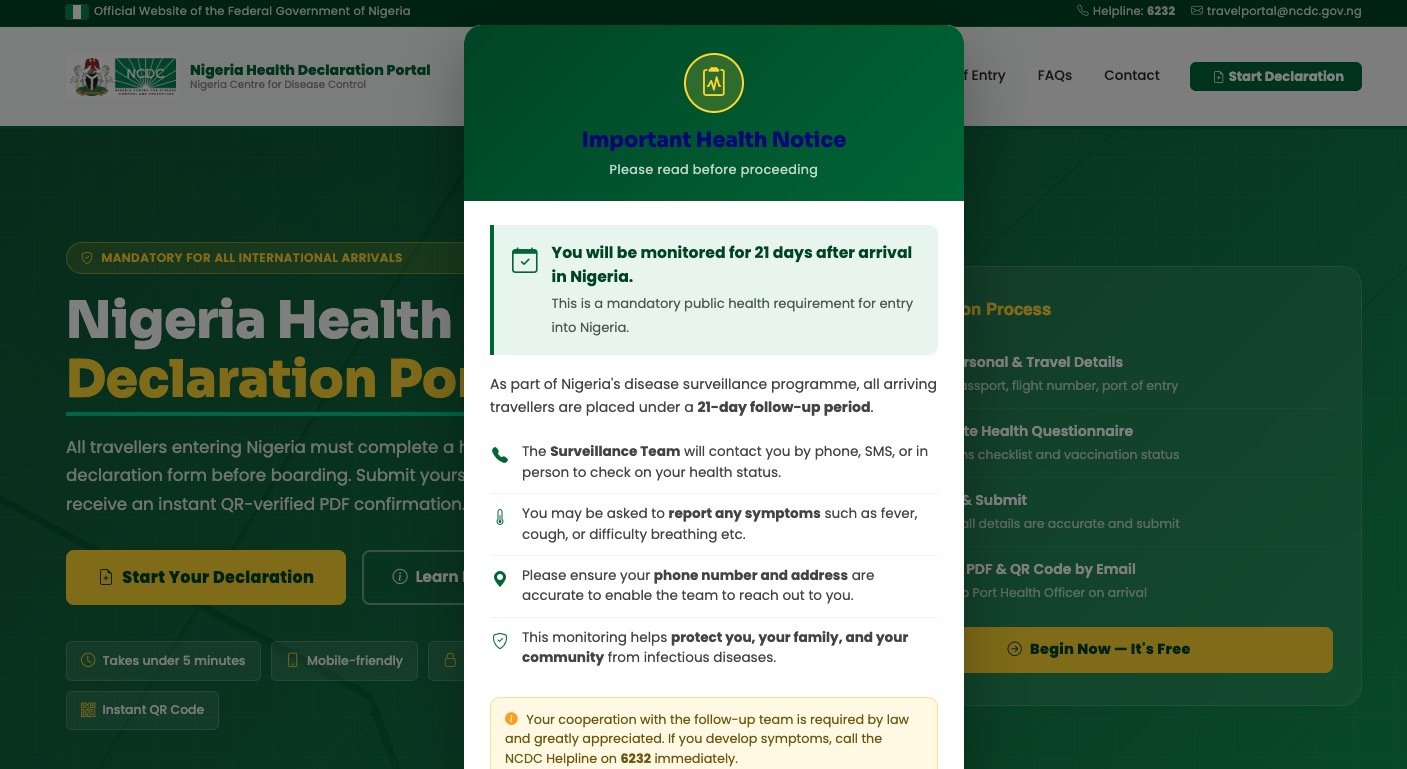
Who must fill out the form and when
The NCDC health declaration portal clearly defines the scope: every person arriving in Nigeria from an international destination—including Nigerian citizens returning from abroad—must complete their own declaration. There are no joint family forms; each traveler must submit a separate declaration.
The form must be completed before boarding. While the NCDC emphasizes submitting it well in advance, a July 6, 2026 update advises travelers to submit at least 24 hours before departure to streamline entry procedures. The submission is free and does not require creating an account.
This requirement applies beyond airports. It covers major airports such as Lagos, Abuja, Kano, Port Harcourt, Enugu, and Kaduna, as well as border crossings with Benin, Niger, and Cameroon at Seme, Idiroko, Illela, Jibia, and Mfun; and the ports of Apapa and Tin-Can Island. Travelers entering by road or sea must also provide information about their vehicle or vessel.
What the form actually asks for
The process takes less than five minutes if travelers have the required information on hand. Two sections often cause surprise:
An emergency contact in Nigeria. A local name and phone number must be provided. A traveler with no local ties should plan ahead—using their hotel or business contact, for example.
The countries visited in the last 21 days, including transit points, plus seat number. Missing transit countries is among the most common errors.
Other required details include exact passport data, passport number, nationality, a valid contact number and email, Nigerian accommodation address, arrival date, flight number, and point of entry. Health-related questions ask about symptoms in the past 21 days, contact with sick individuals, illness during the journey, any recorded body temperature, and vaccination status—including yellow fever vaccination records where applicable.
Foreign phone numbers are accepted, both for the traveler and their local contact. One key detail: once submitted, the declaration cannot be changed. The NCDC urges travelers to review everything before finalizing, noting that submitting false information is a criminal offense under Nigerian law.
The QR code: your admission ticket
Upon submission, travelers receive a PDF certificate via email containing a unique QR code. This document must be shown to Port Health Services agents at the entry point for scanning and verification. Travelers may save the PDF on their phone or print it.
If the email does not arrive, the NCDC advises checking the spam folder and confirming the email address was entered correctly—mismatched email fields is another frequent error. The portal also automatically saves form drafts, with a “Restore” button in the top right corner to recover previously entered information if a session restarts.
The 21-day follow-up: the lesser-known counterpart
Before accessing the form, travelers must explicitly accept a warning: they will be monitored for 21 days after arriving in Nigeria. The NCDC frames this follow-up period as a public health obligation tied to entry into the country, not a voluntary process.
In practice, a surveillance team may contact travelers by phone, SMS, or in person to check on health status and request reporting of symptoms such as fever, cough, or breathing difficulties. That explains why phone number and local address must be accurate—they are used to reach the traveler. The NCDC emphasizes legal cooperation with the follow-up team and cites 6232 as the dedicated assistance number for reporting symptoms.
The NCDC states plainly: failure to complete the declaration may lead to mandatory health screening or denial of entry. The portal links this obligation to the International Health Regulations (IHR 2005), the WHO framework allowing states to require traveler health information.
Reporting symptoms does not automatically result in denial of entry. Instead, the portal flags the case to health agents at the entry point, who decide whether further examination is needed. Travelers unable to complete the online form will be given a paper version at arrival to fill out and submit to Port Health Services, inevitably resulting in longer wait times.
Origin of the system: Ebola epidemic response
Nigeria’s strengthened border controls are part of the regional response to the Ebola epidemic caused by the Bundibugyo virus, which the World Health Organization declared a Public Health Emergency of International Concern on May 17, 2026. The outbreak originated in Ituri Province in the Democratic Republic of the Congo and subsequently spread to Uganda.
Nigeria’s choice of a 21-day tracking period—and the requirement to list all countries visited during that window—stems directly from the virus’s maximum incubation period. While the WHO advises against travel restrictions to affected countries, it supports screening at points of entry—exactly what Nigeria has implemented.
Nigeria is not alone: Vietnam also reinstituted mandatory health declarations from July 1, 2026, albeit under different conditions.
An added requirement alongside others
The health declaration does not replace a visa or arrival card. It complements Nigeria’s recent digital requirements including the introduction of an e-visa and arrival card, and is administered by a different authority: the NCDC and the Federal Ministry of Health, not immigration services.
For form-related questions, the NCDC offers support via email at travelportal@ncdc.gov.ng, as well as the dedicated helpline 6232, available round the clock.

As CEO of Visamundi, I am dedicated to simplifying international travel by assisting our clients in obtaining visas worldwide. By staying at the forefront of ever-changing regulations, I ensure our agency remains a trusted pillar in the visa services industry.

Get our visa news first in your Google results: add Visamundi to your preferred sources.
