

Spain restores border checks on flights and ferries from Italy until 7 September 2026
Spain began documentary checks on passengers arriving by air or sea from Italy on 8 August 2026. The measure, published in Spain’s official gazette, runs until 24:00 on 7 September and follows Italy’s reintroduction of controls on 1 August after the Ceuta crisis.
No new visa requirement is introduced: documents are checked on arrival, and the screening may apply to any traveller regardless of nationality.
What Spain’s order actually says
The Orden INT/846/2026 of 7 August, signed by Spain’s Interior Minister Fernando Grande-Marlaska, reinstates internal air and sea border checks for a 30-day calendar period.
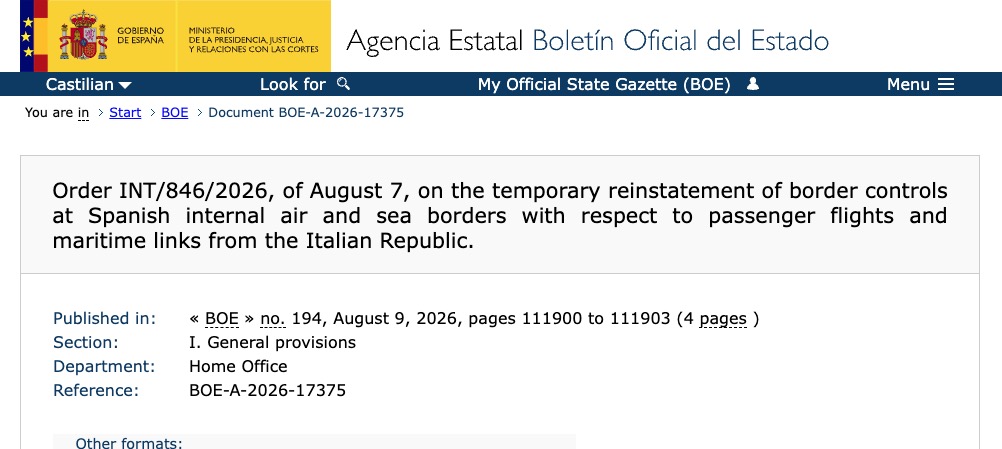
The criterion is the final point of departure. Flights and ferries affected are:
passenger flights whose last airport of departure before Spain is in Italy;
passenger ships, ferries and other maritime services whose last port of departure is in Italy.
The order excludes flights and maritime links from other Schengen states, aircraft or vessels carrying no passengers, and technical stopovers in Italy from which no passengers embark whenever travellers’ actual point of origin can be verified. Checks do not affect any other Spanish borders: the order states that no equivalent threat has been identified in those areas.
Airports, ports and specific routes to be controlled are not listed in the order. They are set in instructions from the Secretary of State for Security, adjusted to risk assessments.
Document checks, not a visa requirement
Public descriptions have framed the move as a “visa reinstatement” for Italians, but the official wording differs—and the distinction matters.
Article 2.2 of the order applies to every person crossing the affected borders, regardless of nationality. Each traveller is checked under the regime that applies to their legal status and whether or not they benefit from free-movement rights. In other words, the trigger for control is the flight or vessel’s last port or airport, not the passport a traveller holds.
The reintroduction of checks does not constitute a general entry ban and cannot be grounded solely on nationality, ethnic origin, religion, physical appearance or any other personal status. The right to seek international protection, the principle of non-refoulement and the best interests of the child remain guaranteed.
In practice, a passenger arriving from Rome or Naples presents the travel document that matches their existing status. A third-country national subject to a Schengen visa must show a valid title, just as they would at an external Schengen border. A traveller exempt from visa requirements faces no new formalities; their situation is merely verified, not changed.
Origins of the measure: the sequence since Ceuta
Spain did not initiate this chain of measures, it is responding to them. On 1 August, Italy reinstated internal air and sea border checks with Spain for the period 1 August to 1 September 2026. The declared motive, set out in the official Commission register of notifications, cites threats to public order, internal security and migration-flow management linked to events in the Spanish autonomous city of Ceuta, with a risk of secondary movements inside the Schengen area. We detailed which countries were controlling their borders with Spain on 1 August at the time Italy was the sole country to take this step.
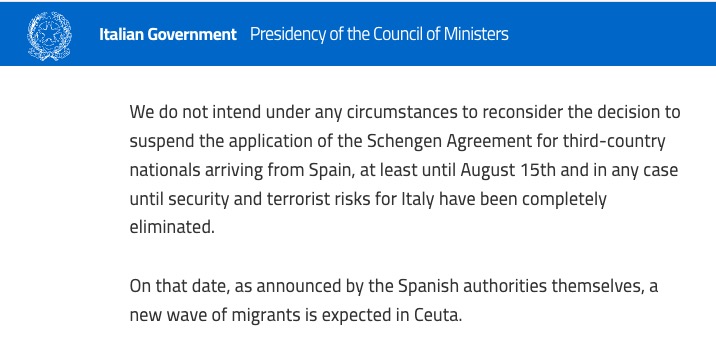
On the Italian side, an Palazzo Chigi note of 7 August states that checks target third-country nationals arriving from Spain and will remain in place at least until 15 August, with removal dependent on events. The notification to Brussels, however, covers the period up to 1 September. Travellers planning round trips should therefore expect controls in both directions until further notice, as the two regimes operate on different calendars and scopes.
Madrid cites central-Mediterranean pressure—66,328 irregular crossings detected on that route by Frontex in 2025 versus 19,403 on the western route—and roughly 11,600 versus 7,100 in the first five months of 2026. The order also references Commission communication COM(2026) 387 final of 15 July 2026 on difficulties Italy faced in applying EU rules on determining the responsible state for examining international-protection claims.
Checks are conducted, per the order, in a proportionate, flexible and risk-based way. They are not systematic: officers may target an entire flight or only select passengers. The text expressly instructs officers to limit waiting times, ease connections and prioritise minors, families and vulnerable persons. The check point is at arrival, in the disembarkation area or immediately before exit—sometimes at the aircraft door. This adds time to an intra-Schengen flight itinerary that until now would have involved no documentary checks at all. Travellers with a connection in a Spanish airport should build in that extra time, not an earlier administrative process. Since 3 August 2026, unimplemented ID models are no longer accepted for travel, including within the Schengen area. A document that would previously have cleared a Rome-to-Barcelona flight will now be checked. We detail which national ID-card models are affected. |
After 7 September
The Spanish order provides for automatic expiry. On the expiry date checks lapse without the need for a specific repeal decision. The measure can also end earlier if the underlying threats subside or can be addressed through less restrictive means; the order remains subject to ongoing evaluation.
Above all, it cannot be tacitly extended. Any renewal must be explicitly decided, preceded by a fresh proportionality assessment and notified to the Commission, in compliance with the Schengen Borders Code. Any extension will therefore appear in Spain’s official gazette and be notified to the Commission—not in political statements.

As CEO of Visamundi, I am dedicated to simplifying international travel by assisting our clients in obtaining visas worldwide. By staying at the forefront of ever-changing regulations, I ensure our agency remains a trusted pillar in the visa services industry.

Get our visa news first in your Google results: add Visamundi to your preferred sources.
