
Thailand’s DTV now asks applicants to apply via nationality or residence country
The Royal Thai Embassy in Vientiane has announced new Destination Thailand Visa requirements worldwide as of 31 August 2026, with stricter application conditions.
Applicants must apply from a country of nationality or permanent residence
The simple rule: you must be a national or permanent resident of the country where you submit your Destination Thailand Visa (DTV) application. This closes the previous practice of applying from another location—often one deemed more lenient. Travelers already outside their home country, such as a British national in Chiang Mai or a Canadian on tour in Southeast Asia, must now apply through the Thai mission responsible for their country of nationality or permanent residence.
Visitors such as a UK national in Chiang Mai, a South African in transit in Kuala Lumpur, or a Canadian traveling in the region can no longer lodge an application where they are currently located. They must submit through the mission that covers their nationality or permanent residence.
Each mission has applied the rule locally. The Embassy in Vientiane now processes applications only from Lao nationals and permanent residents. The Embassy in Singapore states that the DTV is issued only to Singaporean citizens and permanent residents. The principle is the same across all missions, though accepted proof documents vary by location.
Criminal record certificate now required
A new requirement applies to all DTV applicants worldwide: everyone must now submit a criminal record certificate issued by the authorities of either their country of nationality or the country where the application is lodged. This document was previously not part of the standard DTV application package.
Validity periods differ by mission, and this is a common source of unexpected rejections. The Embassy in London requires a certificate issued within the last six months by the UK ACRO or the Irish police, while the consular posts in Los Angeles and Washington require an FBI certificate under three months old. The Consulate General in Ho Chi Minh City accepts either a certificate from the applicant’s country of nationality or one issued by Vietnamese authorities.
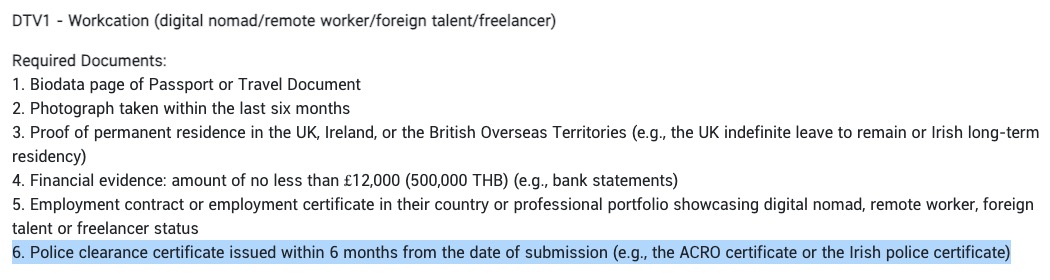
The consulate responsible dictates how the certificate is obtained, translated, legalized, and validated. Many applicants must allow weeks for issuance in their home country, and that timeline dictates their entire application schedule.
Proof of residence requirements vary by mission
Regional variations apply to proof of permanent residence. Accepted documents differ widely by location. A hotel booking or informal letter of accommodation will no longer suffice.
The Embassy in London requires evidence of permanent resident status in the UK, Ireland, or the British Overseas Territories—highlighting indefinite leave to remain or Irish long-term residency. The Consulate General in Los Angeles and the Embassy in Washington accept a current U.S. driver’s license, a valid U.S. visa, or a permanent resident card. The Consulate General in Fukuoka asks residents of Japan to submit a Japanese residence certificate (JUMINHYO).
The Consulate General in Ho Chi Minh City is explicit about exclusions: only a Vietnamese Temporary Residence Card or Permanent Residence Card qualifies as proof of long-term residence. Other documents—such as the temporary residence declaration NA17, the residence confirmation CT07, or similar supporting papers—are not accepted.
What remains unchanged
All other DTV conditions remain intact. Issued for five years and multiple entries, the DTV allows stays of up to 180 days per visit, extendable for 180 more days by applying to Thai immigration. Visa holders must leave and re-enter when the two permitted periods are used up, but the same visa can be reused within its validity.
The three eligible categories remain unchanged: remote work (“workcation”) for remote workers, freelancers, and foreign talent; soft power activities such as Muay Thai training, cookery courses, or medical treatment; and dependents under 20 of DTV holders, including spouses and children. Applicants must still demonstrate financial capacity of at least THB 500,000.
Fees are set locally in local currency and remain non-refundable. They include £300 €358.12 in London, USD $400 €357.02 in Washington, USD $340 €303.46 in Ho Chi Minh City, SGD $500 €349.49 in Singapore, and ¥52,000 €295.87 in Fukuoka. A simple mistake of jurisdiction can significantly increase the cost of the visa.
Applications lodged and paid before 31 August 2026 unaffected
The Embassy in Vientiane confirms that applications lodged and paid for before 31 August 2026 will be processed under the old rules. All other applications starting from that date fall under the new requirements.
Applications are submitted through the portal thaievisa.go.th, where the correct mission must be selected at the outset. Two preliminary steps determine the outcome of each application: first, identify the competent mission based on your nationality or permanent residence; second, check that mission’s list of required documents, because validity periods for the criminal record certificate and accepted forms of residence proof are set at mission level.
Travelers planning a DTV to extend a tourist stay should also note recent changes to Thailand’s entry rules: from 15 September 2026, visa-free entry to Thailand has been reduced to 30 days for citizens of 60 countries and territories, making advance visa planning a necessity for many more travelers.

A specialist in regulatory monitoring and a content destination expert, she analyzes daily changes in entry formalities to turn complex administrative processes into practical guides. Her role blends ground-level expertise with technical precision to ensure the reliability of the information provided to travelers.
Get our visa news first in your Google results: add Visamundi to your preferred sources.
