
In the U.S., a new online portal to report visa fraud
The U.S. Department of State has launched a new online form on September 23, 2026 that allows members of the public to report suspected American visa fraud. The tool also targets birth tourism networks and facilitators.
On the same day, Secretary of State Marco Rubio announced a new visa-restriction policy aimed at birth tourism and facilitators who enable fraud. In early September, the Department of State noted that the majority of the tens of thousands of suspected fraudsters identified and sanctioned since the start of Donald Trump’s second term were uncovered thanks to public tips.
A public-facing reporting tool
The portal is now accessible from the U.S. government’s consular website at travel.state.gov/reportvisafraud. It invites “members of the public” with information about possible visa fraud to come forward.
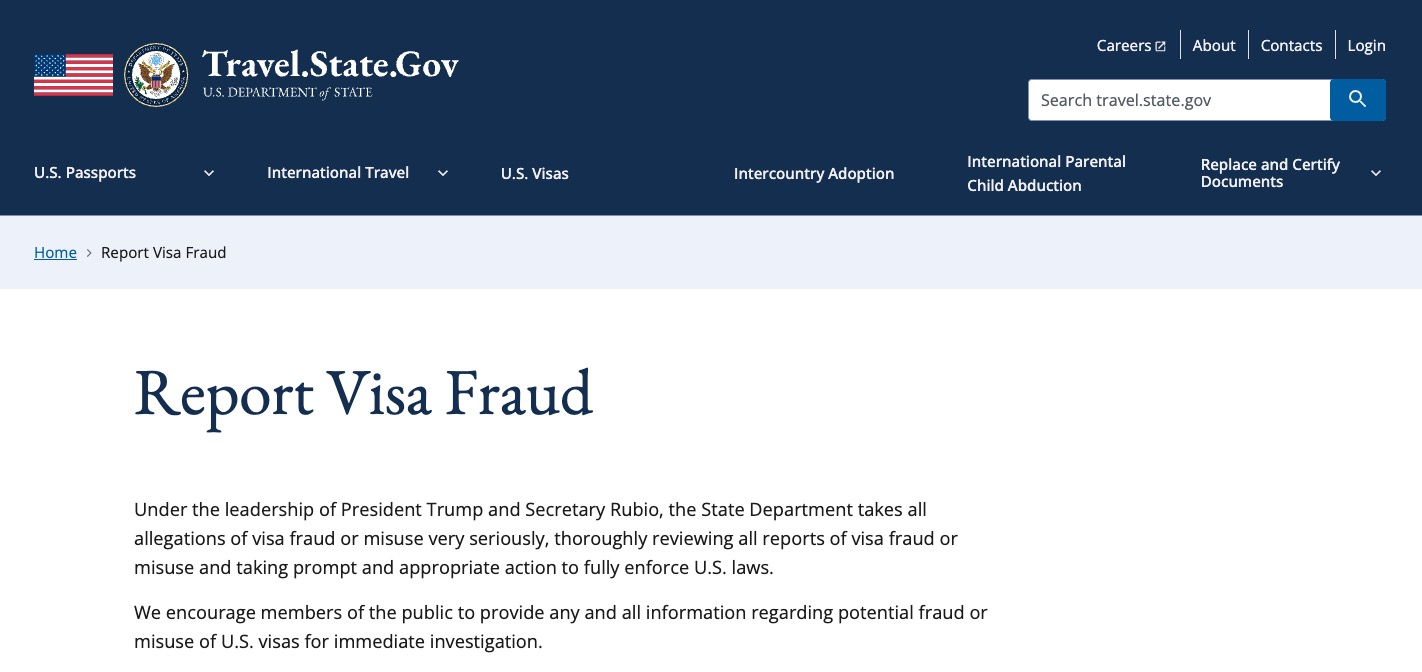
In a September 23 statement, the Department of State explained why it is rolling out this new channel: most of the “tens of thousands” of suspected visa fraud cases identified and sanctioned since the beginning of Donald Trump’s second term were uncovered thanks to tips from the public. Officials say the form will encourage more reports and enable “swift and thorough review and action.”.
The statement does not detail any requirements (attachments, the identity of the tipster, processing time).
What Consular Offices classify as visa fraud
The Department of State has released a list of examples, which it stresses is not exhaustive:
Use of fake documents or fabricated travel plans;
Intermediaries arranging sham marriages;
Shell companies;
Falsified employment offers; and
Birth tourism—whether participating directly or helping others organize it.
Fabricated travel plans in particular refer to fake details submitted when applying for visitor visas; omitting paper trail for the purpose of deceiving officials is as serious as submitting forged documents.
Fake job offers and shell companies apply to work visas, where a non-existent employer or position created specifically to support the application undermines the integrity of the visa itself.
Birth-tourism crackdown
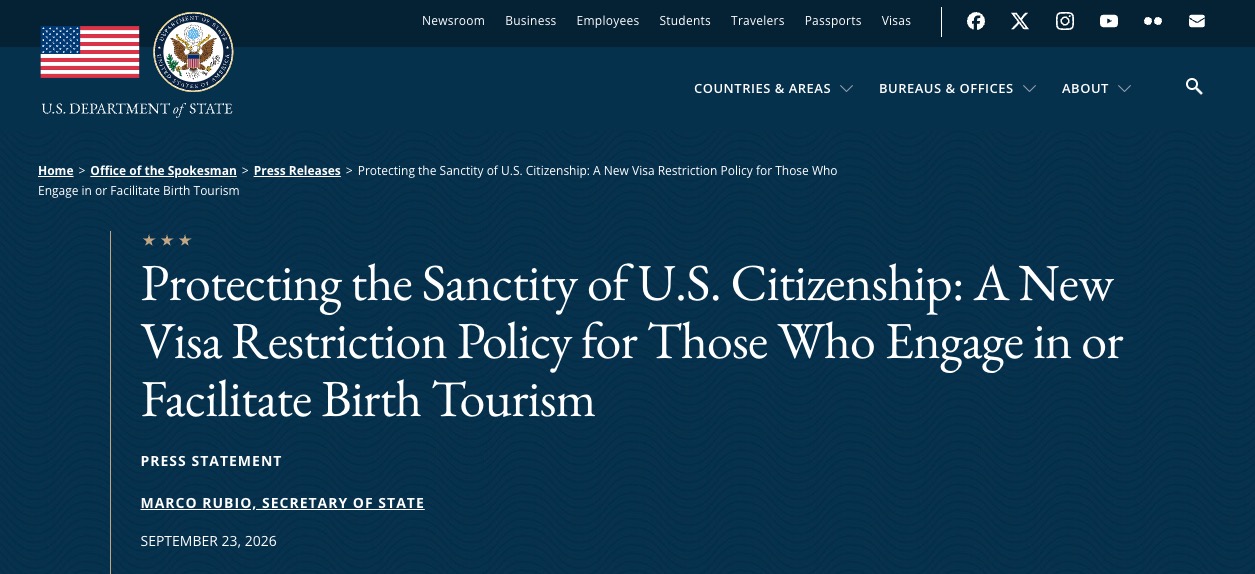
The same day, Mr. Rubio announced a tougher restriction policy under Section 212(a)(3)(C) of the Immigration and Nationality Act (INA), denying visas to anyone who practices, has practiced or facilitates birth tourism—the practice of traveling to the U.S. solely to give birth in order to secure American citizenship for a baby.
The government singled out multiple roles:
Owners, operators or managers within any commercial or organizational network that arranges these maternity stays;
Intermediaries—known locally as “fixers”—who prepare visa applicants and encourage them to lie in their applications;
Health-care professionals facilitating birth tourism with deliberate misuse of U.S. Medicaid, a U.S.-funded public health-insurance program;
Any other person who engages in or supports this activity.
The statement further warns that some family members of the targets may also face visa restrictions. According to the U.S. Department of State, these networks typically promote sham or wholly fabricated pregnancy tourism packages, provide coaching that encourages false statements on visa forms and operate as lucrative, often fraudulent enterprises that can realize tens of thousands of dollars per birth arranged.
What comes next for visa applicants?
The statement says authorities will apply the law “fully” at all stages—revoking visas already issued when warranted and referring fraud cases to law-enforcement and investigatory services.
The new restrictions build on recent removals disclosed in articles, such as more than 175,000 visas revoked, including some post-issuance, when reviewing visitor applications. For visa applicants, the rule now is clear: any information they provide in their requests (stated purpose of stay, employer details, affiliation with someone in the U.S., itinerary) may be called into question by public tips or targeted investigations by visa officials.
New scrutiny on social media
Alongside the new portal, the Department of State is expanding its visa-profiling on social media. As described in a March 2026 announcement, visa categories including I (foreign media), TN (Mexican and Canadian professionals under the USMCA agreement), TD (their family members), F (students), J (exchange visitors), M (trainees) and H-1B (specialty occupation) work visas, and K (fiancé) visas, are now open to such checks. Any applicant across the above groups—including those already covered such as F, J, M, H-1B and K—is now expected to maintain public-facing social-media profiles to allow for full vetting of identity and eligibility.
Authors’ note: visitors or those already named above should likewise review their social media privacy settings to ensure nothing in their profiles undermines an application for a visa.
A specialist in regulatory monitoring and a content destination expert, she analyzes daily changes in entry formalities to turn complex administrative processes into practical guides. Her role blends ground-level expertise with technical precision to ensure the reliability of the information provided to travelers.
Get our visa news first in your Google results: add Visamundi to your preferred sources.
