
Will China extend its visa exemption past December 31, 2026?
With five weeks remaining before the deadline, China has not yet indicated whether it will extend its unilateral 30-day visa exemption. The foreign ministry, questioned on November 17, 2026, said it was still reviewing relevant policies, with no decision or timeline in sight.
For travelers from 48 countries whose visa exemption ends on December 31, 2026, any stay beginning in 2027 remains, as of today, without guarantee.
What the ministry said on November 17
The question came from the EFE news agency: the exemption enjoyed by countries like Spain, France, and Germany expires at the end of the year—will it be extended, and when is the announcement expected? According to the official conference transcript, spokesperson Guo Jiakun responded that China attaches great importance to facilitating people-to-people exchanges and is evaluating the relevant policies.”
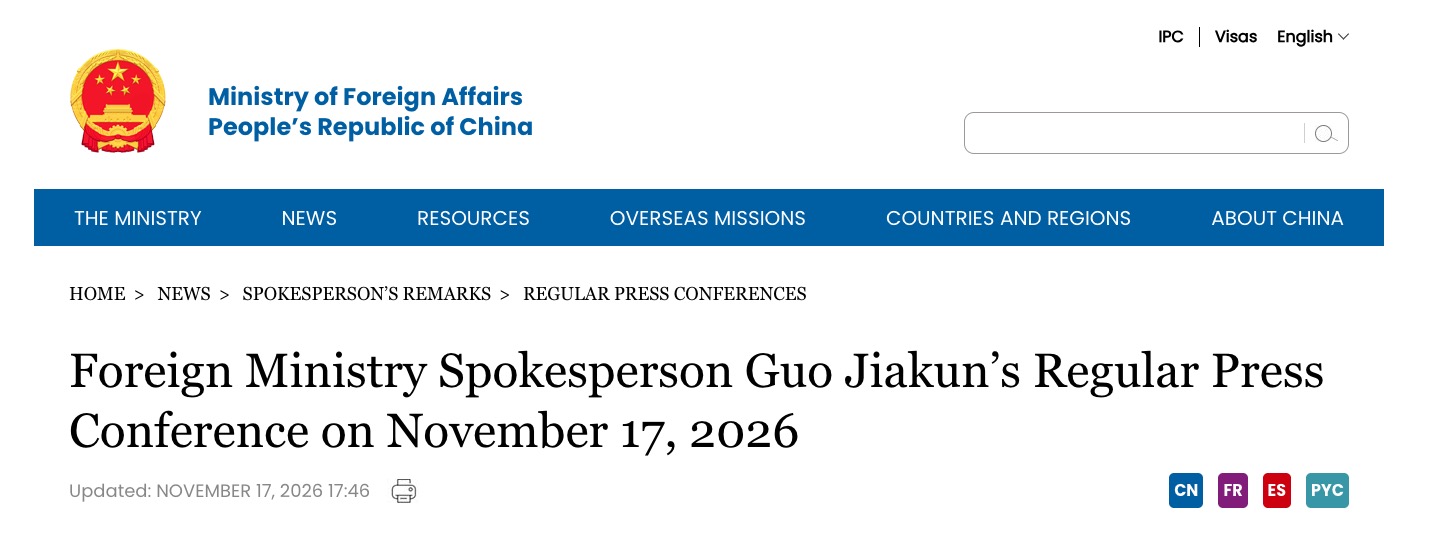
He did not give a yes, no, or date. The transcripts of the press conferences from November 18, 19, 20, 23, and 24 do not address the topic.
The previous statement urges not to jump to conclusions quickly: the extension of the policy, which we had presented in November 2025, had been announced on November 3, 2025, by spokesperson Mao Ning, at the ministry press conference, with the addition of Sweden as of November 10, 2025. This year, the same period has passed without an announcement.
According to the Chinese authorities' published FAQ, updated on May 25, 2026, 50 countries are currently on the list: Brunei, France, Germany, Italy, Spain, the Netherlands, Switzerland, Ireland, Hungary, Austria, Belgium, Luxembourg, New Zealand, Australia, Poland, the Czech Republic, Greece, Cyprus, Slovenia, Slovakia, Norway, Finland, Denmark, Iceland, Andorra, Monaco, Liechtenstein, South Korea, Bulgaria, Romania, Montenegro, North Macedonia, Malta, Estonia, Latvia, Japan, Brazil, Argentina, Chile, Peru, Uruguay, Saudi Arabia, Oman, Kuwait, Bahrain, Russia, Sweden, Canada, and the United Kingdom.
Canada and the United Kingdom have joined the arrangement more recently: the exemption applies to them since February 17, 2026, according to the announcement relayed by the Chinese government.
Citizens of these countries may enter with a valid ordinary passport for business, tourism, visiting family or friends, exchange programs, or transit purposes, for stays of up to 30 days. Employment, study, and journalism purposes remain excluded from this exemption.
End dates are not the same for everyone:
48 countries: the exemption runs until 31 December 2026;
Russia: until 31 December 2027, following the decision announced by Guo Jiakun on 20 May 2026, per the official transcript;
Brunei: no end date has been set.
The case of SlovakiaOn 10 November 2026, after a meeting with Chinese Foreign Minister Wang Yi in Beijing, Slovakian Minister Juraj Blanár announced that he had received positive news: China would be ready to extend the visa exemption for Slovakian citizens by one additional year. The information was reported by the Slovak News Agency TASR. On the Chinese side, the summary of this meeting confirmed the encounter but did not mention visas. The list published by the Chinese authorities still places Slovakia among the 48 countries whose exemption ends on 31 December 2026. Until Beijing publishes its own decision, the commitment reported by Bratislava does not modify the in-force text. |

What does not depend on this deadline
Transit without visa for up to 240 hours is governed by a separate immigration administration text. It allows travelers to stay up to 10 days in the designated zone, provided they hold a ticket to a third country or region with confirmed dates. This applies to travelers from 57 countries following the addition of Kyrgyzstan and Vietnam on August 20, 2026, as reported by a dispatch from Xinhua cited by the Chinese government. The announcement does not specify an end date for this arrangement, unlike the 30-day exemption. We had previously detailed the latest extension in our article on Kyrgyzstan and Vietnam.
This visa regime does not cover the same nationalities as the 30-day visa exemption. The list in the official announcement from June 2025 includes, for example, the United States, Mexico, Qatar and the United Arab Emirates, which are not present in the list of the 30-day exemption.
If your stay starts in 2027
A stay of more than 30 days requires a visa obtained in advance from an embassy or consulate of China, and a traveler already entered without a visa who must remain longer should apply for a residence permit at the Chinese immigration police service.
For arrivals from January 1, 2027, no exemption is guaranteed until Beijing publishes a new decision, which would also apply to stays begun before December 31, 2026, and extended beyond that date.

A specialist in regulatory monitoring and a content destination expert, she analyzes daily changes in entry formalities to turn complex administrative processes into practical guides. Her role blends ground-level expertise with technical precision to ensure the reliability of the information provided to travelers.

Get our visa news first in your Google results: add Visamundi to your preferred sources.
