Available travel documents
Choose the visa that fits your trip. Fully online process, real-time tracking.
Angola has undertaken a major reform of its immigration policy: nearly 99 nationalities now benefit from a visa exemption that covers not only tourism but also — since December 2023 — family visits and business travel (meetings, negotiations, commercial prospecting). Travellers holding a non-exempt nationality obtain their boarding approval online through an electronic pre-authorisation portal. Major change: since 31 August 2026 the Serviço de Migração e Estrangeiros (SME) has moved its applications to a new official portal. Creating a personal account is now compulsory, the visa fee is paid online at the time of application — no file is examined until payment is confirmed — and cash payment on arrival in Luanda no longer exists. The approved visa is emailed within 72 hours and presented on arrival.
01 · The essentials
A two-speed system: tourist exemption or mandatory pre-authorisation
Your passport must be valid for at least 6 months beyond your planned arrival date in Angola and contain at least 2 blank pages, without exception.
The international yellow fever vaccination certificate is physically checked at Luanda airport for all travellers.
99 nationalities benefit from a visa exemption covering tourism, family visits and, since December 2023, business travel (meetings, negotiations, prospecting). Only paid work remains excluded.
Angola's immigration framework rests on two complementary criteria: your nationality determines whether an online step is required before departure, and the actual purpose of the trip determines whether the exemption is enough or a specific visa is required.
For tourist stays, nationals of 99 countries benefit from an automatic exemption: no online formalities are required before departure; simply presenting your passport and the usual supporting documents on arrival is sufficient. This exemption allows a stay of up to 30 days per entry, within a limit of 3 entries per calendar year and 90 days per year.
Since 7 December 2023, this exemption is no longer limited to tourism: it also covers family visits, business travel (meetings, negotiations, commercial prospecting, conferences) and scientific, cultural, sporting or recreational activities. It never covers paid work, services performed under contract, studies, planned medical treatment or relocation: those purposes require the corresponding visa, obtained before departure.
Nationals of non-exempt countries must obtain an e-Visa pre-authorisation on the SME portal, before boarding, whatever the purpose of their trip. The consular route remains available as an alternative: filing with an Angolan embassy or consulate requires an in-person appointment for fingerprinting but issues a full visa before departure.
An important caveat on business travel. The extension of the exemption to business trips has been documented since 7 December 2023, but several official sources — including the French Ministry of Foreign Affairs and some Angolan consulates — still describe the exemption as strictly touristic and state that a visa is required for any purpose other than tourism. While that divergence persists, business travellers are well advised to carry an invitation letter, or to secure entry with an e-Visa pre-authorisation.
- Nature
- e-Visa (true electronic visa — application, payment and decision online before departure; visa received by email)
- Visa exemption
- 99 nationalities — tourism, family visit and business — stay ≤ 30 days/entry, ≤ 3 entries/calendar year, ≤ 90 days/year
- e-Visa required
- All non-exempt nationalities, whatever the purpose of the trip
- Stay > 30 days
- Short-stay visa to be obtained before departure (3-month validity, or multiple-entry valid 1 to 3 years)
- Purposes excluded from the exemption
- Paid work, services under contract, studies, planned medical treatment, residence
- Currency
- Import limited to 5,000 USD (or equivalent) per traveller
- Length of stay (e-Visa)
- Up to 30 days per entry
- Account required
- Personal account to be created on the SME portal before any application — strictly personal
- Use of the e-Visa
- First entry must be made within 60 days of issuance
- Entries
- Multiple (up to 120 days after issuance)
- Visa fee
- Paid online at the time of application — amount shown at the payment step (120 USD €107.05 under the former arrangement). No cash payment on arrival any more
- Processing time
- 72 hours announced by the SME (still allow 15 days before departure)
- Passport
- Valid for at least 6 months after the arrival date, with at least 2 blank pages
- Official portal
- Serviço de Migração e Estrangeiros (SME) — new portal since 31 August 2026, the former address redirects to it
- Alternative route
- Filing with an Angolan consulate or embassy — in-person appointment for fingerprinting, but a full visa issued before departure
- Transit
- No visa if you remain in the international transit area, with a confirmed onward ticket and a connection within 24 hours
- Main entry point
- Luanda International Airport (Dr. António Agostinho Neto)
- Nationalities excluded from the e-Visa portal
- Ukraine and Uzbekistan — application compulsory at an Angolan embassy or consulate
- Visa-free transit
- Allowed if you continue to a third country on the same or first departing aircraft, without leaving the airport
The arrangement changed on 31 August 2026: the SME moved its e-Visa applications to a new official portal, to which the former address now redirects automatically. Three very practical consequences for travellers. First, creating a personal account is a compulsory prerequisite, and that account is strictly personal. Second, the visa fee is paid online, at the time of application: until payment is confirmed, the file is not examined. Third, cash payment on arrival in Luanda no longer applies — essential to know if you are relying on a guide or forum published before the summer of 2026. As the SME has not yet republished its fee schedule, the exact amount is shown at the payment step.
02 · Eligibility
99 exempt nationalities — tourism, family visits and business
Angola grants a full visa exemption for tourist stays to nationals of the following countries and territories:
Algeria, Andorra, Antigua and Barbuda, Argentina, Australia, Austria, Bahamas, Barbados, Belgium, Belize, Botswana, Brazil, Bulgaria, Canada, Cape Verde, Chile, China, Cook Islands, Croatia, Cyprus, Czech Republic, Denmark, Dominican Republic, Ecuador, Equatorial Guinea, Estonia, Eswatini, Fiji, Finland, France, Germany, Greece, Grenada, Guyana, Haiti, Hong Kong, Hungary, Iceland, India, Indonesia, Ireland, Israel, Italy, Jamaica, Japan, Kiribati, Lesotho, Latvia, Liechtenstein, Lithuania, Luxembourg, Madagascar, Malawi, Malta, Marshall Islands, Mauritius, Mexico, Micronesia, Monaco, Morocco, Mozambique, Namibia, Nauru, Netherlands, Niue, Norway, New Zealand, Palau, Philippines, Panama, Papua New Guinea, Poland, Portugal, Qatar, Romania, Russia, Rwanda, Saint Kitts and Nevis, Saint Lucia, Saint Vincent and the Grenadines, Samoa, São Tomé and Príncipe, Saudi Arabia, Seychelles, Singapore, Slovakia, Slovenia, Solomon Islands, South Africa, South Korea, Spain, Sweden, Switzerland, Suriname, Tanzania, East Timor, Tonga, Trinidad and Tobago, Turkey, Tuvalu, United Arab Emirates, United Kingdom, United States, Uruguay, Vanuatu, Vatican, Zambia, Zimbabwe.
If your nationality appears on this list, you may enter Angola without any prior formalities — for tourism, a family visit or business travel (meeting, negotiation, prospecting, conference) — within the limits of 30 days per entry, 3 entries per calendar year and 90 cumulative days per year. Beyond those limits, a short-stay visa must be obtained before departure: 3-month validity, or a multiple-entry option valid 1 to 3 years on presentation of proof of funds and accommodation.
Angolan law sets no exhaustive list of business activities allowed under the exemption: immigration officers retain discretion at the border. Always carry an invitation letter from your Angolan host and any evidence that your trip does not involve paid employment.
This list stems from Decreto Presidencial n.º 189/23, in force since 30 September 2023, and has been extended since — the Philippines, for instance, were added on 17 October 2025. Official sources do not all give the same count (the original decree covers 98 nationalities) and some entries listed are not nationalities in the strict sense. Several countries — South Africa, Mozambique, Namibia, São Tomé and Príncipe and Zambia — are moreover visa-exempt under bilateral agreements separate from the decree, with their own conditions. Before buying a non-refundable ticket, have your eligibility confirmed: if there is any doubt about your nationality, the e-Visa pre-authorisation remains the safe route.
Citizens of Ukraine and Uzbekistan are excluded from the online pre-authorisation system: their application must be filed with an Angolan embassy or consulate before departure. Attempting the online route wastes valuable time — plan even further ahead, as consular processing takes longer than the portal.
Since December 2023 the visa exemption does cover business visits: meetings, negotiations, contract signings, commercial prospecting, conferences and seminars. It never covers paid activity in Angola, technical services performed under contract, long-term assignments, studies, planned medical treatment or relocation. Those purposes require the corresponding visa (work, study, medical treatment, residence…), obtained before departure. Entering under the exemption in order to carry out paid work is an offence that may result in refusal of entry, a fine or removal.
03 · The procedure
Submitting your pre-authorisation application: step by step
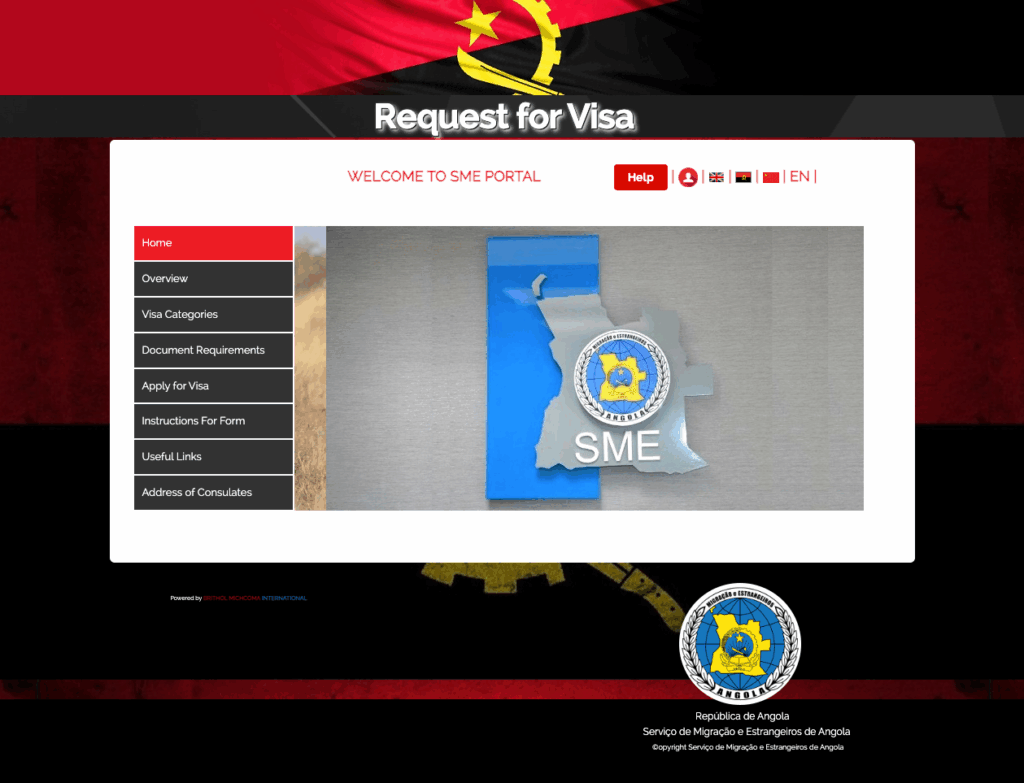
The Angola e-Visa procedure is carried out on the official portal of the Serviço de Migração e Estrangeiros (SME), redesigned on 31 August 2026 and available in Portuguese and English. The first step is now unavoidable: create a personal account. Without an account no application can be opened — and that account is strictly personal: you cannot file someone else's application from your own space. The portal also remains known for its technical rigour: a file that is incorrectly sized, too large, or in a non-compliant format will systematically result in the rejection of the application, without a clear notification of the reason. It is therefore advisable to meticulously prepare each document before beginning data entry.
- 1Gather your documents
Prepare all required documents (see next section) while strictly adhering to the technical specifications: file formats, maximum file size, pixel dimensions. The portal automatically rejects any non-compliant document.
- 2Create your account on the SME portal
Creating a personal account (email address or phone number) has been a compulsory prerequisite for any application since the 31 August 2026 overhaul. The account is strictly personal: every traveller needs their own.
- 3Complete the online form
From your personal space on the official SME portal. Enter your personal details, your itinerary (entry and exit dates, arrival airport), your accommodation address in Angola, and the contact details of your point of contact on the ground.
- 4Upload your supporting documents
Upload each digital document into the form. Verify that each file meets the portal's specifications before submitting (JPEG format for the photo and passport copy, precise dimensions and file size).
- 5Pay the visa fee online
Payment is made directly on the portal at the end of data entry. Until it is confirmed, the application is not considered filed and is not examined. As the SME has not yet republished its fee schedule, the exact amount is displayed at this step.
- 6Submit and wait
After payment, the Angolan immigration services review your application. The SME announces a decision within 72 hours, but this may take longer during busy periods or if additional checks are required. Submit your application at least 15 days before departure.
- 7Receive your visa by email
If approved, the visa is emailed to you. Print it and keep it safe: it is required for boarding. Without this document, the airline will not allow you to board.
- 8Arrival in Luanda: border control
At Luanda airport, present your visa, passport and supporting documents to immigration officers, who complete your admission. There is no longer a payment counter or any fee to settle on the spot. The exact duration granted is generally aligned with your return ticket and hotel booking dates.
Never purchase a non-refundable plane ticket before initiating your pre-authorisation procedure and confirming your eligibility. Planning ahead means avoiding the stress of a last-minute boarding refusal — and the financial loss of a wasted ticket.
04 · Required documents
Assembling a compliant application: all documents to prepare
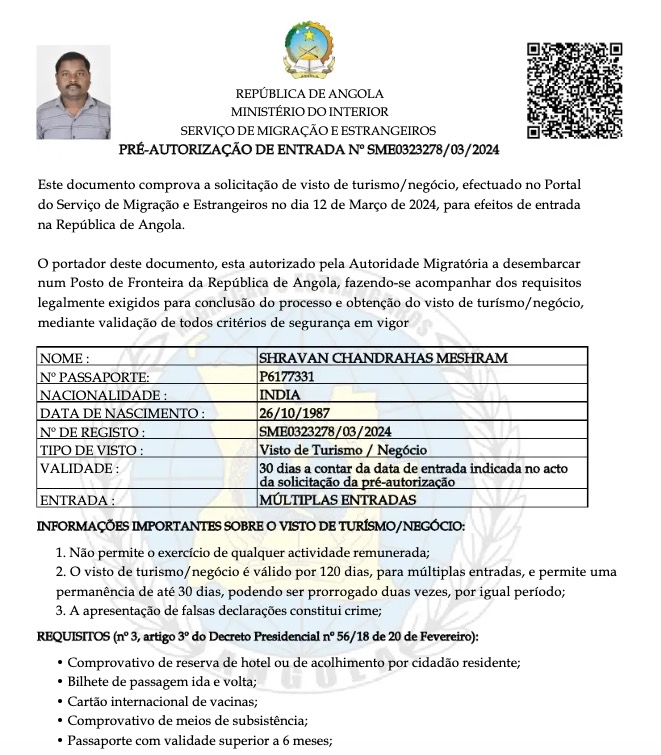
To obtain your e-Visa pre-authorisation, you must submit a digital application that meets very precise technical requirements. The official Angolan portal tolerates no approximation: a file that is too large, incorrectly sized, or in a non-compliant format will systematically result in the rejection of the application. Here is the complete list of documents and information to gather before beginning data entry.
Information about the stay:
- Arrival airport — generally Luanda.
- Full accommodation address in Angola (Address of stay): name and address of the hotel or lodging.
- Contact person details (Contact person): copy of the identity document of the host or host company, postal address, phone number, and email.
- Passport copyValid for at least 6 months after the arrival date. Personal data page and photo only. JPEG format, maximum size: 70 KB.
- Recent identity photoWhite background, standard format. JPEG format, width 381–571 px, height 496–744 px, max size 200 KB.
- Copy of plane ticketReturn booking confirming entry and exit dates.
- Proof of financial meansDocuments demonstrating sufficient funds to cover the duration of the stay.
- Proof of accommodationInvitation letter and/or hotel booking confirmation with full contact details.
- International yellow fever vaccination certificateMandatory for all travellers. Vaccination must be carried out at least 10 days before travel. Yellow booklet physically checked at Luanda airport.
- Invitation letter from the Angolan companySpecifying the purpose of the visit, its duration, and the full contact details and legal references of the host company.
- Letter from your employer or your own companyOn company letterhead, confirming your position and the professional purpose of the trip.
- Documentation from the host entity in AngolaBusiness registration, address, and name of the responsible contact person for your stay.
The international yellow fever vaccination certificate is mandatory for all travellers, without exception. Vaccination must be carried out at least 10 days before travel to be recognised as valid. The yellow booklet is physically checked at Luanda airport: without this document, entry into the country may be refused. It is therefore impossible to get vaccinated the day before departure.
The documents making up your application must be perfectly consistent with each other: ticket dates, declared accommodation address, invitation letter, and the applicant's identity must form a coherent whole without contradictions. The slightest inconsistency may trigger automatic rejection by the portal or requests for additional checks by Angolan immigration services, significantly extending processing times.
05 · Validity & fees
Validity mechanism, multiple entries and arrival fee
The validity structure of the Angolan e-Visa combines several distinct concepts that must not be confused. The pre-authorisation has its own lifespan, independent of the length of stay permitted once the border has been crossed.
The pre-authorisation must be used within 60 days of its issuance date. If this deadline passes without entry into the territory, it becomes void and a new application is required.
At each entry, the visa issued authorises a stay of up to 30 days. The exact duration granted by immigration officers is generally aligned with the return ticket and hotel booking dates.
The visa is issued with multiple entries: you may leave and return to Angola several times during the total validity period (up to 120 days after issuance, within the annual quota of 90 days).
The tourist visa may be extended once, for a maximum of 30 additional days, through the SME in Luanda before the initial visa expires. This administrative process requires patience and payment of local fees.
Regarding fees, the Angolan system is based on two distinct financial components:
- Service fees for processing the online pre-authorisation cover expert guidance and verification of the application's compliance before submission to the portal.
- The visa fee, collected by the Angolan authorities online, at the time of application since 31 August 2026. It is the same for both the tourist visa and the business visa. As the SME has not yet republished its fee schedule on the new portal, the exact amount is shown at the payment step; it stood at 120 USD €107.05 under the former arrangement.
Reference amount under the former arrangement, identical for tourism and business — the exact amount is shown at the payment step
Remember the new mechanics: everything happens before departure. Personal account, form, supporting documents, online payment — then the SME's decision within 72 hours and the visa received by email. In Luanda, immigration officers simply check that visa and your supporting documents before admitting you: there is no longer a payment counter or any fee to settle in cash.
06 · Before you depart
Common mistakes and tips for a trouble-free journey
Angola remains a destination whose formalities can surprise travellers accustomed to more traditional systems. Every year, travel plans are jeopardised for perfectly avoidable reasons. Here are the most common pitfalls, and how to avoid them.
- Confusing a business visit with paid work. Since December 2023 a meeting, a negotiation or a prospecting trip is covered by the visa exemption. However, coming to perform paid services, a technical assignment under contract, or to take up a post in Angola requires a work visa obtained before departure. The actual purpose of the trip always takes precedence over the document presented.
- Ignoring the technical file specifications. A photo of several megabytes, a passport copy in the wrong format, or a file outside the required dimensions will be systematically rejected by the portal. These unintuitive technical standards are the second most common cause of application failure.
- Forgetting the yellow fever certificate. Many people think this is merely a health recommendation. In fact, this document is mandatory, physically checked in Luanda, and the vaccination must have taken place at least 10 days before travel. It is impossible to get vaccinated the day before departure.
- Assuming you will pay on arrival. That was the rule until 31 August 2026; it no longer is. The fee is paid online, at the time of application, and the file is not even examined until payment is confirmed. Make sure you have a valid means of payment before starting, and be wary of guides or forums published before the summer of 2026, which still describe cash payment in Luanda.
- Leaving it too late. Initiating the application just a few days before departure leaves no margin if processing takes longer than expected or if a document needs to be corrected. Allow at least 15 days.
- Presenting a passport close to expiry. The 6-month residual validity rule is strictly applied. A passport valid for 5.5 months may be enough to cause a refusal — check its expiry date before even starting the process.
- Check passport validityAt least 6 months after the planned arrival date in Angola.
- Determine your status (visa exemption or e-Visa required)Check whether your nationality is among the 99 exempt. The exemption covers tourism, family visits and business travel, but never paid work, studies or relocation.
- Yellow fever vaccination checkMedical appointment to be made at least 10 days before departure. Yellow booklet to be kept and presented on arrival.
- Prepare application documents according to specificationsJPEG photo with correct dimensions, passport copy ≤ 70 KB, return ticket, proof of accommodation, proof of financial means.
- Submit the pre-authorisation application at least 15 days before departureTo allow time to correct a non-compliant document or to wait for any extended processing delay.
- Print the visa received by emailMandatory document to be presented to the airline and to Angolan immigration officers.
- Pay the visa fee online, at the time of applicationHave a valid means of payment ready: until payment is confirmed, the SME does not examine the file. Cash payment on arrival has not existed since 31 August 2026.
- Check the planned length of stay and number of entriesThe exemption is capped at 30 days per entry, 3 entries per calendar year and 90 cumulative days per year. Beyond that, a short-stay visa must be obtained before departure.
- Do not import more than 5,000 USD (or equivalent) in currencyAngolan authorities cap the amount of currency each traveller may bring in. Keep your cash within that limit and declare whatever must be declared.
- For a business visa: prepare invitation lettersLetter from the Angolan company + letter from your employer + documentation from the host entity — all consistent with the ticket dates.
Whatever your country of departure, check your national authorities' safety advice before travelling: the situation varies greatly from one region to another.
- Cabinda (city and province) and the provinces of Lunda Norte and Lunda Sul are formally advised against except for imperative reasons: local tensions, banditry and sensitive areas linked to oil and mining (diamond) operations.
- Landmines and unexploded ordnance (UXO): decades of conflict have left mined areas off the main roads in several provinces. Never leave the main roads without reliable local guidance.
- Major cities, including Luanda: urban crime (bag-snatching, muggings) calls for increased vigilance, especially at night. In its 5 March 2026 update, the US State Department keeps Angola at Level 2 ("Exercise Increased Caution") but rates the greater Luanda metropolitan area at Level 3 ("Reconsider Travel"), because of a high risk of armed robbery, assault and carjacking.
- Cholera: Angola has seen recurring outbreaks since 2023, with active cases reported in 2026 in the provinces of Benguela, Malanje, Huíla, Icolo e Bengo and in Luanda. Be especially careful with hand hygiene and the quality of drinking water and food. Heavy seasonal rains also cause flooding and mudslides in Luanda and Benguela.
- Gatherings: demonstrations can turn violent; avoid all crowds and follow the instructions of local authorities.
The Cabinda exclave is not connected to the rest of Angola by road without crossing the territory of the Democratic Republic of the Congo. An overland journey between Cabinda and the rest of the country therefore requires obtaining DRC visas and entry authorisations beforehand, in addition to your Angolan documents: without those valid documents, entry will be refused. Allow enough time for these formalities, or favour the domestic air link.
Angola has considerably simplified access: 99 nationalities can now enter without any prior formalities, for tourism as well as for a family visit or business travel, within the limits of 30 days per entry, 3 entries and 90 days per calendar year. Only paid work, studies, planned medical treatment and relocation still require a visa obtained before departure. For non-exempt nationalities the system changed on 31 August 2026: a compulsory personal account, application and fee payment entirely online, a decision announced within 72 hours and the visa received by email. Cash payment on arrival in Luanda is a thing of the past, but the portal still demands an exceptional level of documentary rigour. The yellow fever vaccination certificate is a non-negotiable requirement. By submitting your application at least 15 days in advance and meticulously preparing each document, travel to Angola is perfectly accessible — including for business travellers from around the world.
Safety
Travel advisories for Angola
The vigilance level recommended by five foreign ministries, on a shared scale.
Average level
Crime, unrest, health risks and landmines; some areas are advised against and road travel remains difficult.
- Read the advice

US Department of StateAdvice dated March 5, 2026
Increased caution · Angola - Level 2: Exercise Increased Caution
- Read the advice

Global Affairs CanadaAdvice dated October 13, 2026
Increased caution · Angola — Exercise a high degree of caution (with regional advisories)
- Read the advice

German Federal Foreign OfficeAdvice dated October 13, 2026
Normal precautions · Angola: Travel and Security Warnings
- Read the advice

UK Foreign Office (FCDO)Advice dated May 28, 2026
Increased caution · Angola travel advice
- Read the advice

France DiplomatieAdvice dated September 15, 2026
Increased caution · Angola: Travel Advice
Levels published by the ministries cited, reproduced unchanged. Visamundi is a private agency with no ties to these administrations.
FAQ
Frequently asked questions
