Available travel documents
Choose the visa that fits your trip. Fully online process, real-time tracking.
Business e-Visa (single entry)
Visamundi service: €39 incl. VAT
Consular fee: ≈ €215(240 USD)
Electronic visaDigital Arrival Card
Visamundi service: €29 incl. VAT
Arrival cardEasy Visitor Permit (30 days)
Visamundi service: €39 incl. VAT
Consular fee: ≈ €45(50 USD)
Electronic visaEasy Visitor Permit (60 days)
Visamundi service: €39 incl. VAT
Consular fee: ≈ €45(50 USD)
Electronic visaLocated in the South Pacific, northeast of Australia, Papua New Guinea is one of the most fascinating and least visited destinations on the planet. To enter the country, every international traveller must obtain authorisation online before departure: the visa on arrival has been suspended by the Immigration and Citizenship Authority (ICA). Visamundi assists travellers in preparing and submitting their application file according to the categories defined by the ICA — Easy Visitor Permit 30 days, Easy Visitor Permit 60 days and single-entry Business e-Visa — for a smooth departure to this extraordinary destination.
01 · The essentials
Before you leave: what you need to know about the PNG visa
The visa on arrival is suspended: every traveller must apply online before departure, regardless of nationality.
In addition to the visa, every traveller must complete the Digital Arrival Card (DAC) online within 72 hours before arriving on the territory.
The document list is quite extensive even for a simple tourist stay; allow sufficient time to prepare your application before departure.
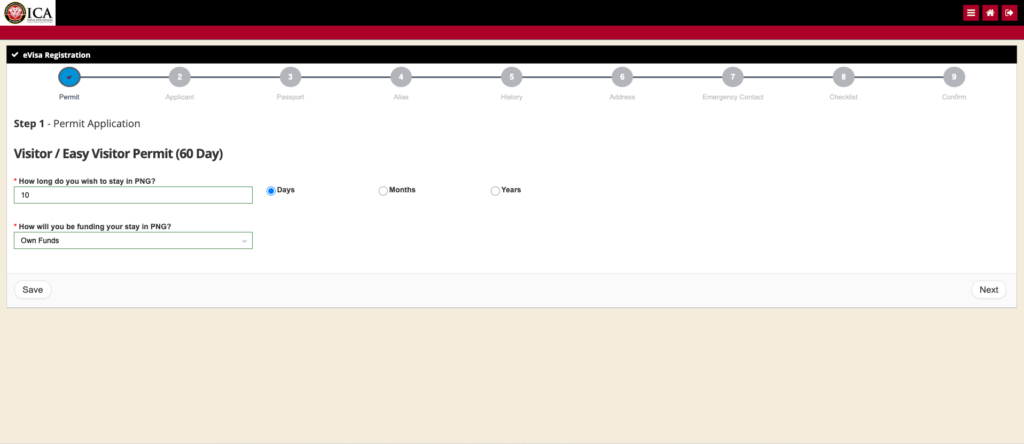
The Papua New Guinea authorities require all foreign nationals wishing to enter the territory to obtain an electronic visa before departure. The visa on arrival — formerly issued at certain entry points — has been suspended: all applications must now be submitted online via the official portal of the Immigration and Citizenship Authority (ICA). This rule applies regardless of the traveller's nationality, including nationals of countries that are normally visa-exempt in other parts of the world.
There are three distinct travel documents, each corresponding to a specific profile and purpose of stay. Choosing the wrong category can result in refusal of entry, deportation or a fine: it is therefore essential to select the correct visa type from the outset. These three authorisations are issued exclusively as single-entry electronic documents. The document received by email must be printed or displayed on a mobile device on arrival, together with a valid passport.
In addition to the visa, the authorities have introduced a separate mandatory formality: the Digital Arrival Card (DAC). This digital form must be completed online within 72 hours before arrival on the territory. Failure to do so may result in refusal of entry, even if the visa has been approved by the ICA.
- Nature of documents
- e-Visa (single-entry electronic visa)
- Competent authority
- Immigration and Citizenship Authority (ICA)
- Visa on arrival
- Suspended — application mandatory before departure
- Available formats
- Easy Visitor Permit 30 days, Easy Visitor Permit 60 days, Business e-Visa
- Covered purposes (EVP)
- Tourism, leisure, family visits, conferences, events
- Covered purposes (Business)
- Meetings, board meetings, conferences, negotiations
- Official currency for ICA fees
- USD (since 1 November 2019 — Visamundi payment in euros)
- Mandatory additional formality
- Digital Arrival Card (DAC) to be completed online — 72 hours before arrival
02 · Eligibility
Who can apply for which visa? The four nationality groups
The ICA has defined four nationality groups, each giving access to different visa categories. It is essential to know your group before starting an application, as the eligible category depends directly on the nationality of the passport presented.
Group A — Full access (30 days + 60 days + Business)
Group A nationals can apply for all three available visa types. These include notably: Australia, Brunei, Canada, Chile, Cyprus, South Korea, United States (including territories), Fiji, Hong Kong, Indonesia, Japan, Kiribati, Macau, Malaysia, Malta, Mexico, Nauru, New Zealand (including territories), Philippines, Samoa, Singapore, Solomon Islands, Thailand, Tonga, Tuvalu, United Kingdom, Vanuatu.
Group B — Europe and equivalent (60 days + Business only)
Group B nationals only have access to the Easy Visitor Permit 60 days and the Business visa. This group includes all Schengen area countries and equivalents: Germany, Andorra, Austria, Belgium, Bulgaria, Croatia, Denmark, Spain, Estonia, Finland, France (including Overseas territories), Greece, Hungary, Ireland, Iceland, Italy, Latvia, Liechtenstein, Lithuania, Luxembourg, Monaco, Norway, Netherlands (including Antilles), Poland, Portugal, Romania, San Marino, Slovakia, Slovenia, Sweden, Switzerland, Czech Republic, Vatican, as well as other countries such as Argentina, Brazil, Ecuador, Israel, Maldives, Marshall Islands, Micronesia, Palau, Taiwan, Uruguay, American Samoa.
French and European nationals in general belong to Group B: they are eligible for the EVP 60 days and the Business e-Visa, but not for the EVP 30 days.
Group C — Commonwealth and specific countries (30 days only)
Group C nationals can only apply for the Easy Visitor Permit 30 days. This group includes notably: Antigua and Barbuda, Bahamas, Barbados, Belize, Botswana, Dominica, Grenada, Guyana, Lesotho, Mauritius, Russia, Seychelles, St Kitts and Nevis, Saint Lucia, Saint Vincent, Trinidad and Tobago, Vietnam.
Group D — India (30 days + Business)
Indian nationals constitute a special case: they are eligible for the EVP 30 days and the Business e-Visa, but not for the EVP 60 days.
Eligible for the Easy Visitor Permit 60 days and the Business e-Visa. The EVP 30 days is not accessible to them.
Group A: access to all three visa types — EVP 30 days, EVP 60 days and Business.
The ICA does not authorise more than 4 uses of the EVP 30 days per year for the same traveller.
The ICA may grant an extension in limited situations for the 60-day version. The 30-day version cannot be extended.
03 · The procedure
How to apply for your visa step by step
- 1Choose the right category
Identify your nationality group (A, B, C or D) and the type of stay planned (tourism, business). Then select the Easy Visitor Permit 30 days, the EVP 60 days or the Business e-Visa according to your profile.
- 2Fill in the online form
Indicate the visa type requested, your travel dates, your nationality and your personal details. The form is available online and guides you through each step.
- 3Pay the government fees and service charges
Payment is made securely online. Official fees are denominated in USD in accordance with ICA rules (National Gazette No. 231 of 27 March 2019). With Visamundi, you pay in euros.
- 4Upload supporting documents
Valid passport, compliant digital identity photo, return flight ticket, proof of sufficient financial means, proof of accommodation. For the Business visa: official invitation letter, employer letter, schedule of appointments.
- 5Review by an advisor
Each file is checked against the requirements published by the ICA. Any anomalies are identified and corrected before submission to maximise the chances of acceptance.
- 6Submission via the official portal
The complete application is transmitted through the official ICA channel. A tracking number allows you to monitor progress in real time.
- 7Receipt of visa by email
The electronic visa is sent by email as soon as it is issued. Print the document or save it to your phone: you will need to present it at check-in and at border control together with your passport.
- 8Complete the Digital Arrival Card (DAC)
Within 72 hours before your arrival in Papua New Guinea, complete the Digital Arrival Card online, either yourself on the ICA portal or by letting Visamundi handle it. This formality is mandatory and separate from the visa. Failure to do so may result in refusal of entry even if your visa is valid.
Visamundi handles it· €29 incl. VAT
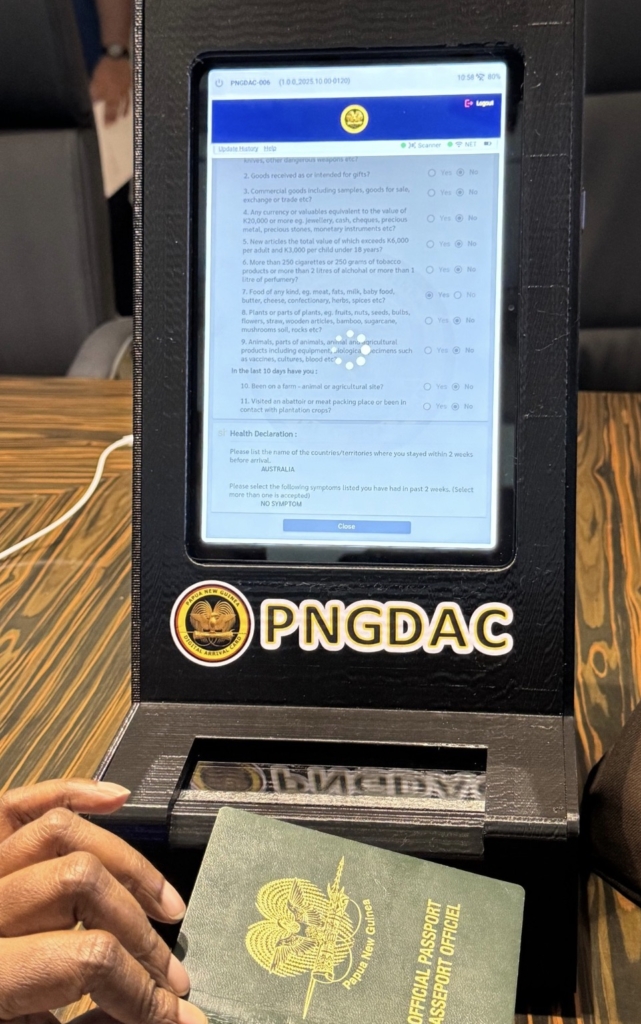
The Digital Arrival Card: a mandatory formality not to be forgotten
In addition to the visa, the Papua New Guinean authorities have introduced a separate digital formality: the Digital Arrival Card (DAC). This online form must be completed within 72 hours before arrival on the territory. It records the visitor's travel information and facilitates entry checks.
The DAC is mandatory for all travellers, regardless of their nationality or the type of visa held. A traveller presenting themselves at border control without having completed their Digital Arrival Card may be refused access to the territory, even if their visa has been approved by the ICA. It is therefore strongly recommended to complete this form as soon as possible in the 3 days before departure.
If you would rather not deal with it yourself, Visamundi can complete and submit the Digital Arrival Card for you, based on your travel details.
04 · Required documents
The complete file according to the type of visa applied for

The document list published by the ICA is common to both versions of the Easy Visitor Permit, with additional requirements specific to the Business visa. It is important to note that additional documents may be requested depending on the applicant's nationality or particular profile.
Documents common to the EVP 30 and 60 days
- Valid passport with at least two blank pages available. The document must remain valid for at least 6 months after the intended end date of the stay.
- Recent digital identity photo on a light background. The ICA's format requirements are strict (dimensions, resolution, background). An automatic normalisation service allows compliance to be verified before submission.
- Return flight ticket or proof of onward travel to a third country.
- Proof of sufficient financial means: recent bank statement, employer letter or sponsorship declaration.
- Proof of accommodation: confirmed hotel reservation, invitation letter from a local contact or detailed itinerary.
- Official invitation letter from the host entity in Papua New GuineaThe letter must specify the purpose of the mission, the dates, the intended duration and, where applicable, the commitment to cover the costs of the stay.
- Letter from your home employerConfirmation of your position in the company, your professional activity and the purpose of the mission in PNG.
- Extract from the commercial register or equivalent documentFor self-employed individuals and company directors. The required document varies depending on the country of activity.
- Provisional schedule of meetings and visitsList of meetings, people met, addresses of sites visited or conferences attended.
05 · Pitfalls to avoid
The six most common mistakes when applying for a PNG visa
The ICA is strict about the compliance of application files. An incomplete or inconsistent file can result in refusal with no possibility of correction on the spot. Here are the most frequently observed mistakes and how to avoid them.
A coloured background, insufficient lighting or an outdated photo leads to automatic rejection. Check that your photo is compliant before submitting it.
The passport must remain valid for at least 6 months after the end of the stay. A passport expiring within 6 months of your return will result in refusal.
An Easy Visitor Permit does not cover business activities. A Business e-Visa does not cover paid local employment. Choosing the wrong category risks refusal of entry at the airport.
For the Business visa, the invitation letter from the host entity is mandatory and must be signed by an authorised representative. An unsigned or incomplete document is sufficient to block the application.
The ICA does not authorise more than 4 uses of the Easy Visitor Permit 30 days per year for the same traveller. A fifth application within the year will be refused. If you plan multiple annual trips to Papua New Guinea, take this limit into account from the planning stage.
Furthermore, do not underestimate processing times. Always submit your application several weeks before the departure date. A file submitted too late leaves no margin in the event of a request for additional documents or an extended processing period.
Finally, do not forget the Digital Arrival Card: it must be completed within 72 hours before arrival. Make sure to include it in your travel preparation routine, just like online check-in.
06 · Before you leave
Papua New Guinea: planning your trip in practice
Papua New Guinea is one of the most logistically demanding destinations in the world, but also one of the most extraordinary. Its exceptional biodiversity, hundreds of local cultures and landscapes ranging from high volcanic mountains to some of the world's richest coral reefs make it a unique destination. To approach this trip in the best possible conditions, several practical aspects deserve particular attention.
- Local currency
- Papua New Guinean Kina (PGK) — bank cards accepted in urban areas, cash recommended outside cities
- ICA visa fees
- Denominated in USD (payment in euros with Visamundi)
- Official languages
- English, Tok Pisin, Hiri Motu — English is used in administrative exchanges
- Road network
- Limited — many provinces are only accessible by plane
- Domestic transport
- Domestic flights available, but subject to delays or cancellations depending on the weather
- Main entry point
- Port Moresby (Jacksons International Airport)
- Passport required
- Valid for at least 6 months after the end of the stay, with a minimum of 2 blank pages
The capital, Port Moresby, is the country's main international entry point and serves as a base for reaching the different regions. It reflects the typical contrast between modern infrastructure and vibrant local traditions. Beyond the capital, each province has a strong cultural identity: the highlands, the province of Madang, the Trobriand Islands archipelago or the Kimbe region offer radically different experiences.
The national road network remains limited, and a large part of the territory is only accessible by plane. Domestic airlines may experience delays or cancellations depending on weather conditions — sometimes unpredictable in tropical mountain regions. It is strongly advised to allow a safety margin of at least 24 hours before any international return flight.
The three official languages — English, Tok Pisin and Hiri Motu — coexist with several hundred local languages. However, English is widely used in hotels, administrative exchanges and services for international travellers. For the most remote areas, the presence of a local guide or interpreter is strongly recommended.
- Passport valid for a minimum of 6 months after the intended return dateAlso check that it has at least 2 blank pages for entry and exit stamps.
- Electronic visa received by email and ready to be presented (printed or on phone)Keep a digital copy and a paper copy in your luggage.
- Digital Arrival Card completed online within 72 hours before arrivalAvailable on the official ICA portal. Remember to complete it before boarding.
- Return flight ticket or proof of onward travelAn exit ticket from the territory is required by the ICA at border control.
- Proof of accommodation for the entire duration of the stayConfirmed reservation, invitation letter or detailed itinerary.
- Proof of sufficient financial meansRecent bank statement, employer letter or sponsorship declaration.
- Digital identity photo compliant with ICA standardsLight background, recent photo, format and resolution compliant with requirements.
- For the Business visa: invitation letter and mission scheduleOfficial document signed by the host entity in PNG, plus the provisional schedule of appointments.
- Carry cash in Papua New Guinean kina for areas outside the main citiesBank cards are not accepted everywhere, particularly in remote regions.
- Safety margin before the international return flightDomestic flights can experience significant delays. Allow at least 24 hours of margin.
Papua New Guinea is an extraordinary destination, both demanding on the administrative side and unforgettable in human and natural terms. The golden rule is simple: plan ahead. The electronic visa must be applied for well in advance, in the correct category, with a complete file. The Digital Arrival Card must be completed within 72 hours before arrival. By complying with these formalities, entry to the territory proceeds in the best possible conditions — and the adventure can begin.
Safety
Travel advisories for Papua New Guinea
The vigilance level recommended by five foreign ministries, on a shared scale.
Average level
Crime, civil unrest and piracy, with some areas advised against except for essential travel; the UK also reports water and electricity supply interruptions.
- Read the advice

US Department of StateAdvice dated April 29, 2025
Reconsider travel · Papua New Guinea - Level 3: Reconsider Travel
- Read the advice

Global Affairs CanadaAdvice dated September 24, 2026
Reconsider travel · Papua New Guinea — Avoid non-essential travel
- Read the advice

German Federal Foreign OfficeAdvice dated October 13, 2026
Normal precautions · Papua New Guinea: Travel and Security Advice
- Read the advice

UK Foreign Office (FCDO)Advice dated August 17, 2026
Increased caution · Papua New Guinea travel advice
- Read the advice

France DiplomatieAdvice dated September 15, 2026
Increased caution · Papua New Guinea: Travel Advisory
Levels published by the ministries cited, reproduced unchanged. Visamundi is a private agency with no ties to these administrations.
FAQ
Frequently asked questions
