
Singapore Arrival Card now easier to fill out
The Singapore arrival card has been redesigned in late August with a new interface, now offering 19 languages instead of 12, and automatic pre-fill by scanning your passport.
This version was already available on the Immigration & Checkpoints Authority (ICA) website. Since September 30, 2026, it is also included in the MyICA app, which you will need to update to continue submitting the arrival card from your phone.
What has changed on the arrival card
The ICA has improved the user experience of the service. The home page now separates two pathways: I am a Resident, for Singaporean citizens, permanent residents, and holders of long-term work, dependant, or visit passes, and I am a Visitor, for tourists, business travelers, and persons holding a letter of in-principle approval. Each user then chooses between automatic pre-fill using a passport scan and manual entry.
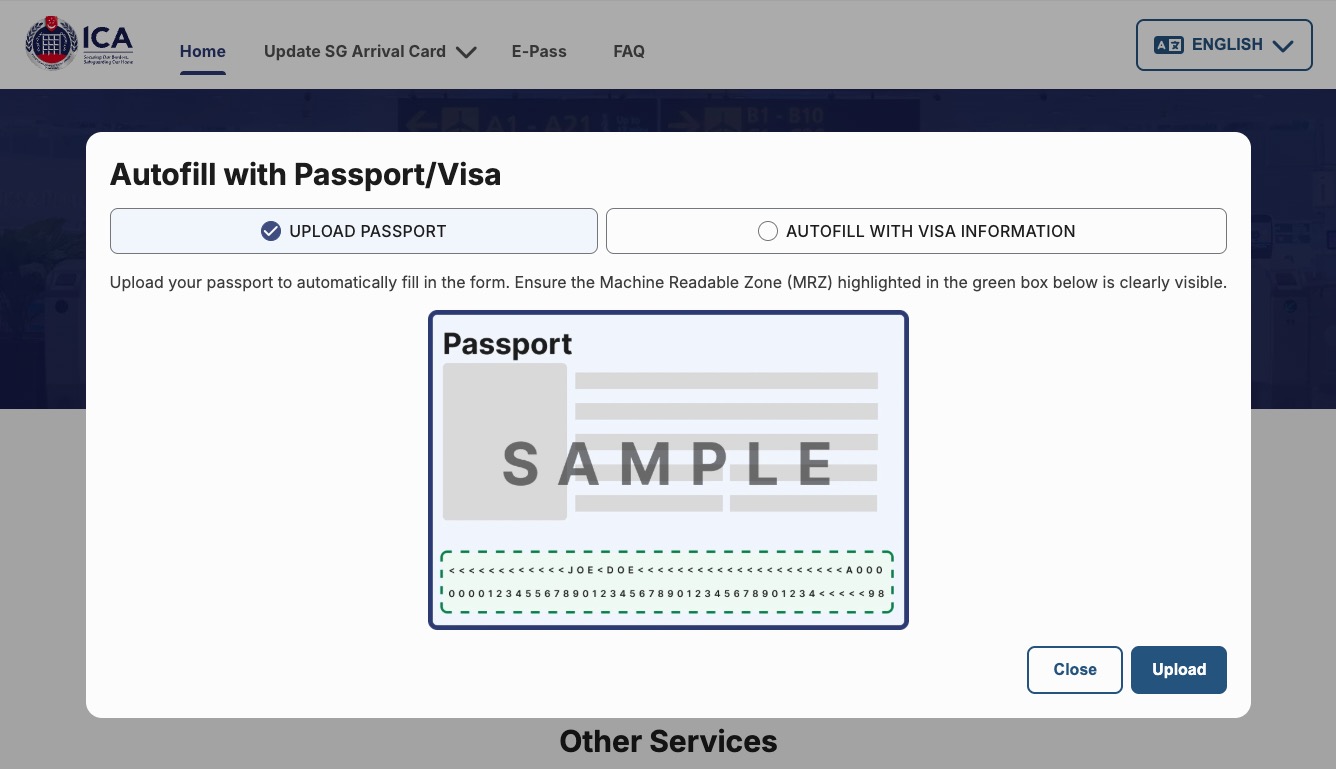
The most noticeable change for a foreign traveler is the Autofill with Passport/Visa button on the official submission service. Instead of re-entering personal details and document numbers, passengers can simply photograph the data page of their passport, and the fields will auto-fill. The MyICA app page published by the ICA describes the same mechanism: filling in personal information by scanning the biographical page of the passport.
Taiwan introduced a similar system when it launched its digital arrival card, indicating that passport scanning is gradually becoming the standard for these types of forms.
In terms of languages, the official submission service now offers 19 options. Added to the previously available languages are Arabic, Indonesian, Dutch, Spanish, Russian, Filipino, and Italian. French is available—alongside German, Japanese, Korean, Thai, Vietnamese, Hindi, Bengali, Tamil, simplified Chinese, Malay, and English. For an airport handling tens of millions of passengers from around the world each year, having fewer barriers when filling out an administrative form in a foreign language is a significant advantage.
An updated website ahead of the mobile app
The new version has been accessible on the ICA website since August 26, 2026—a date noted in the footer of the service. The MyICA mobile app, however, switched over on September 30.
If you usually submit your arrival card using the app, make sure to update it; otherwise, you won't access the new version. This also applies to travelers using MyICA to generate the QR code for land checkpoints from Malaysia, a common practice at Woodlands and Tuas.
Whether you use the website or the app, it does not impact the validity of your submission: both are official channels, and the website remains available if you prefer not to install the app.
Who needs to submit a Singapore Arrival Card—and when
The requirement is broad: all travelers must submit the Singapore Arrival Card, along with the electronic health declaration, before arriving in Singapore. The paper card that used to be handed out on board flights has been discontinued since March 27, 2020, and the ICA no longer accepts it.
The submission must be made within three days before arrival, including the day of arrival itself, as outlined in the service FAQ. A card submitted too early won't be accepted: for a flight arriving on September 30, submissions open on September 28. The ICA justifies this tight timeline for smoother immigration clearance. This short window is a recurring feature of arrival cards, which we explain further in our global overview of arrival cards.
Two groups are exempt: those in transit without seeking immigration clearance and Singaporean residents, permanent residents, or holders of long-term passes who transit in the Woodlands and Tuas land checkpoints—though note that travelers who exit the international transit zone do require a card.
If traveling as a group, one person can submit on behalf of up to ten travelers. The travel details of the first traveler are then copied for all group members, so common itineraries apply. Should an error be discovered—or if there's a flight change—it is possible to amend an already submitted arrival card prior to your travel, thanks to the service's flexibility.

A specialist in regulatory monitoring and a content destination expert, she analyzes daily changes in entry formalities to turn complex administrative processes into practical guides. Her role blends ground-level expertise with technical precision to ensure the reliability of the information provided to travelers.

Get our visa news first in your Google results: add Visamundi to your preferred sources.
