
Tanzania Implements Online Health Form for All Travelers
Since October 17, 2026, all travelers entering Tanzania must complete an online health surveillance form, either before departure or upon arrival.
Previously, only passengers arriving from the Democratic Republic of Congo (DRC) or Uganda were required to complete this form. Tanzanian Ministry of Health has now extended the rule to include a 21-day follow-up for high-risk travelers, even after they have left the country.
New Rule Applies to All Arrivals
The Tanzanian Ministry of Health released the Traveler Advisory No. 18 dated October 17, 2026, signed by its Permanent Secretary, the Dr. Grace E. Magembe. It applies “immediately” to all entry points in the country: airports, land border crossings, and ports.
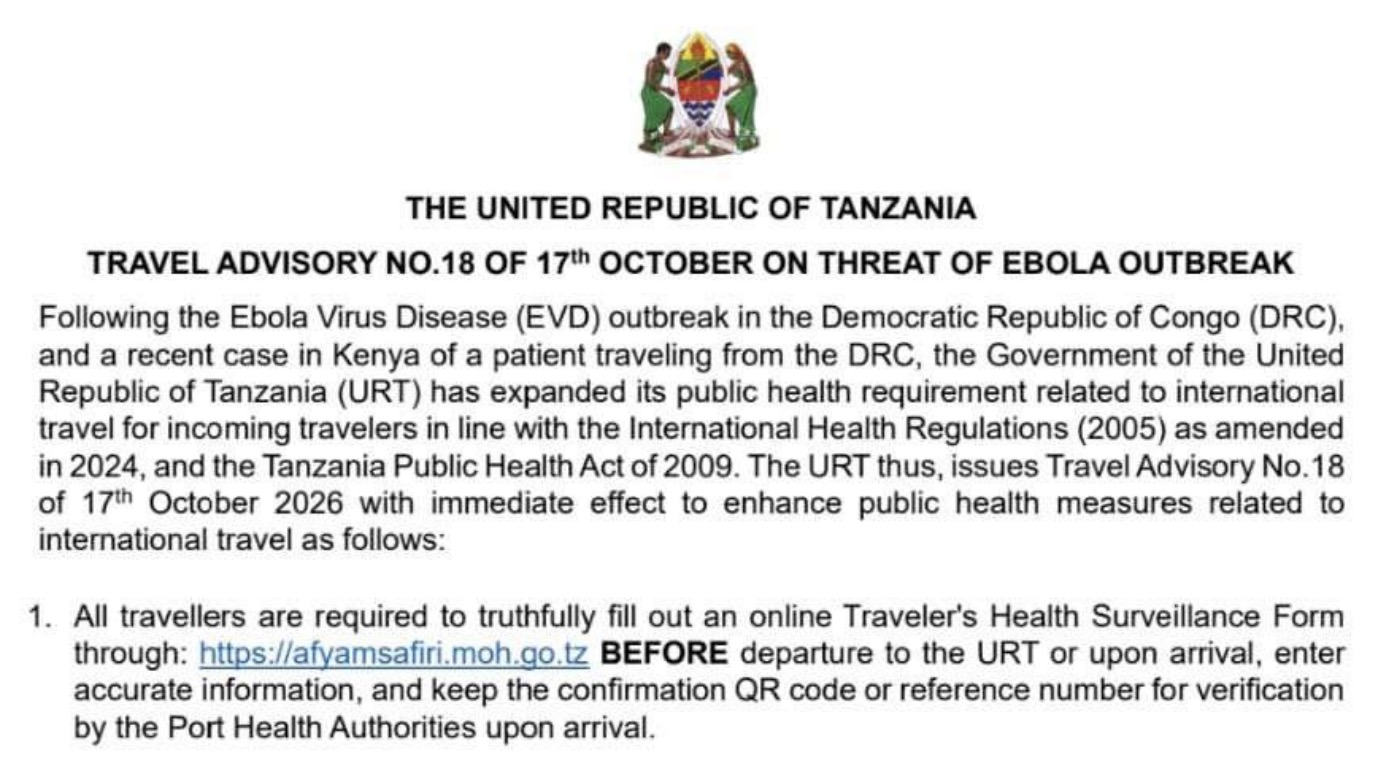
The ministry cited two main reasons for this tightening of rules. First, the ongoing Ebola virus outbreak in the Democratic Republic of Congo. Second, a recent case in Kenya involving a patient arriving from DRC. It is based on the International Health Regulations of 2005, as amended in 2024, and the Tanzanian Public Health Act of 2009.
This obligation applies regardless of nationality. A Senegalese traveler on safari, a Kenyan businessman, or a Belgian family heading to Arusha must all complete the form. Whether entering by air, land, or sea makes no difference. Tanzania now joins other regional nations that have made digital health declarations mandatory for all arrivals, such as Malawi with its online health declaration for entry.
Changes Since the May Advisory Update
This form already existed. Advisory No. 17 dated May 18, 2026, which took effect on May 19, had limited it to travelers arriving from or transiting through DRC or Uganda. It also allowed a paper version, distributed on board or upon arrival.
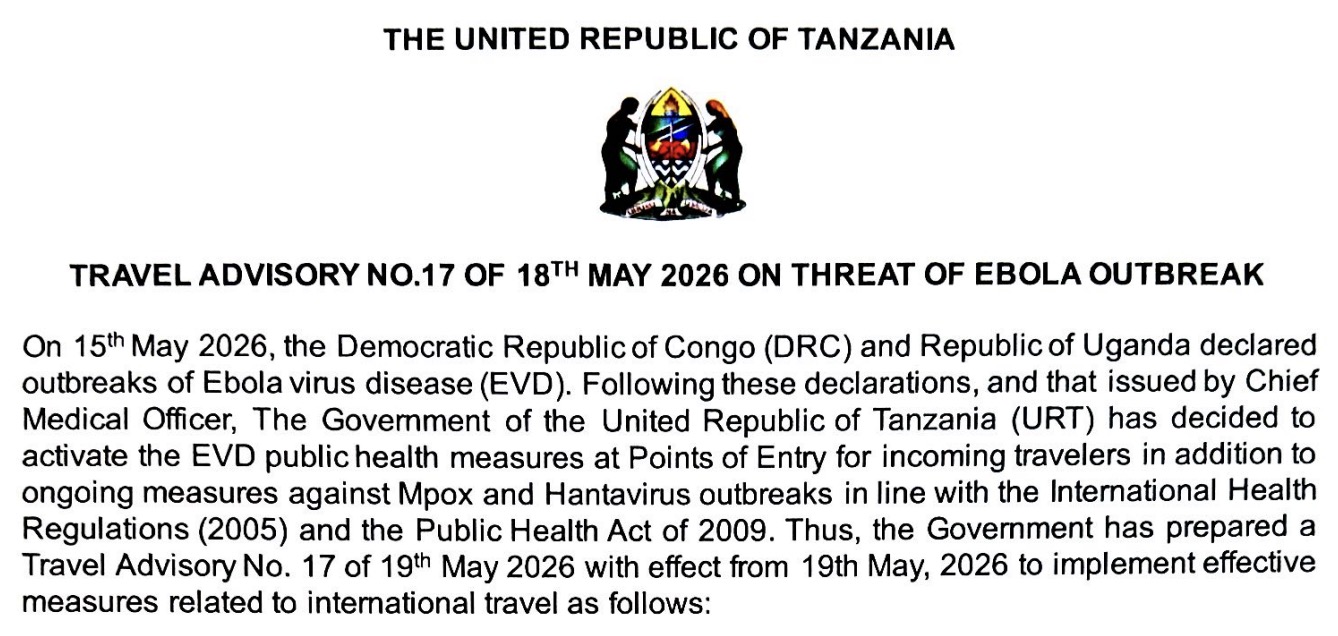
However, the new advisory expands the scope to “all travelers” and removes the mention of a paper form. It also introduces the 21-day follow-up and adds an email contact address, poe@afya.go.tz, to the existing toll-free number 199.
The arrival temperature screening is not new: the May advisory already applied to everyone entering the country. Anyone showing signs of Ebola or another infectious disease will be handled according to national border screening procedures.
Completing the Form on Afya Msafiri
The process must be completed through the official portal Afya Msafiri, managed by the Ministry of Health and available in Swahili, English, and French. Travelers begin by entering their passport or ID number, then complete the various sections of the form. Children traveling with a parent or guardian must also have their own form.
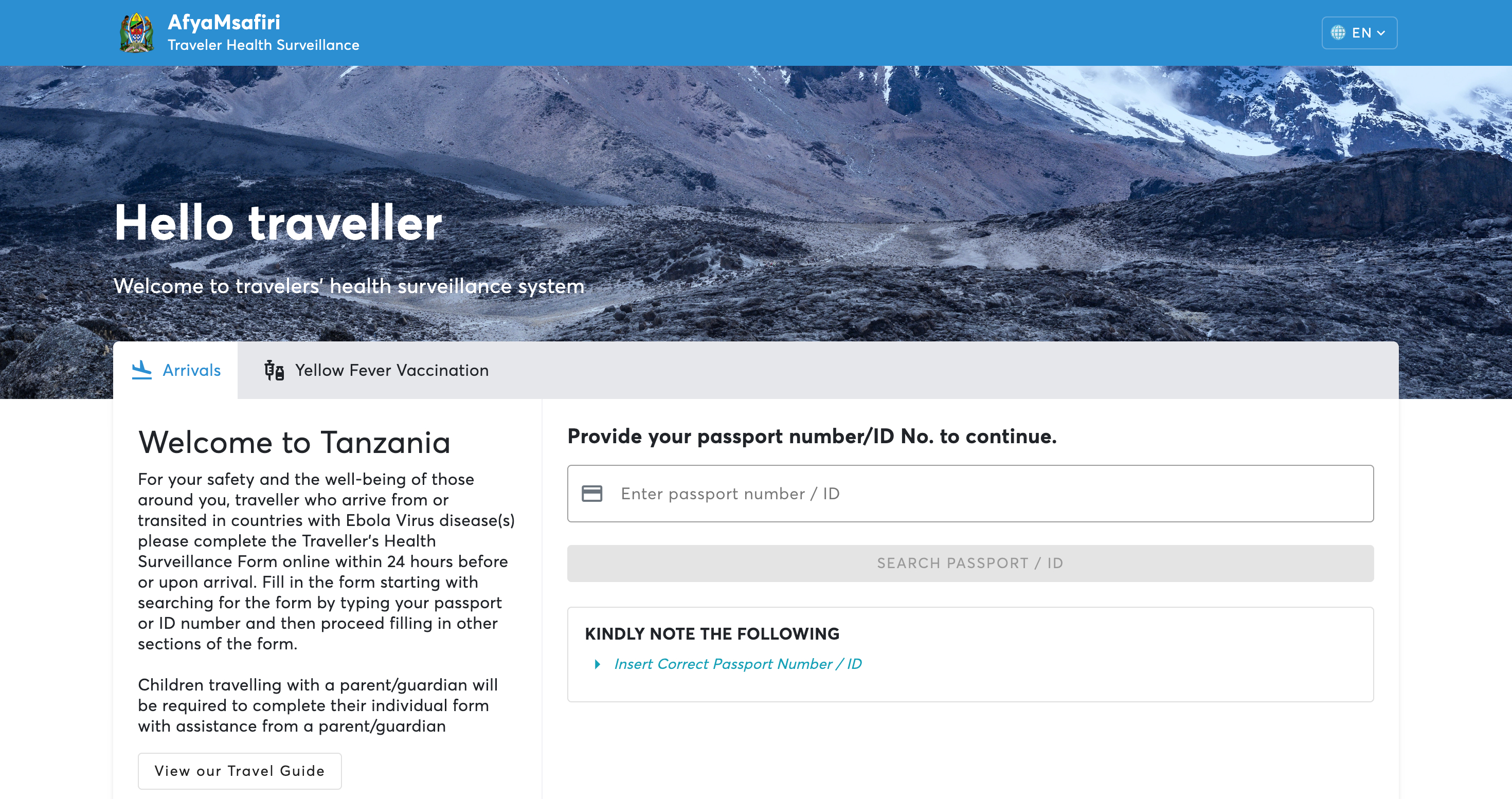
Advisory No. 18 mandates filling out accurate information, then keeping the confirmation QR code or reference number received. This proof is checked by health authorities upon arrival. While the advisory leaves room for when travelers must fill the form—either before entering Tanzania or upon arrival—the homepage of the portal still instructs travelers coming from Ebola-affected countries to complete the form within 24 hours before arrival. The “travel guide” link on the homepage also still points to Advisory No. 17.
However, Advisory No. 18 is the official rule now in force for all travelers, regardless of origin, as confirmed by the Ministry of Health. The advisory does not specify fees or penalties for failure to comply.
The 21-Day Follow-Up Continues Even After Leaving Tanzania
This is the most stringent measure in the advisory. High-risk travelers must undergo mandatory health monitoring for 21 days. They will receive automatic daily messages or other forms of communication to check on their condition.
Those affected must comply and respond to messages for the entire follow-up period, “even after leaving the country,” Advisory No. 18 states. A high-risk traveler spending just a week in Tanzania must continue responding once back home.
The advisory does not list the criteria for high-risk classification. Instead, it delegates this to national border screening protocols at entry and exit points.
All travelers also receive health information upon entry. In case of symptoms, they must report to the nearest health facility, a border entry point, the toll-free number 199, or email poe@afya.go.tz.
Hygiene and Exit Measures
The advisory also imposes preventative measures for travelers and transport operators: handwashing, hydroalcoholic gel use, and limiting unnecessary physical contact. Any vehicle, aircraft, or ship that transported a suspected person, goods, or remains linked to Ebola or another infectious disease will be disinfected at the entry point.
For exiting the country, the Ministry of Health reminds travelers they must also comply with entry requirements of their destination country or transit point. This is important because several states have their own Ebola-related border measures, sometimes including travel bans, as detailed in our guide on border controls for Ebola published in September 2026.
The ministry notes that Advisory No. 18 is subject to revision “from time to time” based on the evolving situation.

A specialist in regulatory monitoring and a content destination expert, she analyzes daily changes in entry formalities to turn complex administrative processes into practical guides. Her role blends ground-level expertise with technical precision to ensure the reliability of the information provided to travelers.

Get our visa news first in your Google results: add Visamundi to your preferred sources.
