
Available travel documents
Choose the visa that fits your trip. Fully online process, real-time tracking.
Electronic visa8
30-day e-Tourist visa
PopularVisamundi service: €39 incl. VAT
Consular fee: ≈ €25(25.75 USD)
1-year e-Tourist visa
Visamundi service: €39 incl. VAT
Consular fee: ≈ €39(41.20 USD)
5-year e-Tourist visa
Visamundi service: €39 incl. VAT
Consular fee: ≈ €189(206 USD)
e-Business Visa
Visamundi service: €39 incl. VAT
Consular fee: ≈ €156(169.95 USD)
e-Conference Visa
Visamundi service: €39 incl. VAT
Consular fee: ≈ €161(175.10 USD)
e-Medical / e-Ayush (patient and companion)
Visamundi service: €39 incl. VAT
Consular fee: ≈ €77(82.40 USD)
e-Mountaineering Visa
Visamundi service: €39 incl. VAT
Consular fee: ≈ €77(82.40 USD)
e-Transit Visa
Visamundi service: €39 incl. VAT
Consular fee: ≈ €20(20.60 USD)
Arrival card1
e-Arrival Card
Urgent departureVisamundi service: €29 incl. VAT
Health declaration1
Air Suvidha
Visamundi service: €29 incl. VAT
Since 2015, India has issued an electronic visa — the e-Visa, first called the "e-Tourist Visa" — operational in most of the country's ports and airports. Everything happens online: no trip to the embassy, no postal mail. You receive a travel authorisation as a PDF, to print and present on arrival so the final visa can be stamped into your passport and your fingerprints taken.
01 · The essentials
Understanding the Indian e-Visa

In 2019, the scheme became considerably more flexible: it allows stays of up to 90 days for tourism and up to 180 days for business travel. People sometimes call it a "visa on arrival", but that's misleading: the e-Visa must be applied for before boarding, and no visa is issued on the spot.
In practice, you complete and pay for your application online, then send a copy of your passport and a passport photo. Once approved, the authorisation reaches you as a PDF. All that's left is to print it and present it on arrival.
The e-Visa is for holders of a passport valid for at least six months from the date of arrival, for each stay in India. The good news: no registration with the FRRO (Foreigners Regional Registration Office) is required as long as the stay does not exceed 180 days — which covers the vast majority of travellers. Beyond 180 continuous days (possible on 1-year or 5-year e-Visas for US, UK, Canadian and Japanese nationals), registration with the FRRO/FRO becomes mandatory within 14 days.
As a reminder, any traveller heading outside the European Union needs a visa to legally enter the destination country. A visa, electronic or traditional, is issued by the destination's authorities and serves as proof of authorisation to stay for a set period. The network of entry points has also grown: a land border crossing opened from Nepal in 2025, at Raxaul.
02 · Who it's for
Who can get an e-Visa for India?
More than 190 nationalities are eligible for the Indian e-Visa. Only nationals of Nepal, Bhutan and the Maldives are fully exempt. Most travellers, whatever their continent of origin, can access it easily.
The Indian e-Visa comes in several types depending on the purpose of travel. The Tourist ETA comes in three durations: the 30-day version now allows multiple entries (it permitted only two before 12 June 2026) and is valid for 4 months; the 1-year version allows multiple entries with stays of up to 90 consecutive days; the 5-year version works the same way over a five-year validity. The Business ETA grants multiple entries, up to 180 days within one year. The Medical ETA (and its e-Ayush variant for ayurveda) allows up to three entries for a cumulative 60 days of stay, with 120 days to make the first entry. There are also the Conference ETA (one entry, 30 days), the Transit ETA (two transits of up to three days) and the Mountaineering ETA, for climbing and trekking.
A passport valid for at least six months from your arrival date is required, for each stay, along with at least two blank pages for the visa and immigration stamps. Your fingerprints are taken on arrival, after the final visa is stamped.
You clear immigration at your first Indian airport, even if it isn't your final destination: that's the one to enter in your application. Domestic flights don't check the visa.
Travellers of Pakistani origin may face difficulties obtaining an e-Visa from the Indian authorities and often fall under a separate process.
03 · How to
The procedure, step by step

Compared with a traditional visa, the e-Visa radically simplifies processing. Thanks to our complete, intuitive form, you handle every step online, with no trip to the nearest Indian embassy to finalise your file.
The copy of your passport and your passport photo are only sent once the application is completed and paid for. All documents are uploaded directly to your account: no postal step is needed.
- 1Online form
You fill in our application form, designed to be clear and quick, with no travel required.
- 2Sending documents
After payment, you upload a copy of your passport and a passport photo — a business card for Business, a hospital invitation for Medical.
- 3Visamundi review
We check the consistency and compliance of your documents before sending them to the Indian authorities, to rule out any risk of rejection.
- 4Receiving the authorisation
Once the authorities approve, you receive your travel authorisation as a PDF.
- 5Presentation on arrival
You present the printed PDF at one of the eligible entry points: the final visa is stamped and your fingerprints taken on the spot.
Although processing is fairly quick, your trip must take place at least five days after the application is filed. Keep in mind too that the e-Visa's validity only starts from your date of arrival on Indian soil, not when the document is issued.
04 · How much
How much does an e-Visa for India cost?
Our form shows a clear, detailed price grid, fully transparent. The price depends on the type chosen — Tourism, Business, Medical, Conference, Transit or Mountaineering — and includes both the consular fees of the Indian authorities and our service fees. Note: prices now vary noticeably by nationality.
From April to the end of June, consular fees drop slightly for the 30-day e-Visa only. A handy thing to know if your trip falls in that period.
05 · New in 2026
The e-Arrival Card, now mandatory
Since 1 April 2026, the Indian authorities have permanently scrapped the paper disembarkation form handed out on the plane. The process is now 100% digital: every foreign national must fill in their e-Arrival Card before travelling. This applies to all international travellers entering the territory, whatever the purpose of the stay (tourism, business, study, medical care), as well as OCI cardholders. Only travellers in transit who do not clear immigration are exempt.
- Deadline
- To submit within the 72 hours before arrival
- Who
- All foreign travellers (tourism, business, study, medical) and OCI cardholders
- Exempt
- Travellers in transit not crossing immigration
- Cost
- Free
- Prepare
- Passport and visa/OCI number, flight number, full address of first accommodation
- Delivery
- A confirmation QR code by email, single use (one entry)

To complete the form calmly and avoid your session expiring on the official portal, gather your documents beforehand. The form requires your identity details (passport and visa/OCI number) as well as the logistics of your stay: keep your flight number and the full address of your first accommodation in India to hand.
Once the form is validated, a confirmation QR code is emailed to you. Keep it on your smartphone or print it: it will be scanned at immigration gates to speed up your entry and officially validate it.
Although the official procedure is free, the very short window before departure makes it stressful. We check the consistency of your data (passport, visa, flights) to rule out any rejection, and submit your application at the right time, as soon as the legal window opens — so you don't have to watch the calendar.
06 · New since June 2026
Air Suvidha 2.0: the mandatory health declaration
In response to the ongoing Ebola outbreak, the Directorate General of Health Services (DGHS) of the Government of India has tightened health checks at its borders. Since June 2026, every passenger arriving in India by air must complete a health self-declaration form on the Ministry of Civil Aviation's Air Suvidha 2.0 portal before departure. It lets the authorities spot high-risk itineraries and assess travellers' health before they even land.
The rule applies to all international passengers without exception, whatever their age, nationality or reason for travel — Indian citizens included. It comes on top of the e-Arrival Card: these are two separate formalities and both must be completed. Airlines check the declaration at check-in, and travellers without one may be denied boarding.
- Deadline
- Within the 24 hours before arrival in India
- With Visamundi
- Order whenever you like: we submit your declaration as soon as the 24-hour window opens
- Who
- All passengers arriving in India by air, of any age and nationality, Indian citizens included
- Exempt
- International transit passengers who stay airside without clearing immigration
- Cost
- Free
- Have ready
- Passport, details of every flight (including stopovers), countries visited in the last 21 days, addresses of your accommodation in India
- Delivery
- A document with a unique QR code, emailed as soon as the form is validated
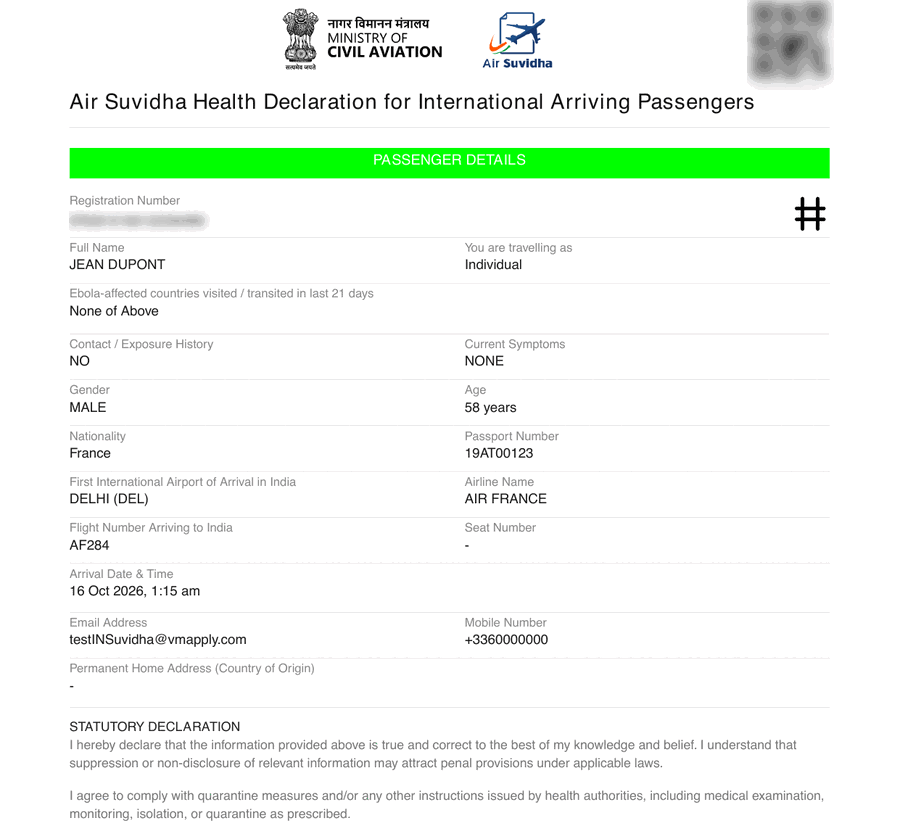
The core of the form is your travel history over the 21 days before arrival. If you have not stayed in any country affected by the outbreak, you simply confirm it. If you have been through a risk area — in particular the Democratic Republic of the Congo or South Sudan — you must declare it, with the exact entry and exit dates for each country. The form also asks about any contact with sick people and about your symptoms.
Next come your arrival details: Indian airport, airline, flight number, and local date and time of landing. If your journey includes one or more stopovers, extra fields appear: every connection must be declared, from your departure airport all the way to India.
| Onward travel | When to choose this option |
|---|---|
| None | Your final destination is the city of your arrival airport. |
| Domestic flight | You are connecting to another Indian airport: give the destination airport and flight details. |
| Others (road / train) | You leave the arrival city by car, taxi, bus or train. |
| International | India is just a stop, but you clear immigration before flying on to another country: give the airport, flight number and date. |
The onward-travel options offered by the form after landing.
The last part covers your itinerary in India, required for health tracing. For a stay at a single address, the full address of your accommodation is enough; for a multi-stop trip, every stage must be declared. Gather your booking confirmations before you start — it will save you a lot of time.
The declaration is validated with a one-time password (OTP) — sent by email, or by text message for Indian travellers — followed by a review and a pledge that the information is accurate. The document arrives immediately by email with a unique QR code: keep it on your phone or print it. You will be asked for it at check-in, then by the health authorities and immigration on arrival.
07 · Safety & regulations
Sensitive areas and restricted items: what to know before you go
India bans the import and use of satellite phones (Thuraya, Iridium, etc.) without an official licence: mere possession is a criminal offence carrying penalties of up to three years' imprisonment. Satellite messengers and beacons (Garmin inReach, SPOT), some GPS trackers and drones fall under the same restrictions. Foreign travellers are arrested on arrival for this every year — the safest choice is to leave such devices at home.
Beyond the "protected" or "restricted" areas that require a permit (RAP/PAP), several regions are subject to a formal travel warning from foreign ministries for security reasons:
- Jammu and Kashmir (except eastern Ladakh / Leh), due to the risk of unrest and terrorist attacks;
- Manipur, affected by inter-communal violence;
- the 10 km strip along the border with Pakistan, as well as certain areas near the border with China (LAC).
These recommendations change regularly: always check your own government's official travel advice before departure.
The e-Visa never exempts you from local regulations. A specific permit, obtained on site, is still required for parts of Sikkim, the Andaman and Nicobar Islands, Arunachal Pradesh, Nagaland or Mizoram.
Safety
Travel advisories for India
The vigilance level recommended by five foreign ministries, on a shared scale.
Average level
Crime and terrorism; some areas advised against by the UK.
- Read the advice

US Department of StateAdvice dated June 16, 2025
Increased caution · India - Level 2: Exercise Increased Caution
- Read the advice

Global Affairs CanadaAdvice dated October 14, 2026
Increased caution · India — Exercise a high degree of caution (with regional advisories)
- Read the advice

German Federal Foreign OfficeAdvice dated October 14, 2026
Increased caution · India: Travel and Security Advisories
- Read the advice

UK Foreign Office (FCDO)Advice dated October 7, 2026
Reconsider travel · India travel advice
- Read the advice

France DiplomatieAdvice dated October 5, 2026
Increased caution · India: Travel advice
Levels published by the ministries cited, reproduced unchanged. Visamundi is a private agency with no ties to these administrations.
FAQ
Frequently asked questions
