Choose the visa that fits your trip. Fully online process, real-time tracking.
Indonesia, an archipelago of more than 17,000 islands in Southeast Asia, is one of the most sought-after tourist destinations in the world. For the vast majority of travellers — European, North American, British or East Asian — entry to the country runs through an e-Visa — a genuine electronic visa issued online, not to be confused with a simple travel authorisation. Two options are available: the Visa on Arrival (30 days) and the Tourist Visa (60 days). In addition, since October 2025, the All Indonesia Arrival Card (AIAC) is a mandatory digital formality for every traveller entering the country, regardless of visa type.
01 · The essentials
Whichever visa you choose, your passport must be valid for at least 6 months after your intended entry date into Indonesia.
Since October 2025, the All Indonesia Arrival Card (AIAC) is mandatory for all travellers, regardless of their visa type.
Both Indonesian e-Visa options are applied for entirely online; no in-person consulate submission is required.
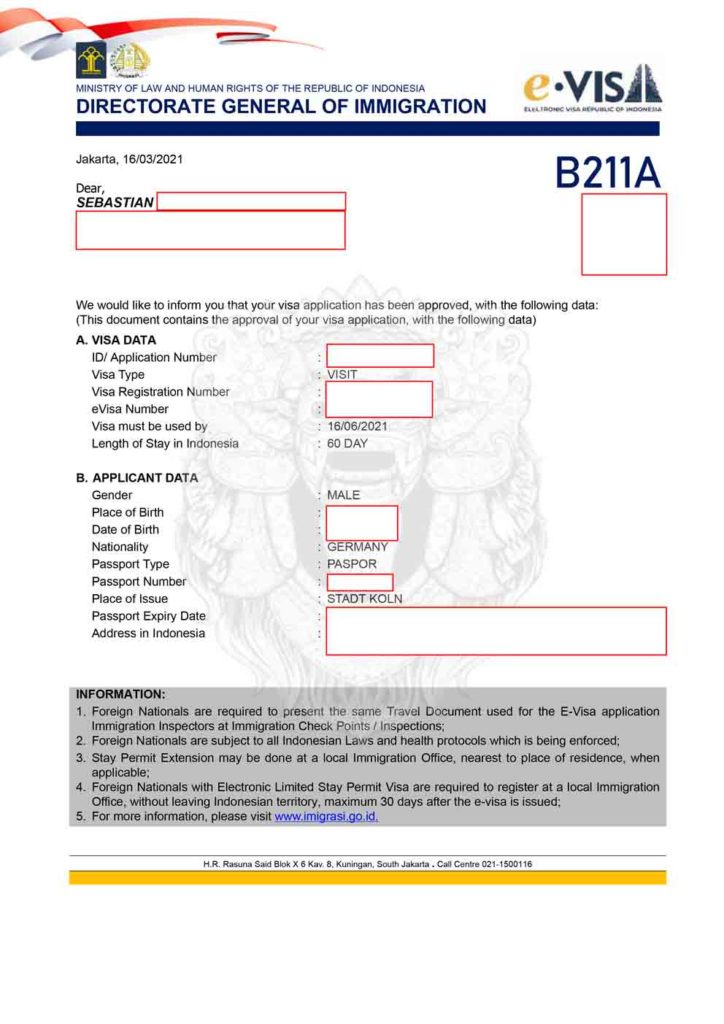
Indonesia offers two types of electronic visa (e-Visa) for foreign travellers. These are genuine visas issued online by the Indonesian authorities — not a simple authorisation of the ETA or ESTA type — which allow legal entry into the country.
The Visa on Arrival (formerly e-VOA, or Visitor Visa) is the most commonly issued document. Valid for 30 days with a single entry, it suits the majority of short tourist stays. The application is made entirely online, and the response is generally communicated within 2 to 3 business days.
The Tourist Visa (formerly B211A) offers a stay of 60 days. This option requires more supporting documents — in particular proof of sufficient financial means — but allows you to explore the archipelago at a more leisurely pace. It is advisable to apply at least 12 days before departure.
Both visa types are single-entry and may be presented in electronic form (smartphone, tablet) or printed, depending on the preference of immigration officers at the point of entry.
02 · Eligibility
The Indonesian e-Visa is accessible to nationals of more than 100 countries, including France, Belgium, Switzerland, Canada and many other French-speaking or European countries. Both options — the 30-day Visa and the 60-day Visa — are available to the same nationalities.
Accepted purposes of stay include tourism, visits to family or friends, participation in conferences, business meetings or events. The 60-day Tourist Visa is more specifically aimed at extended tourist stays.
Those wishing to work in Indonesia cannot use these e-Visas: a separate work visa, issued by the Indonesian embassy or consulate, is required. Similarly, stays of more than 60 days or long-term studies require a different type of document.
It is important to note that each traveller must hold their own personal e-Visa, linked to their passport. It is not possible to include a child or accompanying person in a joint application.
More than 100 nationalities are eligible for the Indonesian e-Visa, including French, Belgian, Swiss and Canadian nationals. The full list is available on the official Indonesian immigration website.
Tourism, visits to relatives, conferences, business meetings and events are the accepted purposes. Paid employment requires a separate visa.
Your passport must be valid for at least 6 months after your intended entry date into Indonesia. A blank page is required for the arrival stamp.
The Indonesian authorities require the presentation of a round-trip airline ticket or proof of departure from the country when submitting the e-Visa application. This is a non-negotiable condition.
03 · The procedure
The Indonesian e-Visa application is made entirely online. Depending on the type of visa chosen, the process may require creating an account on the official Indonesian immigration portal — which represents additional complexity compared to more straightforward e-Visas. Documents provided must strictly comply with the format required by the Indonesian authorities: any deviation in format, quality or file size may result in rejection of the application.
Prepare a colour copy of your passport (valid for at least 6 months), a recent identity photo meeting the required standards, and — if you are applying for the 60-day Visa — a copy of your round-trip ticket and a bank statement showing a minimum of 2,000 USD in available funds.
For certain options, in particular the 60-day Tourist Visa, creating an account on the official Indonesian immigration portal is necessary before submitting the form. Allow a few minutes for this step.
Enter your personal details (civil status, contact information, passport data), your travel details (planned dates, point of entry) and the purposes of your stay. Carefully check each piece of information before submitting.
Upload the scanned documents in the required format and quality. The Indonesian authorities are particularly strict about the technical specifications of files: follow the instructions carefully.
Payment of the consular fees (500,000 IDR €24.51 for the 30-day Visa, 1,500,000 IDR €73.53 for the 60-day Visa) takes place at this stage. The processing time begins from the confirmation of payment.
The processing time is generally 2 to 3 business days. To be safe, allow a full week before your departure. Once approved, the e-Visa is transmitted electronically.
Keep your e-Visa in electronic form (smartphone, tablet) and, as a precaution, print a paper copy. On arrival, immigration officers may check the document electronically or request the printed document.
04 · Documents & fees
05 · The arrival card
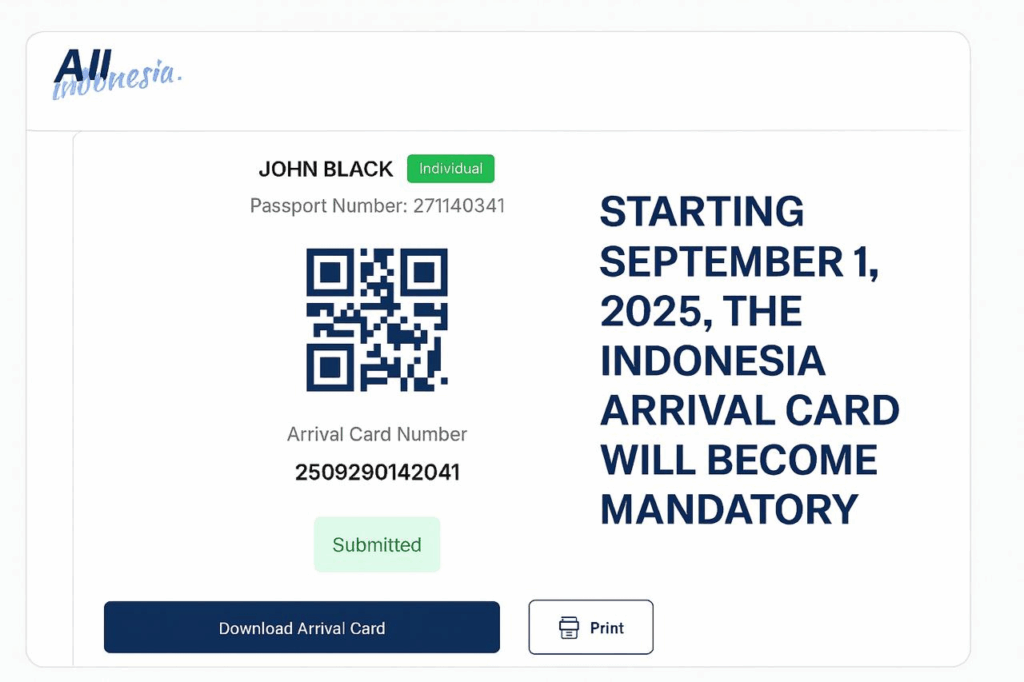
Since 1 October 2025, Indonesia has rolled out the All Indonesia digital portal across all its international airports. This system replaces the old paper forms (separate arrival card and customs declaration) with a single electronic document: the AIAC (All Indonesia Arrival Card).
The AIAC is a separate and complementary formality to the visa. Whether you travel with a 30-day Visa, a 60-day Visa or a visa on arrival, you will also need to complete this card. The two procedures are independent of each other: the AIAC does not replace the visa, and vice versa.
The arrival card now incorporates the customs declaration: you no longer need to fill in the blue paper form on the plane. Everything is consolidated in a single electronic form, completed before arrival.
All nationalities, including Indonesians. All modes of entry are covered: by air, sea and land. Each traveller — including children and infants — must have their own card (an adult may complete the card for minors).
Travellers in transit who do not pass through passport control and Indonesian residents entering by land are not required to complete the AIAC.
The All Indonesia Arrival Card (AIAC) is completely free of charge. No consular fee is associated with this formality.
The AIAC replaces both the arrival card and the customs declaration. There is no need to fill in the blue paper form on the plane: everything is consolidated in a single digital form.
After a first trial at Jakarta Soekarno-Hatta in July 2025, then a wider pilot phase on 1 September 2025, the All Indonesia portal became mandatory across all international airports on 1 October 2025. It has since been extended to every entry point in the country.
How it works: the declaration can be completed up to 72 hours (3 days) before arrival, at the official portal or through the official All Indonesia mobile app. Allow a few minutes. It generates a QR code to be shown at the checkpoint on arrival: keep it on your phone, and save a screenshot in case of poor connectivity.
What the declaration covers: four parts in a single form — personal details and travel dates, the health declaration (symptoms and 21-day travel history), the quarantine declaration (plants, fruit, seeds, animals and animal products) and the customs declaration (luggage, alcohol, tobacco, medicines, electronics subject to IMEI registration).
06 · Before you leave
Beyond the visa formalities and the arrival card, a few practical points are worth anticipating before travelling to Indonesia.
Visa extension: both options can be extended, but not to the same degree. The 30-day Visa on Arrival can be extended once by 30 days, giving 60 days at most, after which you must leave the country. The 60-day Tourist Visa can be extended up to twice, by 60 days each time, allowing a stay of up to 180 days.
Since 28 May 2025, biometrics are mandatory for every extension. The application is still filed online on the official immigration portal, but it then requires an in-person visit to the local immigration office: fingerprints, photograph, digital signature and a short verification interview. Plan to start the process 2 to 3 weeks before your visa expires, to allow time to secure an appointment.
Land entry: if you enter Indonesia by land — in particular from Malaysia via Borneo, or from Timor-Leste — you must use one of the 7 authorised border crossing points: Aruk Kalimantan Barat, Entikong Kalimantan Barat, Mota'ain Nusa Tenggara Timur, Motamasin Nusa Tenggara Timur, Sota Papua, Tunon Taka Kalimantan Utara and Wini Nusa Tenggara Timur. Any attempt to enter outside these points could result in being turned back.
Cruises: if you arrive in Indonesia by sea, an electronic visa is required. The application can be made in advance online or directly at one of the 91 Indonesian ports equipped with an immigration office.
A new Criminal Code entered into force in January 2026 in Indonesia. It introduces two offences that may concern foreign travellers:
These offences can only be prosecuted upon a complaint from a close family member (spouse, parents or children). They are not subject to systematic enforcement. Nevertheless, unmarried couples sharing a hotel room are theoretically exposed to these provisions. Check with the consular authorities of your country before departure.
Indonesian immigration enforces overstay rules strictly, and the fine is calculated per day.
An unpaid fine blocks departure. If something unforeseen stops you leaving on time — a cancelled flight, a hospital stay — go to an immigration office straight away: emergency stay permits exist, but they must be applied for before the visa expires.
Beyond the 6 months of validity and the blank page, a damaged passport — torn pages, detached cover, illegible data — can justify a refusal of entry. Renew it at the slightest doubt.
Your host — hotel, landlord or private individual — must report your presence to the local authorities within 24 hours, with a copy of your passport and visa. Informal accommodation risks heavy fines.
In force since 14 February 2024, the IDR 150,000 €7.35 levy is paid once per entry, online before departure or on arrival. Diplomatic passport holders, crew members and certain visa categories (family reunion, student) are exempt.
The provinces of Papua, Central Papua, Highland Papua and South Papua see recurrent armed tension and are advised against by several foreign ministries. Check current advice before planning a trip there.
Indonesia is accessible to the vast majority of travellers through two e-Visa options: the Visa on Arrival (30 days) and the Tourist Visa (60 days). Both are single-entry electronic visas, valid for 90 days from their date of issuance. The procedure is entirely online, with a processing time of 2 to 3 business days. Check your nationality first, though: nationals of ASEAN countries, Brazil, Türkiye, Peru, Kazakhstan, Macau and Belarus are visa-exempt for 30 days.
Since October 2025, the All Indonesia Arrival Card (AIAC) is mandatory for all travellers entering the country — in addition to the visa, not instead of it. This free digital formality replaces the old paper forms and includes the customs declaration.
For travellers visiting Bali, the "Love Tax" tourist levy of IDR 150,000 €7.35 should also be budgeted for. Finally, extension remains possible — once for 30 days with the Visa on Arrival, up to twice for 60 days with the Tourist Visa — but since 28 May 2025 it requires an in-person biometric appointment at the immigration office: start the process 2 to 3 weeks before your visa expires, and never leave it to the last day, as the overstay fine reaches IDR 1,000,000 per day.
Safety
The vigilance level recommended by five foreign ministries, on a shared scale.
Average level
Volcanic eruptions and other natural disasters, terrorism and local unrest; some provinces are subject to stricter restrictions.

US Department of StateAdvice dated July 7, 2026
Increased caution · Indonesia - Level 2: Exercise Increased Caution

Global Affairs CanadaAdvice dated September 10, 2026
Increased caution · Indonesia — Exercise a high degree of caution (with regional advisories)

German Federal Foreign OfficeAdvice dated September 8, 2026
Normal precautions · Indonesia: Travel and Security Warnings

UK Foreign Office (FCDO)Advice dated September 10, 2026
Reconsider travel · Indonesia travel advice

France DiplomatieAdvice dated September 4, 2026
Increased caution · Indonesia: Travel advice
Levels published by the ministries cited, reproduced unchanged. Visamundi is a private agency with no ties to these administrations.
FAQ