Available travel documents
Choose the visa that fits your trip. Fully online process, real-time tracking.
The Saudi Arabia e-Visa is a genuine electronic visa issued by the Saudi government, authorising stays of up to 90 days within a one-year validity period. Whether for tourism, a family visit, an event or the Umrah pilgrimage, this digital document considerably simplifies access to a country that was long closed to international travellers. Obtain it before booking your flight — a step that is strongly recommended.
01 · The essentials
The Saudi e-Visa: a real visa, entirely online
Your passport must be valid for at least 6 months after your arrival date in Saudi Arabia, regardless of the option chosen.
Medical insurance is mandatory for any stay — it is automatically selected by the Saudi government and its cost is included in the consular fees.
The entire process is carried out online: form, payment and receipt of the document by email, with no visit to an embassy.
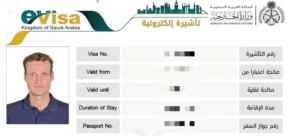
Unlike travel authorisations such as ETA or ESTA — reserved for nationals exempt from visa requirements — the Saudi e-Visa is a full visa, applied for online by foreigners wishing to stay in Saudi Arabia. It is linked to your passport number and is not stamped in its pages. Its validity runs for 365 days from the date of issue, or until the expiry of the associated passport if that date comes first.
During this one-year validity period, it authorises up to 90 days in the country, spread across as many trips as you wish: it is a multiple-entry visa, well suited if you are planning several visits to Saudi Arabia over the same period.
One point deserves your attention: the official portal states only "up to 90 days", without specifying whether that ceiling is counted per entry or cumulatively over the year. Several administrations, including the UK Foreign Office, read it as a total of 90 days across the 365 days of validity. Plan your stays on that basis — the more prudent reading — and have your case confirmed by the Saudi authorities if you expect to exceed that total.
- Nature
- Electronic visa (e-Visa) — a real visa, not a travel authorisation
- Length of stay
- Up to 90 days across the year of validity (multiple entries)
- e-Visa validity
- 1 year from the date of issue
- Entries
- Multiple, throughout the one-year validity period
- Passport
- Valid for at least 6 months after the arrival date in Saudi Arabia
- Medical insurance
- Mandatory — automatically included in the consular fees
- Consular fees
- 403 SAR €96.37
Visit Riyadh, AlUla, the Red Sea, the historic sites of the Hejaz and many other wonders.
Reunite with family or friends living in Saudi Arabia.
Attend cultural, sporting or professional events open to tourists.
Perform the minor pilgrimage — the Hajj requires a specific visa obtained through an embassy or accredited agency.
02 · Eligibility
Who can apply for the Saudi e-Visa?
The Saudi e-Visa is open to many nationalities, with the exception of nationals of Bahrain, the United Arab Emirates, Kuwait, Oman and Qatar, who enter Saudi Arabia without a visa. Other nationalities, however, must go through the Saudi embassy to obtain a standard visa.
For travellers of Moroccan or Algerian nationality, specific conditions apply: you must be under 60 years of age and hold a valid visa (at least one year, used at least once) for the Schengen area, the United States or the United Kingdom. Tunisian nationals are currently experiencing difficulties obtaining the e-Visa. In all cases, verify your eligibility at the time of your application.
Travellers eligible for the e-Visa may also, depending on their nationality, obtain their visa directly on arrival at a Saudi airport, via dedicated terminals (card payment only). This option is also available to holders of a permanent residence permit or a valid US, UK or Schengen visa. However, it is strongly advised to apply for the e-Visa in advance to avoid any complications on arrival.
British nationals: a separate route since 1 July 2026. The United Kingdom is the only country whose nationals come under the Saudi Electronic Travel Authorization (ETA) instead of the e-Visa. Open to all British passport holders, it is valid for 730 days from the date of issue and allows multiple entries, with stays of up to 180 days. It covers tourism, business travel, short-term study, medical treatment and Umrah outside the Hajj period. It covers neither Hajj, nor employment, nor residence. It costs USD 25, is processed in 1 to 3 working days, is not available on arrival and cannot be extended. Each traveller, including children, needs their own ETA; minors must apply together with a parent or legal guardian.
Each year, around the Hajj period — whose date moves about eleven days earlier each year in the Gregorian calendar, falling around mid-May in 2027 — e-Visa issuance is temporarily suspended and certain entry dates are blocked in the application form. The exact dates are set annually by the Saudi authorities — check them when you apply and plan your trip accordingly.
The Saudi e-Visa covers the Umrah pilgrimage, but not the Hajj. If you wish to perform the major pilgrimage (Hajj), you must contact a Saudi embassy or accredited agency to obtain a specific Hajj visa. If you select the "Umrah Pilgrimage" purpose on the e-Visa, the document will bear the mention "Tourism" — this is a normal situation recognised by the Saudi authorities.
Since 2025, to perform the Umrah — regardless of your visa type — you must obtain an Umrah permit via the Nusuk app and book your accommodation and transfers through the Nusuk platform before accessing the holy sites. The Umrah is not permitted during the Hajj period.
03 · The procedure
How to obtain your e-Visa step by step
- 1Choose your purpose of travel
Tourism, event, visit to relatives or Umrah pilgrimage — select the purpose that corresponds to your stay. The travel dates indicated can be modified afterwards: the e-Visa is valid for 1 year.
- 2Fill in the online form
Enter your surname and given names (as they appear on your passport), your passport number, your planned arrival and departure dates. For a family trip, each member — including minors — requires a separate application.
- 3Pay the consular fees
Payment is made online by bank card. The consular fees automatically include the mandatory Saudi medical insurance, selected by the Saudi government. You do not need to take out a separate policy.
- 4Submit a photocopy of your passport
After payment, send a photocopy of your passport (currently valid, valid for at least 6 months after your arrival) and a colour identity photo. These are the only two documents required.
- 5Receive your e-Visa
Processing time varies from a few minutes to several days. The e-Visa is sent to you by email. It does not need to be printed in most cases, but some travellers may be asked to present a paper copy on arrival.
- 6Travel with peace of mind
Present yourself at the airport with your passport and, if necessary, a copy of the e-Visa. The authorisation is linked to your passport number: any change of passport before the trip requires a new application.
If your e-Visa is lost or misplaced, you can request to have it resent by email. This service is entirely free of charge.
In the event of a refusal by the Saudi authorities, the alternative procedure is to submit an application directly on arrival at the airport, or to contact the competent Saudi embassy.
04 · Documents & conditions
What you need to prepare before you leave
The Saudi e-Visa application requires only two supporting documents: your passport (currently valid) and a recent colour identity photo. No hotel booking or return ticket needs to be provided — this is one of the major simplifications offered by this electronic system.
However, your passport must meet a strict requirement: it must be valid for at least 6 months after your arrival date in Saudi Arabia. If your passport expires before the end of this period, renew it before submitting your application. The e-Visa is linked to your passport number: a passport renewal requires a new application.
- Valid passportMinimum validity of 6 months after your arrival date in Saudi Arabia.
- Colour identity photoRecent, plain background, standard format.
- Bank card for paymentThe consular fees (403 SAR €96.37) include the mandatory medical insurance.
- For minorsThe e-Visa of a minor must be linked to that of the accompanying adult. Make sure to declare the responsible adult(s) in the application.
Saudi medical insurance is mandatory for any stay in Saudi Arabia. The good news: the Saudi government automatically selects one when issuing your e-Visa, and its cost is included in the consular fees. It covers medical expenses up to SAR 100,000 €23,914.31. You do not need to take out an additional policy on your own initiative, though separate travel insurance remains useful for repatriation and cancellation, which this policy does not cover.
For business travel, the e-Visa cannot be used. You will need to submit a standard visa application at the competent Saudi embassy or consulate, which involves a more comprehensive file and a longer processing time. One exception: since 1 July 2026 British nationals come under the Saudi ETA, which does cover business travel.
05 · Transits & special cases
Transit, cruise and special situations
If you have a stopover in Saudi Arabia, the rules vary depending on the duration and the airline:
| Transit situation | Visa required | Exit from transit zone possible |
|---|---|---|
| Stopover < 12 h, same airline | No | No |
| Stopover < 12 h, different airline | Transit visa (embassy) | No |
| Stopover between 12 h and 96 h | Transit visa or stopover visa | Possible depending on conditions |
| Stay > 96 h | Tourism e-Visa recommended | Yes |
Summary of transit rules in Saudi Arabia according to stopover duration.
Saudi airlines offer a 96 h transit visa at the time of booking a ticket. The process is entirely online and free — it is carried out directly on the airline's website. Beyond 96 hours, the stay is no longer considered a transit and the tourism e-Visa is the appropriate solution.
If you stop in Saudi Arabia as part of a cruise, the e-Visa is possible depending on your nationality. Check the rules when preparing your port of call.
If your e-Visa expires during your stay, you will need to go to the Saudi immigration office to apply for a new document. Plan ahead for the expiry date and, if possible, travel well before the deadline.
Saudi Arabia can be visited by people of all faiths. Mecca is the exception: the entire city is closed to non-Muslims, and road checkpoints filter access well before the city.
Medina, by contrast, is not closed to non-Muslims. Only the Haram area — the Prophet's Mosque and its immediate perimeter, including the Jannat al-Baqi cemetery — remains off limits; its boundaries are marked on the ground and monitored. The rest of the city, hotels and shops included, is accessible, provided you dress and behave in line with local customs. If you are planning a religious stay, check in advance which areas are accessible based on your situation.
Regarding Zamzam water: the tourist e-Visa allows you to perform the Umrah and access the holy sites, provided you obtain an Umrah permit via the Nusuk app (the Hajj, however, requires a specific visa through an embassy or accredited agency). The export of Zamzam water in bottles to your home country is prohibited for all travellers, regardless of the type of visa.
06 · Before you leave
Practical tips and trip preparation
Saudi Arabia can be complex when putting together an application for a family trip with minors: each child must have their own e-Visa, linked to that of an accompanying adult. In addition, the country places great importance on its cultural identity, and restrictions apply to immigration conditions — particularly during the Hajj period, during which e-Visa issuance is suspended.
The recommendation advising against travel to Saudi Arabia has been lifted following the memorandum of understanding signed between the United States and Iran on 17 June 2026. One exception remains, however: the border area with Yemen, shown in red on the map of the French Ministry for Europe and Foreign Affairs, is still formally advised against (terrorism risk and cross-border fire). Across the rest of the country, travellers are urged to exercise heightened vigilance, as the regional situation may change quickly — the United States, for its part, maintains a higher alert level. Always check the travel advisories published by your government before departure and register on a consular alert platform (the Ariane platform for French nationals).
- Check your passport validityAt least 6 months after your planned arrival date in Saudi Arabia.
- Apply for the e-Visa before booking your flightIt is preferable to have the e-Visa before finalising a flight booking.
- Prepare a recent colour identity photoPlain background, standard format, meeting the form requirements.
- For a family trip: one application per personEach minor must have their own e-Visa, linked to an accompanying adult's application.
- Check Hajj-related restrictionsThe Hajj follows the Hijri calendar and moves about eleven days earlier each year (around mid-May in 2027). Check the blocked dates in force when you apply.
- Consult travel adviceThe travel advice section of your country's foreign affairs ministry and registration platforms allow you to monitor the security situation and be contacted in the event of a crisis.
- Check local cultural rulesSaudi Arabia has its own dress codes, behavioural norms and religious customs. Researching these in advance helps avoid awkward situations.
- Note on Zamzam waterIts export in bottles is prohibited for all travellers, regardless of the type of visa.
The Saudi Arabia e-Visa is a multiple-entry electronic visa, valid for one year, covering up to 90 days in the country for tourism, family visits, events or the Umrah pilgrimage. It is straightforward and quick to obtain, with only two supporting documents required. The mandatory medical insurance is included in the consular fees. Be aware, however, of the blocked periods during the Hajj and the specific requirements for family applications with minors. The Hajj itself requires a separate standard visa, obtained exclusively through an embassy or an approved agency. British nationals, finally, no longer come under the e-Visa since 1 July 2026 but under the Saudi ETA, valid for 730 days with stays of up to 180 days.
Safety
Travel advisories for Saudi Arabia
The vigilance level recommended by five foreign ministries, on a shared scale.
Average level
Drone and missile targeting of US interests (Iran, Houthis), armed conflict, terrorism, exit bans; King Fahd International Airport to be avoided.
- Read the advice

US Department of StateAdvice dated October 23, 2026
Reconsider travel · Saudi Arabia - Level 3: Reconsider Travel
- Read the advice

Global Affairs CanadaAdvice dated October 22, 2026
Reconsider travel · Saudi Arabia — Avoid non-essential travel (with regional advisories)
- Read the advice

German Federal Foreign OfficeAdvice dated October 26, 2026
Do not travel · Saudi Arabia: Travel and Safety Information
- Read the advice

UK Foreign Office (FCDO)Advice dated October 27, 2026
Reconsider travel · Saudi Arabia travel advice
- Read the advice

France DiplomatieAdvice dated October 13, 2026
Reconsider travel · Saudi Arabia: Travel Advisory
A destination under advisory still issues its visas and authorisations. Before applying, check that your travel insurance covers it.
Levels published by the ministries cited, reproduced unchanged. Visamundi is a private agency with no ties to these administrations.
FAQ
Frequently asked questions
