

The US military operation that led to the capture and exfiltration of Venezuelan President Nicolás Maduro and his wife Cilia Flores has thrown travel formalities to and around Venezuela into turmoil.
Cancelled flights, closed airspace, suspended passports, and ghost consulates: this is the situation for anyone who had planned to travel to the region.
Venezuelan airspace: a de facto no-fly zone
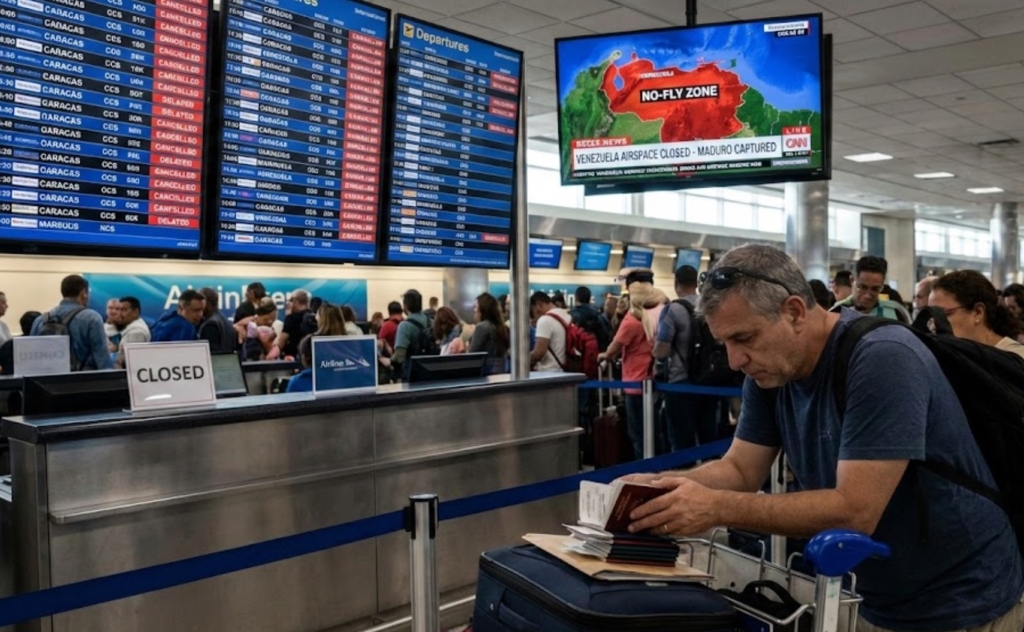
If you had a ticket to Caracas this week, you won't be going.. The reaction of global civil aviation authorities was immediate and radical, cutting Venezuela off from the rest of the world by air.
The air traffic blackout
In the first few hours after the operation, the FAA (Federal Aviation Administration) The US has issued a total ban on US carriers entering Venezuelan airspace (Maiquetía FIR), citing major security risks. Europe followed suit: the’EASA issued the alert bulletin CZIB 2026-01, recommending that European airlines avoid this area at all costs due to the risk of misidentification by anti-aircraft defenses.
The hemorrhage of commercial flights
The consequences are tangible for passengers:
- Air France canceled its flights to Caracas, which also had a knock-on effect on certain routes to the Caribbean (Fort-de-France, Pointe-à-Pitre), which had to be adjusted to avoid the area.
- Copa Airlines, a vital hub for connections via Panama, has suspended its flights, leaving many passengers without an alternative.
- Iberia Other Spanish carriers have also grounded their aircraft on this route.
The domino effect in the Caribbean: This goes beyond Venezuela. With contiguous airspace, major tourist destinations such as Aruba, Puerto Rico Or Curacao hundreds of flights were canceled this weekend because planes were unable to fly through the usual secure air corridors.
Land borders: the trap is closing
If the sky is closed, the earth is hardly more welcoming. Land borders, historically porous but conflictual, have been transformed into militarized zones.
- Colombian side: The Simón Bolívar International Bridge, a barometer of relations between the two countries, is experiencing unusually low traffic. While the border is not officially “closed,” the massive presence of Colombian troops deployed by President Gustavo Petro and uncertainty on the Venezuelan side are discouraging any crossings.
- Brazilian side: Brazil has activated emergency plans at its northern border, anticipating migration flows or security breaches.
Our advice: Under no circumstances should you attempt to cross land borders at this time. The “trochas” (illegal paths) have become life-threatening areas given the state of alert of the remaining armed forces.
Are Venezuelan documents still valid?
The fall of a head of state often leads to a legal vacuum regarding the recognition of official documents issued by his or her administration.
The Venezuelan passport: a document with variable geometry
For dual nationals or Venezuelan citizens residing in Europe, passport validity is a maze:
- In the United States: Venezuelan passports are considered valid for 10 years after their printed expiration date, according to a decree recognized by Washington..
- In Panama: A recent decree (No. 20) extends the validity of expired passports until February 2026.
- Elsewhere (Europe/France): Exercise extreme caution. In the absence of clear guidelines after January 3, an airline may refuse to allow you to board with an expired passport, even if the destination country has been tolerant in the past.
U.S. visas: total suspension
The Trump administration, as soon as the operation was over, took a tougher stance. There Proclamation 10998 effective January 1, 2026 suspends the issuance of many types of visas (B1/B2, F, J) for Venezuelans. With embassies closed or inoperative, obtaining a visa for the US is currently impossible.
Consulates: “Absent subscribers”
The French Embassy in Caracas has issued a clear message: stay at home. Regular consular services have been suspended. Similarly, do not rely on Venezuelan consulates abroad (such as the one on Rue Copernic in Paris) for urgent matters: as the loyalty of their staff to the new (or former) government is uncertain, any document issued today could be worthless tomorrow.7–
| Insurance: the “act of war” clause” This is the financial sticking point for stranded travelers. Most travel insurance policies contain an exclusion for “acts of war” or “hostilities,” whether declared or not. In practical terms, if your flight is canceled or your trip is interrupted due to this military intervention, it is very likely that your insurance company will refuse to compensate you, classifying the event as a case of force majeure or an act of war. Only insurance policies with the “Cancellation for any reason” (CFAR) could offer a way out. |

 English
  Français
  Deutsch
  Italiano
  Español