

With a government not recognized by almost the entire international community, obtaining a visa for Afghanistan meant juggling with often inaccessible consulates.
The situation has just changed. Following a number of announcements and in response to growing tourist demand (almost 9,000 visitors in 2024 and more than 7,000 in the first half of 2025) Kabul has deployed the portal E-Afghans : https://visaportal.eafghans.com/
This digitalization comes at just the right time: since July 2024, the Afghan authorities no longer recognize visas issued by former embassies in Europe (France, Germany, the UK...), Canada or Australia. Travelers had to fall back on Dubai, an option made more complex by regional tensions between Iran, Israel and the United States.
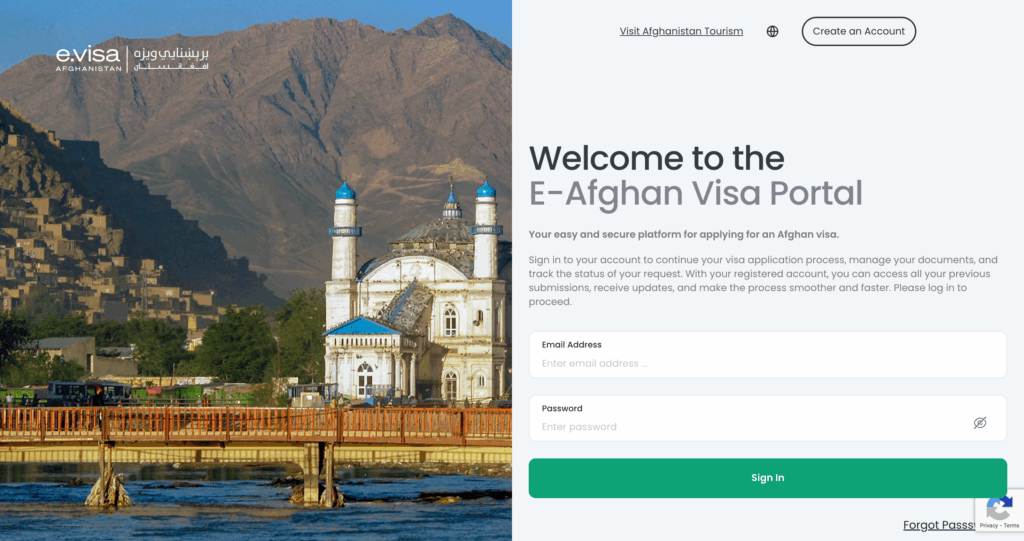
Features of the Afghan e-Visa
The online system delivers a very strict visa format, calibrated for tourism and short stays.
- Input type : Single admission.
- Mandatory finish point : The electronic visa is only valid for arrival at Kabul International Airport. You cannot use it to cross a land border.
- Length of stay : 30 days maximum on site.
- Validity : You have 90 days to enter the country from the date of issue of the document.
A two-step payment system
Forget the single tariff. The government has introduced a two-stage payment structure that is unforgiving of delays.
Initial costs (8.25 $) : Upon submission of your application, you must pay this non-refundable fee. Please note: you only have 48 hours to make this payment, failing which your request is automatically cancelled.
Issuing costs (from 123.71 $ to 257.73 $) : Once your file has been approved by the authorities, you will receive notification to pay the balance. The exact amount varies according to your nationality and the processing option (standard or express). You have 7 days to pay this final amount.
Expert's note: None of these amounts are refundable once the visa has been approved and issued.
The eligibility filter: blacklisted nationalities
The portal E-Afghans incorporates a highly specific filtering algorithm. To be eligible, your nationality must be AND your current country of residence fall outside the list of restrictions. If either of these two criteria is blocked, the platform will refuse you access.
Passports banned from e-Visa : Citizens of Afghanistan, Pakistan, Iran, Tajikistan, Uzbekistan, Turkmenistan and Israel cannot use the online portal.
Restricted countries of residence : Even with a French or Canadian passport, you will be blocked if you currently reside in one of these countries: India, China, Russia, Turkey, United Arab Emirates, Saudi Arabia, Qatar, Oman, Malaysia, Indonesia, Kyrgyzstan, Kazakhstan or Azerbaijan.
Documents to prepare before logging on
The process is entirely paperless. Before starting the application timer, please gather the following information:
- Passport : Valid for at least 6 months after your planned arrival date.
- Passport photo : Strict 45 mm x 35 mm format, in color, on a perfectly white background.
- Proof of residence : A copy of your national identity card or residence permit if required
- Facial verification : This is the technological innovation of the device. When creating your account, you'll need to use the camera on your smartphone or computer for a live biometric scan, to prove that your face matches the passport.
- Optional documents : Although classified as “optional” by the system, we strongly recommend that you enclose your full itinerary (often supplied by specialized agencies) and accommodation confirmation to speed up validation.
Processing times: Standard or Express?
If you plan your trip in advance, the Standard will do the trick, with a turnaround time of between one and four weeks.
For last-minute departures or unforeseen logistical problems, the portal offers an option Express capable of issuing the visa in a single working day, subject to an unspecified surcharge on final payment.
If you are not eligible for the digital format (because of your place of residence, for example), the classic solution applies: you will need to compile a physical file and make an appointment at one of the few Afghan consulates still able to operate. A guide has even been published by the authorities!

 English
  Français
  Deutsch
  Italiano
  Español