

South Korea, which continues to assert its status as a major global destination, is simplifying access to its territory in order to attract more visitors. In a strong move to promote post-crisis tourism recovery, the country has not only extended the exemption from its electronic travel authorization, the K-ETA, but has also accelerated the full digitization of its entry formalities, particularly to facilitate immigration controls.
Following the 10th meeting on the national tourism strategy, chaired by Prime Minister Kim Min-seok, it was confirmed that the K-ETA exemption would be temporarily extended until December 2026.
“We will extend the temporary exemption from the electronic travel authorization (K-ETA), which was due to expire this year, by one year (until December 2026).”
Press release – September 25, 2025, in Seoul
Exemption from the K-ETA electronic travel authorization
L'K-ETA exemption (Korea Electronic Travel Authorization), introduced in 2021, allows many nationals, including Europeans, to travel to South Korea without having to obtain the mandatory K-ETA electronic travel authorization, provided that their stay is less than 90 days. Initially granted until December 31, 2025, it will be extended until December 31, 2026.
As part of the «Visit Korea Year 2023-2024» program to support growth in the tourism sector, this strategy has proven effective: Korea welcomed 16.37 million visitors in 2024, a spectacular increase of 48.4% compared to the previous year. France stands out in particular, now ranking as the leading European market for South Korea, with 137,000 French citizens visiting the country last year.
Even if the K-ETA exemption is extended, travelers from 67 countries will still be required to obtain a visa. option to submit an optional K-ETA application. The advantage of this approach is that it avoids waiting time at the arrival airport. This online formality still allows you to simplify your procedures when immigrating.
E-Arrival Card form mandatory in 2026
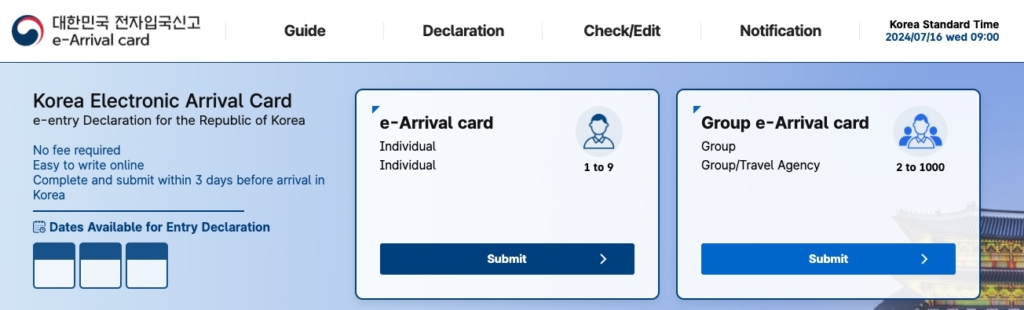
Alongside K-ETA, South Korea has undertaken a major transformation of its arrival process. Introduced in 2025, the e-Arrival Card is a fully digital arrival card which permanently replaces the paper document that travelers previously had to fill out at the airport.
This new system allows visitors to complete this process. fully online, from the official platform of the authorities: e-arrivalcard.go.kr. Travelers can complete it up to three days before their arrival. The advantage of completing this formality in advance is that you can pass through immigration controls more quickly.
It is important to note that this digital card will become mandatory starting in 2026. This transition ensures an «even more relaxed» vacation by eliminating paperwork upon arrival.
Improvements to biometric controls
The innovations don't stop there. South Korea plans to to expand its digital control system in order to make entry into the country «even faster and smoother.».
The country plans to roll out self-check-in kiosks at airports. These kiosks will allow travelers to scan their documents and pass through immigration in just a few seconds. In addition, the biometric checks, using facial recognition or fingerprints, already in use at some airports, will see their use expand.
Thanks to the extension of K-ETA until 2026 and the gradual adoption of the mandatory e-Arrival Card, entering South Korea has never been easier, allowing travelers to focus on planning their trip.
Fill in a file from K-ETA South Korea
 English
  Français
  Deutsch
  Italiano
  Español