
The days when a consular officer simply stamped your passport by looking at your pay slips are officially over. In the United States, the border is no longer just physical: it's digital.
At Visamundi, we receive dozens of emails from travelers and expatriates who are completely taken aback. Their mistake? Underestimating the weight of their digital history. The U.S. government has turned the simple routine check into a full-blown audit of your online life, and what was once reserved for a handful of “at-risk” profiles now applies to almost everyone.
The snowball effect: the massive expansion of targeted visas
If you thought that only complex immigration applications were scrutinized, think again. The administration has aggressively and methodically expanded social network verification in 3 distinct phases.
Students in the crosshairs (June 2025) It all started last summer with students and exchange program participants (F, M, J visas). Faced with political unrest on American campuses, the State Department required consular officers to track down the slightest attitude deemed “hostile” towards American culture or government.
The professional world under the grill (December 2025) The second wave hit highly-skilled workers. Since mid-December 2025, it has been mandatory for H-1B visa holders and their spouses (H-4) to submit their presence online to the consular officer. Gone is the simple administrative form: the officer will literally compare what you declared on your DS-160 form with your LinkedIn profile. An inconsistency in your job title or date of hire? Your file goes straight to administrative processing (the dreaded 221g refusal).
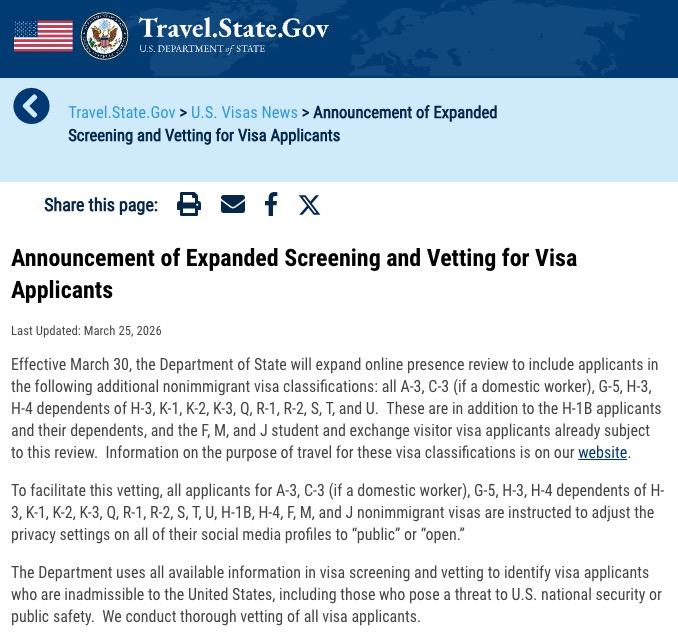
Total expansion (Mars 2026) It's the crushing blow of this spring. From March 30, 2026, the search of social networks extends to a dizzying list of new categories. The following are now covered :
- Fiancés of American citizens (K-1, K-2, K-3 visas).
- Religious workers (R-1, R-2).
- Diplomats' household staff (A-3, C-3, G-5).
- Cultural trainees and visitors (H-3, Q).
- And even, significantly, victims of human trafficking or crime seeking protection (T and U visas).
Even travellers from the 42 visa-exempt countries (such as France and Switzerland) are affected: the ESTA form, which used to ask for your social networks on an optional basis, now requires a complete and compulsory history of your identifiers over the last five years.
Mandatory “Public” mode: the privacy trap
One of the most unsettling changes in this new policy concerns the confidentiality of your accounts.
THE State Department gave a very clear directive All applicants for the visa categories listed above are advised to set their social network privacy settings to “public” or “open”.
What happens if you leave your accounts private? Consular officers are trained to interpret this as a lack of credibility. A locked profile can be perceived as a desire to conceal, triggering further questions or outright refusal.
Worse still: the total absence of social networks. If you're thinking you can just delete everything, you've got the wrong idea. A directive from the administration pointed out that a lack of online presence, or a massive deletion just before the interview, is seen as a sign of evasion. You'll need to be able to justify in a credible and natural way why you have no digital footprint, or risk having your file blocked.
In concrete terms, what are consular officers looking for?
They don't just look for links to terrorism. With the help of algorithmic analysis tools, they track :
Professional consistency : On work visas, a skill touted on the networks but missing from your official CV can scupper a job offer.
Authentic relationships: For K visas (engaged couples), your photos, interactions and online chronology are scanned for marriage fraud.
Migration offences : A simple photo or “check-in” suggesting that you have worked illegally on a previous tourist trip.
Ideology: The government actively tracks down “hostile attitudes” towards the United States or speech deemed discriminatory/anti-Semitic, very broad criteria that leave a huge margin of discretion to the agent.
How to secure your application (Visamundi tips)
Faced with this digital inquisition, improvisation is not an option. Here's our plan of action before applying for a visa:
Do a cross-audit: Take your DS-160 form in one hand and your LinkedIn profile in the other. Dates, employers and job descriptions should match to the decimal point.
Don't panic at the “Delete” button: Frantically cleaning up your Instagram or Twitter account the day before your embassy appointment is an immediate red flag. Clean up your accounts logically and well in advance.
Think of your loved ones: For H-1B visas, for example, be aware that your spouse's publications (H-4) may have an impact on the main application. Screening is family-based.
Plan elastic deadlines: With this massive volume of data to process, consulates are reducing their daily appointment quotas. Processing times are getting longer, and the number of administrative holds is exploding. Don't buy your plane tickets before you've got your visa.
Your digital footprint is now an integral part of your passport. If you are applying for a complex work visa, a family reunion or if your online history is atypical, let us analyze your file. At Visamundi, we anticipate questions from consular officials to make your interview a simple formality.
Fill in a file from ESTA USA
 English
  Français
  Deutsch
  Italiano
  Español