

If you're used to crossing the Atlantic for business or pleasure, you know the procedure by heart: an online application, about forty dollars, and 72 hours later (often less), the famous ESTA lands in your mailbox. But did you know that this comfort, which we've taken for granted for nearly 15 years, is now on the chopping block?
Washington has issued a clear ultimatum to European capitals: by 2027, access to European citizens' biometric data must be opened up to US authorities. Otherwise, the Visa Waiver Program (VWP) could be suspended. Here's what this means for your future travels.
The new price of admission: your biometric data
Until now, trust has reigned supreme. The U.S. relied on our biometric passports and declarations of good faith (“Have you ever been arrested?“, “Are you a terrorist? ?”). But the Department of Homeland Security (DHS) now feels that this is no longer enough.
As part of a new protocol called “Enhanced Border Security Partnership (EBSP), The United States is demanding that European police forces allow them to directly query their national databases (fingerprints and facial recognition). The aim is to check the identity of any traveler applying for a ESTA or crossing the border, and to ensure that he or she is not known unfavorably to local police services, even for offenses that have not been traced back to Interpol.
The deadline has been set: the United States expects these systems to be operational by the end of 2026, for full application in 2027.
Worst-case scenario: back to B1/B2 Visa
For travelers accustomed to ESTA, the stakes are colossal. If the European Union refuses to give in to these demands, deemed highly intrusive by the guardians of our privacy, the United States threatens to withdraw recalcitrant countries from the exemption program.
In concrete terms, this would mean the end of ESTA to 40 $ and a return to the ’back to square one“.“B1/B2 Visa“. For those who have never experienced it, it's an obstacle course. It costs around 185 USD (158 €), fill out an interminable DS-160 form, go to the American embassy or consulate for an interview and fingerprinting, and sometimes wait several weeks or even months for an appointment.
The Israeli example: a glimpse of the future?
To understand what lies ahead, we need look no further than Israel, which joined the visa waiver program at the end of 2023. To obtain this privilege, the Israeli government had to amend its national law to allow the United States access to its fingerprint files.
Israeli travelers must have a biometric passport to apply for a ESTA. Those with older or temporary passports are excluded and must go through the visa process. What's more, the ESTA is no longer an automatic formality: ’screening“ is more intense.
What's likely to change for you
Even if Europe and the U.S. reach an agreement (which is likely, as the economic stakes are so high), the ESTA user experience will get tougher, with facial recognition access for example, or the obligation to present the mobile app on your phone.
The battle for privacy
Why hasn't this already been done? Because Europe has the RGPD, the strictest data protection regulation in the world. The European Data Protection Supervisor (EDPS) has already sounded the alarm, calling this project a “serious” interference in our fundamental rights.
The EU is trying to negotiate a system where the U.S. would not be able to “vacuum” the data, but only receive a “Yes/No” response (Hit/No-Hit) in the event of an alert. Washington, for its part, is pushing for direct, systematic access for “routine control”.
| Our expert advice: If you have a trip planned to the USA in the next few years, all is well. But keep a close eye on 2026 and 2027. The “world before”, when you could decide on a weekend in New York on a whim, will soon depend on Brussels and Washington's ability to plug their police servers into each other. |
And meanwhile: ETIAS, quiet reciprocity
Faced with these growing American demands, is Europe preparing a response? The answer is ETIAS (European Travel Information and Authorisation System). Often referred to as “Europe's ESTA”, by 2026-2027 this system will require American citizens to register online and pay a €7 fee before setting foot on European soil.
The U.S. State Department has already updated its travel advisories, implicitly accepting that the European Union is finally applying the administrative reciprocity that the U.S. has been imposing on the rest of the world since 2008. Do the latest US announcements confront this ETIAS? In 2023, the American president made it clear that he would refuse ETIAS for his compatriots.…
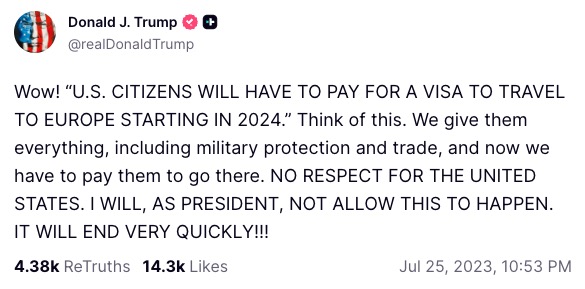
Where Europe will politely ask American tourists to fill in a declaratory form (similar to the current ESTA), the USA, via the EBSP, will in return demand in-depth, automated access to Europeans’ biometric and police data. The exchange is unequal: an administrative entry ticket in exchange for biological surveillance.
Fill in a file from ESTA USA
 English
  Français
  Deutsch
  Italiano
  Español