

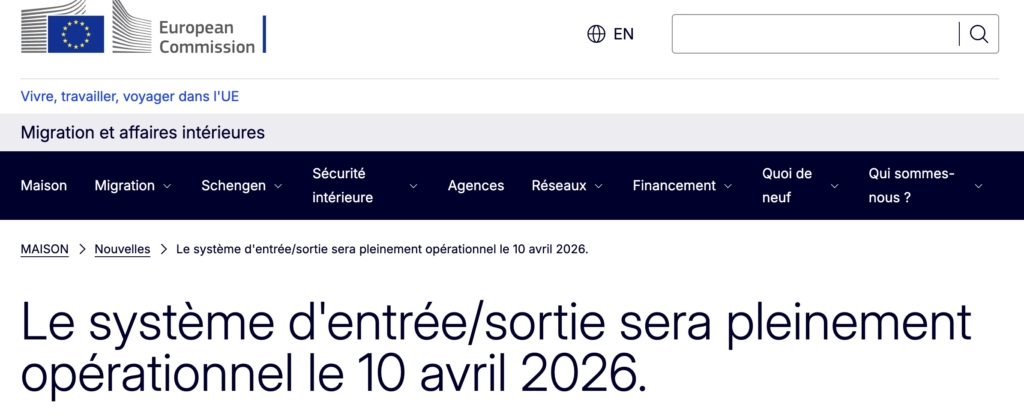
As of this Friday, April 10, 2026, the European Union has definitively updated its migration policy: the input/output systemor EES is now fully operational in the 29 participating European countries. Major airports were the first to install self-service check-in kiosks as early as gradual launch end 2025. If you're flying internationally, chances are you'll land at Paris-Charles de Gaulle (CDG) and Paris-Orly (ORY), Amsterdam-Schiphol (AMS), Frankfurt (FRA) and Munich (MUC) or Geneva (GVA).
What is EES and what's changing today?
Launched progressively on October 12, 2025, the EES system has reached its final stage. It marks the end of manual stamping of passports for third-country nationals on short-stay visits (up to 90 days within a 180-day period). In concrete terms, the customs officer will no longer stamp your date of entry or exit on a blank page of your passport.
Recording is 100% digital. The system captures your facial imageyour fingerprints, and instantly cross-references your personal data with your travel document.
Your biometric data is captured and secured from the very first passage. This process, designed to reinforce homeland security, will eventually considerably smooth traffic flow through the automated airlocks of major international hubs.
What every traveller needs to know before setting off
The EES system does not apply to everyone. You can escape these new gantries if :
- You are a citizen of a the European Union or the Schengen Area.
- You have a long-stay visa or a valid residence permit in a European country (e.g. student visa, talent passport, family reunion).
For international travelers arriving from the Americas, Asia, the Middle East or Africa, the preparation of travel documents is of paramount importance. Digital intelligence leaves no room for documentary doubt.
Check the consistency of your supporting documents: The EES keeps track of your entire Europe-wide refusal history. Make sure you have your hotel reservations, return tickets and travel insurance to hand (or on your smartphone).
Plan wider connections: Initial enrolment (photo and fingerprinting) on your very first visit with the EES system takes approximately one to two minutes longer per passenger. Plan ahead if you have a connecting flight in one of the European countries.
Strictly observe the 90/180 day rule: The system now calculates the length of your stay. Visit overstays (visa overstays) are automatically flagged, seriously jeopardizing your future travels to Europe. Gone are the days of illegible stamps!
Next step: Don't confuse EES with ETIAS!
Our customers often ask us: “Do I have to pay for EES?’. The answer is NO. The EES is a completely free border control technology.
However, it paves the way for the ETIAS (the equivalent of the American ESTA). Scheduled for a second phase, the ETIAS will be a travel authorization fee (€7) and mandatory Before board the plane for travelers from countries currently exempt from Schengen visas (Americans, Canadians, British, Brazilians, etc.).

 English
  Français
  Deutsch
  Italiano
  Español